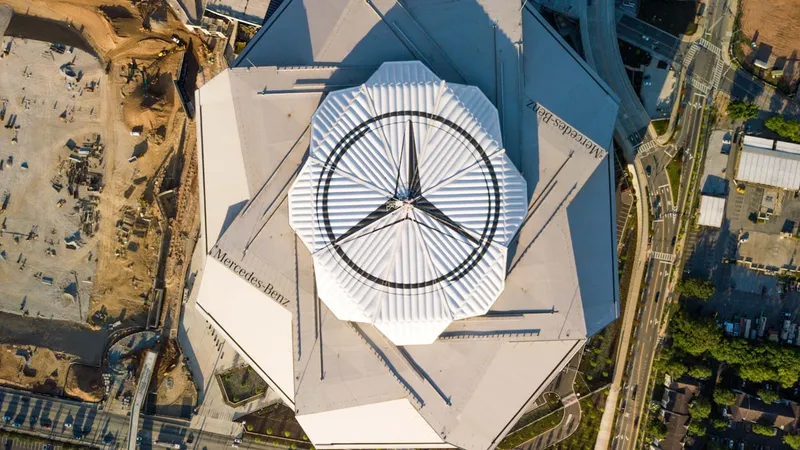
Mercedes-Benz Stadium will be one of the most important American venues at the FIFA World Cup 2026, hosting eight matches in Atlanta, Georgia, including a semi-final.
During the tournament, the venue will be called Atlanta Stadium because FIFA uses neutral venue names for World Cup matches. But for most sports fans, this is Mercedes-Benz Stadium: the home of the Atlanta Falcons, Atlanta United FC and some of the loudest football crowds in North America.
Opened in 2017, the stadium is one of the most modern venues in the United States. It is known for its retractable roof, huge circular halo video board, downtown location, strong public transport access and major-event experience.
For World Cup 2026, the stadium’s FieldTurf surface will be replaced with natural grass to meet FIFA requirements. That change will make the venue suitable for elite international football while keeping the stadium’s famous climate-controlled environment.
Atlanta’s assignment is a major statement. Only two U.S. venues were trusted with a World Cup 2026 semi-final: AT&T Stadium in Arlington and Mercedes-Benz Stadium in Atlanta. That puts Atlanta among the tournament’s decisive host cities.
Quick Facts About Mercedes-Benz Stadium
| Fact | Detail |
|---|---|
| Stadium name | Mercedes-Benz Stadium |
| FIFA World Cup name | Atlanta Stadium |
| Location | Atlanta, Georgia, USA |
| Address | 1 AMB Drive NW, Atlanta, GA 30313 |
| Capacity | 71,000 |
| Opened | 2017 |
| Roof | Retractable |
| Surface | FieldTurf normally; natural grass for FIFA events |
| Main tenants | Atlanta Falcons and Atlanta United FC |
| Competition focus | FIFA World Cup 2026 |
| World Cup matches | 8 matches |
| Biggest match | Semi-final |
| First World Cup match | June 15, 2026 |
| Semi-final date | July 15, 2026 |
| Known for | Retractable roof, halo video board, Atlanta United atmosphere and LEED Platinum design |
Where Is Mercedes-Benz Stadium?
Mercedes-Benz Stadium is located at 1 AMB Drive NW in Atlanta, Georgia. It sits in the Vine City area, west of downtown Atlanta, close to Centennial Olympic Park, the Georgia World Congress Center and several major tourist attractions.
This central location gives the stadium one of the better transport profiles among the U.S. World Cup venues. Fans can reach it by MARTA rail, rideshare, car or on foot from nearby downtown hotels.
The venue is also about 10 miles north of Hartsfield-Jackson Atlanta International Airport. That airport connection matters because Atlanta will welcome fans from across the United States, Africa, Europe, Latin America and beyond during the World Cup.
For visitors, the stadium’s location is one of its biggest strengths. It is not hidden far outside the city. It sits near hotels, restaurants, fan zones, attractions and public transport.
History of Mercedes-Benz Stadium
Mercedes-Benz Stadium replaced the Georgia Dome, which had been the home of the Atlanta Falcons for 25 years. The Georgia Dome hosted major events, including Super Bowls, college football games and events during the 1996 Atlanta Olympics.
By the early 2010s, Falcons owner Arthur Blank wanted a new venue that could serve more than one team and more than one sport. The plan grew into one of the most ambitious stadium projects in the United States.
Construction began in 2014, and the stadium opened in 2017. For a short time, the Georgia Dome and the new stadium stood near each other before the older building was demolished.
Mercedes-Benz Stadium quickly became more than an NFL venue. Atlanta United, the city’s Major League Soccer club, also began playing there in 2017. The club’s huge crowds helped prove that Atlanta was a serious football city, not only an American football market.
That soccer culture strengthened Atlanta’s case for World Cup 2026.
Construction and Design
Mercedes-Benz Stadium was designed by 360 Architecture, a subsidiary of HOK, with tvsdesign, Goode Van Slyke and Stanley Beaman & Sears also involved. BuroHappold Engineering worked on the structural side, while Hoberman Associates contributed to the kinetic roof system.
The stadium’s most famous feature is its retractable roof. Eight triangular ETFE panels move in a pinwheel pattern around a central opening, creating a design inspired by the Roman Pantheon. The roof can open or close in roughly 8 to 12 minutes.
Inside the bowl, the halo video board gives the stadium one of the most recognisable interiors in world sport. The 360-degree LED display wraps around the stadium and is visible from every seat.
Outside the main entrance, a large bronze falcon sculpture gives the stadium a strong Atlanta Falcons identity. But inside, the venue can transform for NFL, MLS, college football, concerts and global football events.
The final cost reached about $1.6 billion, making it one of the most expensive stadiums in the United States at the time.
Mercedes-Benz Stadium and World Cup 2026
Mercedes-Benz Stadium will host eight FIFA World Cup 2026 matches. That includes five group-stage matches, one Round of 32 match, one Round of 16 match and one semi-final.
The first match at the venue is scheduled for June 15, 2026. The final Atlanta match will be the semi-final on July 15, 2026.
That schedule makes Mercedes-Benz Stadium one of the tournament’s most important venues. It will host early group-stage drama, knockout football and one of the matches that decides who reaches the World Cup final.
For global viewers, Atlanta Stadium will offer a modern and climate-controlled football setting. For local fans, it will be a chance to show the world how strong Atlanta’s football culture has become.
World Cup 2026 Matches at Mercedes-Benz Stadium
| Date | Match |
| June 15, 2026 | Spain vs Cabo Verde |
| June 18, 2026 | Czechia vs South Africa |
| June 21, 2026 | Spain vs Saudi Arabia |
| June 24, 2026 | Morocco vs Haiti |
| June 27, 2026 | Group-stage match |
| July 1, 2026 | Round of 32 |
| July 7, 2026 | Round of 16 |
| July 15, 2026 | Semi-final |
The early match list gives African fans several strong storylines. Cabo Verde will play Spain in Atlanta, South Africa will face Czechia, and Morocco will meet Haiti. That makes Mercedes-Benz Stadium especially relevant for African readers following the World Cup.
For Kenyan fans, these matches offer a direct connection to African football’s tournament journey before Atlanta hosts one of the biggest games of the competition.
Why Mercedes-Benz Stadium Was Chosen for a Semi-Final
Mercedes-Benz Stadium was chosen for a World Cup semi-final because it offers a strong mix of football atmosphere, modern infrastructure and operational reliability.
The stadium has hosted major events, including Super Bowl LIII, the College Football Playoff National Championship, MLS Cup and high-attendance Atlanta United matches. That experience matters because a World Cup semi-final is not just a football match. It is a major global broadcast, security operation, hospitality event and transport challenge.
The stadium’s retractable roof also gives FIFA more control over playing conditions. Atlanta summers are hot and humid. With the roof closed and the cooling systems active, organisers can protect players and fans from extreme conditions.
Atlanta United’s history at the venue also helped. The club has shown that Mercedes-Benz Stadium can deliver a loud, passionate football environment with crowds of more than 70,000 for major matches.
Natural Grass for FIFA Events
Mercedes-Benz Stadium normally uses FieldTurf. For FIFA World Cup 2026, that surface will be replaced with natural grass.
This matters because World Cup football is played under strict pitch requirements. Natural grass gives players a surface closer to what they use at top international level. It affects passing speed, ball control, player movement and injury prevention.
The conversion will likely use a modular grass system. That approach allows the stadium to install and maintain a temporary natural-grass pitch while still returning to its usual multi-sport schedule after the tournament.
The venue has already handled soccer configurations before, including major international fixtures and Atlanta United matches. That experience should help with sight lines, field dimensions and football operations.
The Retractable Roof Advantage
The retractable roof gives Mercedes-Benz Stadium one of the clearest advantages of any World Cup 2026 venue.
Atlanta in June and July can be hot and humid. Open-air venues in similar climates can create difficult conditions for players, fans and officials. Mercedes-Benz Stadium can manage that risk by closing the roof and cooling the stadium bowl.
That could improve the quality of matches. Players may be able to press harder, recover better and maintain tempo for longer. Fans will also enjoy a more comfortable experience, especially during afternoon games.
The roof also gives the venue a dramatic visual identity. When open, it creates a striking architectural image. When closed, it turns the venue into a controlled, modern football arena.
The Halo Board
The halo board is one of the stadium’s signature features.
It is a 360-degree LED video ring that wraps around the interior of the bowl. Instead of one large screen at one end, the stadium gives fans a continuous display above the seating area.
For World Cup matches, that board can support replays, team graphics, match timing, crowd prompts and tournament branding. It also helps the venue feel modern and immersive.
On television, the halo board gives Mercedes-Benz Stadium a unique look. Viewers will immediately know when a match is being played in Atlanta.
Major Events Hosted at Mercedes-Benz Stadium
Mercedes-Benz Stadium has already hosted several major events since opening in 2017.
Super Bowl LIII was played there in 2019, with the New England Patriots beating the Los Angeles Rams. The stadium also hosted the College Football Playoff National Championship in 2018 and again in 2025.
In soccer, its most famous moment came during MLS Cup 2018, when Atlanta United defeated the Portland Timbers in front of more than 73,000 fans. That match remains one of the strongest examples of Atlanta’s football culture.
The stadium has also hosted major concerts and annual college football events, including the Peach Bowl and SEC Championship Game.
This track record explains why FIFA trusted Atlanta with a semi-final.
Transport and Fan Access
Mercedes-Benz Stadium has strong public transport access compared with many U.S. World Cup venues.
MARTA is the main rail system in Atlanta. Two stations serve the stadium area: Vine City and GWCC/CNN Center. Vine City is usually the closest option, while GWCC/CNN Center is convenient for fans coming from the downtown convention and hotel district.
From downtown Atlanta, fans can reach the stadium quickly by rail or on foot from some hotels. From the airport, MARTA connects to the city centre, making it one of the better airport-to-stadium routes in the tournament.
For World Cup 2026, fans should still allow extra time. Security checks, crowd movement and FIFA event operations will make match-day travel busier than normal.
Driving and Parking
Fans who drive to Mercedes-Benz Stadium will find several official and private parking options around the venue.
Stadium-managed lots are close to the gates, but they can be more expensive. Private lots further from the stadium may cost less, although the walk can be longer. During World Cup matches, parking should be booked in advance where possible.
Atlanta traffic can be heavy, especially around downtown and on major event days. Fans should not rely on normal travel times. Arriving early will reduce stress and make it easier to pass through security.
For visitors staying downtown, MARTA or walking may be easier than driving.
Rideshare and Airport Access
Uber and Lyft will be popular for fans travelling to the stadium, especially visitors staying in hotels outside walking distance.
Before matches, rideshare drop-offs can be manageable. After matches, wait times and prices may rise sharply because thousands of fans request rides at once. A useful approach is to walk several blocks away from the stadium before requesting a ride, where pickup may be easier.
Hartsfield-Jackson Atlanta International Airport is about 10 miles from the stadium. By rail, fans can take MARTA from the airport toward downtown and transfer to reach Vine City. By car, travel time depends heavily on traffic.
For international supporters, the airport connection is a major advantage. Atlanta is one of the easiest U.S. host cities for air access.
Nearby Attractions
Mercedes-Benz Stadium sits close to several major Atlanta attractions.
Centennial Olympic Park is nearby and will likely be one of the city’s most active gathering areas during the World Cup. The Georgia Aquarium and World of Coca-Cola are also within walking distance or a short ride.
The Georgia World Congress Center is next to the stadium district, making the area familiar with large conventions and international visitors.
For fans interested in culture and history, Atlanta also offers the Martin Luther King Jr. National Historical Park, Sweet Auburn, museums, restaurants and music venues.
That mix gives travelling fans plenty to do before and after matches.
What Fans Should Know Before Visiting
Fans attending World Cup matches at Mercedes-Benz Stadium should prepare for a major-event environment.
Tickets, bag policies, entry gates and security rules will be controlled by FIFA and local organisers. Fans should check official instructions before match day.
The stadium is climate-controlled, but fans will still spend time outside before and after matches. Atlanta summer weather can be hot and humid, so comfortable clothing, hydration and early arrival will matter.
The easiest route for many fans will be MARTA. Those driving should pre-book parking and expect delays. Those using rideshare should plan for waiting time after matches.
Why Mercedes-Benz Stadium Matters to African Fans
Mercedes-Benz Stadium will be highly relevant to African fans at World Cup 2026.
Cabo Verde, South Africa and Morocco all have matches scheduled in Atlanta. That gives the venue direct importance for African football storylines during the group stage.
South Africa’s match against Czechia will attract attention across the continent, while Morocco’s meeting with Haiti will be watched closely after Morocco’s historic 2022 World Cup run. Cabo Verde’s game against Spain also gives the island nation a massive global platform.
For Kenyan readers, Atlanta Stadium will be one of the venues to follow because it links African teams, major group-stage tests and a semi-final in one city.
Why Mercedes-Benz Stadium Is Important
Mercedes-Benz Stadium is important because it represents the modern direction of World Cup hosting in the United States.
It is not an old football ground. It is a multi-purpose, climate-controlled, technology-heavy venue built for huge crowds and global broadcasting. That fits the scale of the expanded 48-team World Cup.
It also shows how football has grown in Atlanta. Atlanta United’s crowds proved that the city can deliver a serious soccer atmosphere. That reputation gives the 2026 matches extra meaning.
By hosting a semi-final, Mercedes-Benz Stadium will be part of the final chapter of the tournament. One team will leave Atlanta with a place in the World Cup final.
Key Takeaways
- Mercedes-Benz Stadium is located in Atlanta, Georgia.
- It will be called Atlanta Stadium during FIFA World Cup 2026.
- The stadium opened in 2017.
- It has a listed capacity of 71,000.
- It is home to the Atlanta Falcons and Atlanta United FC.
- The venue has a retractable roof.
- It normally uses FieldTurf but will use natural grass for FIFA events.
- Mercedes-Benz Stadium will host eight World Cup 2026 matches.
- The venue will host a semi-final on July 15, 2026.
- MARTA gives the stadium strong public transport access.
- The halo video board is one of its most famous features.
- African teams including Cabo Verde, South Africa and Morocco are scheduled to play in Atlanta.
Frequently Asked Questions
Where is Mercedes-Benz Stadium located?
Mercedes-Benz Stadium is located at 1 AMB Drive NW in Atlanta, Georgia, near downtown Atlanta and Centennial Olympic Park.
What will Mercedes-Benz Stadium be called during World Cup 2026?
During the tournament, Mercedes-Benz Stadium will be called Atlanta Stadium because FIFA uses neutral venue names.
What is Mercedes-Benz Stadium’s capacity?
Mercedes-Benz Stadium has a listed capacity of 71,000, with expanded configurations possible for major events.
When did Mercedes-Benz Stadium open?
Mercedes-Benz Stadium opened in 2017.
Which teams play at Mercedes-Benz Stadium?
The stadium is home to the Atlanta Falcons of the NFL and Atlanta United FC of Major League Soccer.
Does Mercedes-Benz Stadium have a retractable roof?
Yes. The stadium has a retractable roof made of eight triangular panels that open and close in a pinwheel pattern.
Will Mercedes-Benz Stadium use natural grass for World Cup 2026?
Yes. The stadium will use natural grass for FIFA World Cup 2026 matches.
How many World Cup 2026 matches will Mercedes-Benz Stadium host?
Mercedes-Benz Stadium will host eight matches at the FIFA World Cup 2026.
Will Mercedes-Benz Stadium host a World Cup semi-final?
Yes. Mercedes-Benz Stadium will host a FIFA World Cup 2026 semi-final on July 15, 2026.
Is Mercedes-Benz Stadium easy to reach by public transport?
Yes. The stadium is served by MARTA rail, with Vine City and GWCC/CNN Center stations close to the venue.
Conclusion
Mercedes-Benz Stadium will be one of the defining venues of the FIFA World Cup 2026. Its retractable roof, central Atlanta location, strong transport links and proven event record make it a natural host for major tournament matches.
The stadium will host eight matches, including a semi-final, and will carry major importance for African fans because Cabo Verde, South Africa and Morocco are scheduled to play there.
For Atlanta, the tournament is a chance to show the world its football culture. For global fans, it is a chance to watch elite World Cup matches inside one of the most advanced stadiums in the United States.
On July 15, 2026, Atlanta Stadium will become one of the biggest stages in world football. Mercedes-Benz Stadium was built for that kind of moment.
Read Also: AT&T Stadium World Cup 2026 Guide: Capacity, Location, Matches and Semi-Final Venue