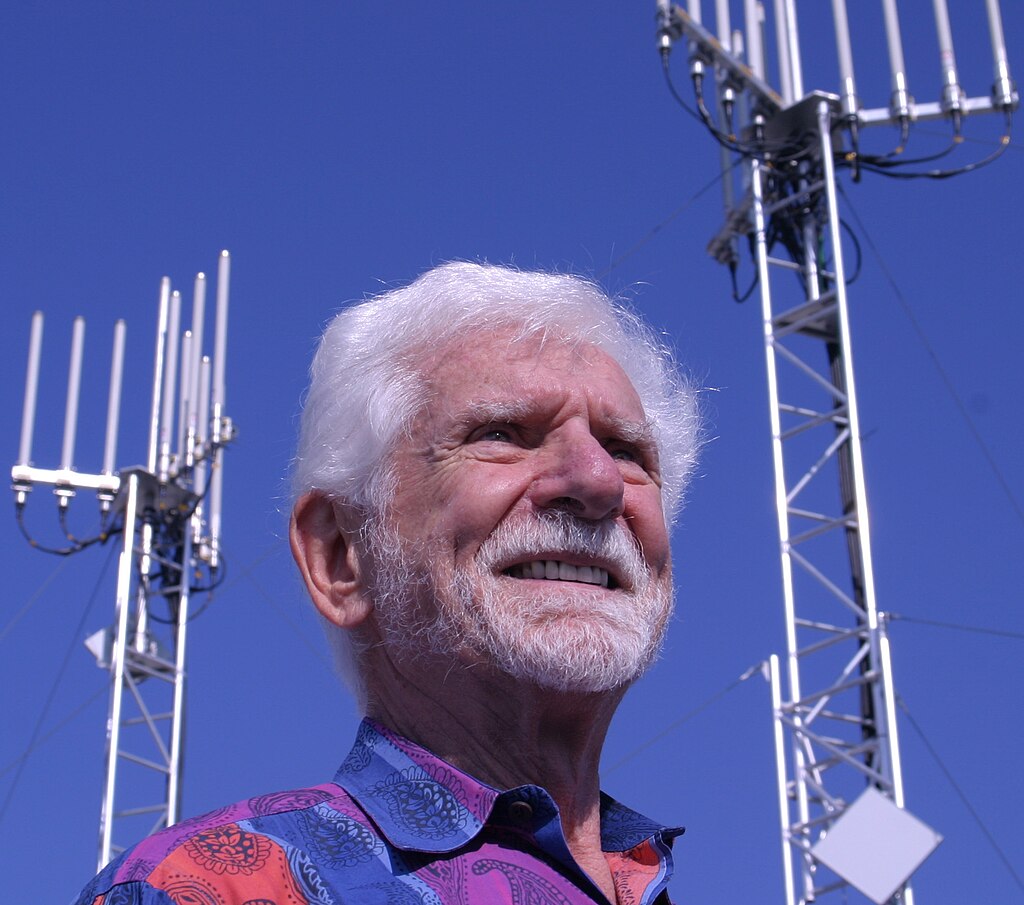
Martin Cooper, often hailed as the “Father of the Cell Phone,” is an American engineer whose work revolutionized wireless communication and mobile technology. Born on December 26, 1928, in Chicago, Illinois, Cooper’s journey from humble beginnings to becoming a pioneer in the wireless industry is a testament to his vision, innovation, and perseverance.
Early Life and Education
Cooper was born to Ukrainian Jewish immigrants in Chicago, where he grew up in a modest environment. He attended Illinois Institute of Technology (IIT), earning a Bachelor’s and Master’s degree in Electrical Engineering. His educational foundation laid the groundwork for his future contributions to the telecommunications industry. Cooper also served as a submarine officer during the Korean War, gaining leadership skills that would serve him well in his career.
Motorola and the Birth of the Cell Phone
In 1954, Cooper began his career at Motorola, a company where he would spend nearly three decades. His work there would eventually lead to groundbreaking innovations in the telecommunications sector.
In the early 1970s, Cooper became the head of Motorola’s communications systems division. His vision for mobile communication led him to conceive of the first portable cellular phone, setting him apart from his contemporaries in the field. At the time, the concept of portable, personal communication seemed far-fetched, but Cooper was determined to make it a reality.
On April 3, 1973, Cooper made history by placing the first-ever public call from a handheld mobile phone on a Manhattan sidewalk. The call, made from a Motorola DynaTAC prototype, was directed to his competitor, Dr. Joel S. Engel at Bell Labs. The moment was monumental, marking the first step toward the ubiquitous mobile phones we use today.
The DynaTAC 8000X: A Groundbreaking Device
After the success of the initial call, Cooper and his team went on to develop the DynaTAC 8000X, which would become the first commercially available handheld mobile phone. Released in 1983, the DynaTAC was a revolutionary device, but its size and weight made it far from practical by today’s standards. It weighed 2.5 pounds and stood at 10 inches long, earning it the nickname “the brick” phone.
Despite its bulk, the DynaTAC was a symbol of innovation and determination. With only 30 minutes of talk time and a 10-hour recharge time, the phone’s limitations didn’t deter Cooper. The vision was clear: a mobile phone should be about the person, not the location, and Cooper believed that the future of telecommunications would revolve around this idea.
Cooper’s Law: A Fundamental Principle in Wireless Communication
In addition to his work on the first handheld phone, Martin Cooper is credited with formulating Cooper’s Law, which is foundational in the field of spectral efficiency. The law states that the maximum number of voice conversations or data transactions that can be conducted within a given area doubles approximately every 30 months. This principle has had far-reaching implications for radio spectrum management and wireless communication development.
Co-Founder of Dyna LLC and GreatCall
After his time at Motorola, Cooper and his wife, Arlene Harris, co-founded Dyna LLC in 1986. This company became a launchpad for several ventures, including Subscriber Computing Inc. and Cellular Pay Phone, Inc. (CPPI), which later became GreatCall, Inc..
GreatCall, best known for the Jitterbug cell phone targeted at seniors, focused on simplicity and ease of use, making mobile technology more accessible to older adults. The company became a pioneer in senior mobile services before its acquisition by Best Buy in 2006.
Awards and Recognition
Martin Cooper’s contributions to technology have not gone unnoticed. His extensive work in telecommunications earned him numerous awards and accolades, including:
- 2013 Marconi Prize
- 2015 IEEE Masaru Ibuka Consumer Electronics Award
- 2007 Wireless World Research Forum Fellow
- 2009 Prince of Asturias Award for Scientific and Technical Research
He was also inducted into the National Academy of Engineering in 2010, recognizing his leadership in the creation and deployment of cellular mobile phones.
Cooper’s Impact on the Industry
Cooper’s vision and leadership have fundamentally shaped the wireless communications industry. From the first mobile phone call to the massive global adoption of smartphones, his work laid the foundation for the connected world we live in today.
His advocacy for smart antenna technologies and mobile communications standards continues to influence the development of modern wireless technologies. Cooper’s legacy is not just about the DynaTAC phone but the entire field of mobile communications.
Personal Life and Philanthropy
Beyond his professional achievements, Cooper has maintained a passion for mentoring, innovation, and giving back to society. He actively lectures about technological innovation, wireless communications, and R&D management. His company, Dyna LLC, remains at the forefront of developing new wireless technologies.
Together with his wife, Arlene Harris, Cooper has been deeply involved in philanthropic activities, particularly in supporting education and entrepreneurship.
Conclusion
Martin Cooper’s contributions to the wireless communication industry are immeasurable. From his pioneering work at Motorola to his post-Motorola ventures with Dyna LLC, Cooper has remained a driving force in mobile communications. His legacy is not just marked by the invention of the cell phone but by his vision, leadership, and impact on the modern telecommunications landscape.
As the wireless communication industry continues to evolve with technologies like 5G and beyond, Cooper’s work remains a cornerstone, a reminder of how innovation can transform the way we connect and communicate globally.