Wireless network technologies have evolved dramatically over the last seven decades, shaping the way we communicate, access information, and connect devices globally. From the earliest analog systems to the anticipated 6G networks, each generation has brought faster speeds, lower latency, and innovative applications. This article provides a comprehensive guide to the evolution of wireless network technologies.
0G: The Pre-Cellular Era
The 0G networks, also called pre-cellular systems, were introduced in the late 1940s. These were primarily mobile radio telephones that operated on 50-150 MHz frequencies. Unlike modern cellular systems, 0G networks were analog and non-cellular, offering basic mobile communication with extremely limited coverage.
1G and 1.5G: The Birth of Cellular
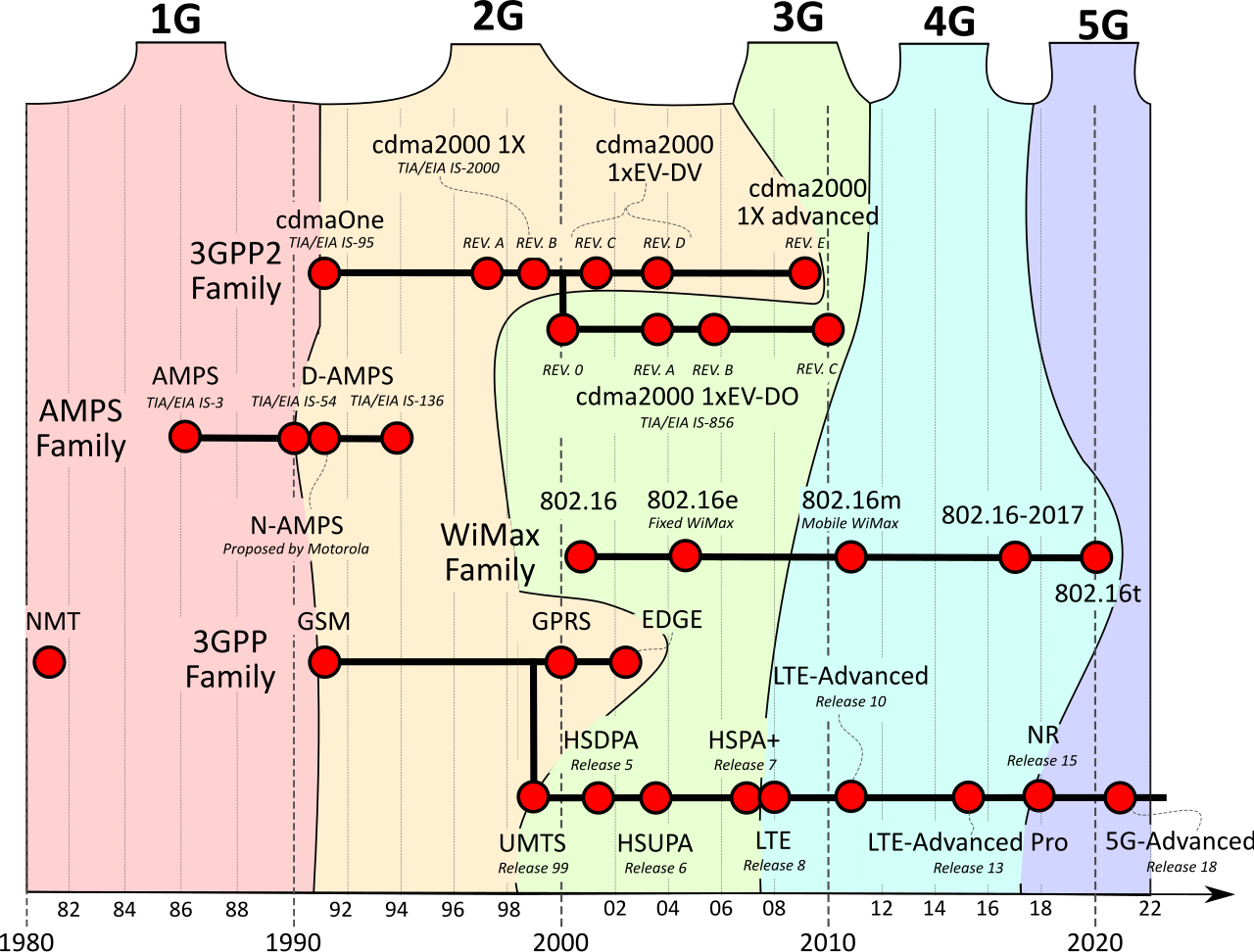
- 1G: Introduced in 1979, 1G marked the first generation of cellular networks, relying on analog signals. Systems like NMT, AMPS, and TACS provided voice-only services with coverage spanning urban areas.
- 1.5G (Digital AMPS): This transitional generation introduced some digital elements to 1G networks, enhancing call setup and reliability.
2G and 2.5G: Digital Communication and SMS
The second generation (2G) networks, deployed in the early 1990s, switched entirely to digital signals. Key innovations included:
- Encrypted voice calls
- SMS (Short Message Service) and MMS (Multimedia Messaging Service)
- Improved spectrum efficiency, allowing more users per channel
Popular 2G standards included GSM, CDMAone, and PDC.
2.5G (GPRS) introduced packet-switched data, enabling mobile internet access at speeds up to 48 kB/s, while 2.75G (EDGE/EGPRS) enhanced data throughput further.
3G to 3.95G: The Mobile Internet Era
- 3G: Introduced in 2001, 3G networks enabled mobile internet access with speeds up to 7.2 Mbps. Technologies included UMTS and CDMA2000, supporting video calls and multimedia.
- 3.5G and 3.75G (HSPA/HSPA+): Offered faster mobile broadband, with HSPA+ reaching 42 Mbps download speeds.
- 3.95G (LTE): LTE marked the beginning of 4G-like speeds, laying the groundwork for high-speed mobile data with low latency.
4G and 4.5G: High-Speed Mobile Broadband
4G networks delivered high-speed mobile internet for smartphones, tablets, and laptops. Key technologies:
- LTE (Long Term Evolution) and LTE Advanced
- WiMAX for mobile broadband
- Speeds: Theoretical downloads up to 150 Mbps, with improved upload speeds
4.5G (LTE Advanced Pro and MIMO) provided incremental improvements in speed, capacity, and reliability, often marketed as “5GE” by telecom operators like AT&T.
5G: The Era of Ultra-Fast Connectivity
5G, using the New Radio (NR) standard, introduced revolutionary capabilities:
- Data rates: Up to 10 Gbps
- Latency: Significantly reduced for real-time applications
- Massive connectivity: Supports hundreds of thousands of devices per square kilometer
- Frequency bands: FR1 (<6 GHz) and FR2 (mmWave)
- Applications: Internet of Things (IoT), autonomous vehicles, augmented reality, and lifeline communications in emergencies
Deployment began in 2018, with commercial rollouts from 2021 onwards in multiple countries.
6G: The Future of Wireless Networks
6G networks, currently in development, are expected to launch around 2028–2030. Anticipated features include:
- Speeds exceeding 1 Tbps, far faster than 5G
- Ultra-low latency, near-instantaneous communication
- Frequency spectrum: 100 GHz to 3 THz, enabling new applications in AI, holographic communications, and high-precision sensing
- Deployment options: Integration into devices themselves or dedicated 6G towers
Companies like Xiaomi and Nokia are actively involved in 6G research, with standards still under discussion.
Summary Table of Wireless Generations
| Generation | Key Standards | Max Download | Max Upload | Key Features |
|---|---|---|---|---|
| 0G | SN, SN+ | 2 B/s | – | Analog, pre-cellular |
| 1G | NMT, AMPS | – | – | Analog voice |
| 1.5G | D-AMPS | – | – | Hybrid analog/digital |
| 2G | GSM, CDMAone | – | – | Digital voice, SMS |
| 2.5G | GPRS | 48 kB/s | – | Packet data |
| 2.75G | EDGE | 236 kB/s | – | Enhanced data |
| 3G | UMTS, CDMA2000 | 7.2 Mbps | 2 Mbps | Mobile internet, video calls |
| 3.5G | HSPA | 14 Mbps | 5.76 Mbps | Faster mobile broadband |
| 3.95G | LTE | 100 Mbps | 50 Mbps | High-speed mobile internet |
| 4G | LTE Advanced, WiMAX | 150 Mbps | 50 Mbps | HD streaming, gaming |
| 4.5G | LTE Advanced Pro | 1 Gbps | 100 Mbps | Improved latency & capacity |
| 5G | NR | 10 Gbps | 1 Gbps | IoT, AR/VR, autonomous tech |
| 6G | TBD | >1 Tbps | Ultra-low latency | AI, holography, ultra-sensing |
Conclusion
Wireless network technology has transformed communication and connectivity across the globe. From the pre-cellular 0G systems to the forthcoming 6G era, each generation has expanded what is possible in mobile communication, from basic voice calls to ultra-fast internet and IoT ecosystems. For Africa, keeping pace with these advancements will be crucial for digital inclusion, economic growth, and technological innovation.