Ethnic Kazakhs derive from a mix of Turkic nomadic tribes that migrated to the region in the 15th century. The Russian Empire conquered the Kazakh steppe in the 18th and 19th centuries, and Kazakhstan became a Soviet Republic in 1925. Forced agricultural collectivization led to repression and starvation, resulting in more than a million deaths in the early 1930s. During the 1950s and 1960s, the agricultural “Virgin Lands” program generated an influx of settlers — mostly ethnic Russians, but also other nationalities — and by the time of Kazakhstan’s independence in 1991, ethnic Kazakhs were a minority. However, non-Muslim ethnic minorities departed Kazakhstan in large numbers from the mid-1990s through the mid-2000s, and a national program has repatriated about a million ethnic Kazakhs (from Uzbekistan, Tajikistan, Mongolia, and the Xinjiang region of China) to Kazakhstan. As a result of this shift, the ethnic Kazakh share of the population now exceeds two-thirds.
Kazakhstan’s economy is the largest in Central Asia, mainly due to the country’s vast natural resources. Current issues include diversifying the economy, attracting foreign direct investment, enhancing Kazakhstan’s economic competitiveness, and strengthening economic relations with neighboring states and foreign powers.
Geography
Location
Central Asia, northwest of China; a small portion west of the Ural (Oral) River in easternmost Europe

Geographic coordinates
48 00 N, 68 00 E
Map references
Asia
Area
total : 2,724,900 sq km
land: 2,699,700 sq km
water: 25,200 sq km
comparison ranking: total 10
Area – comparative
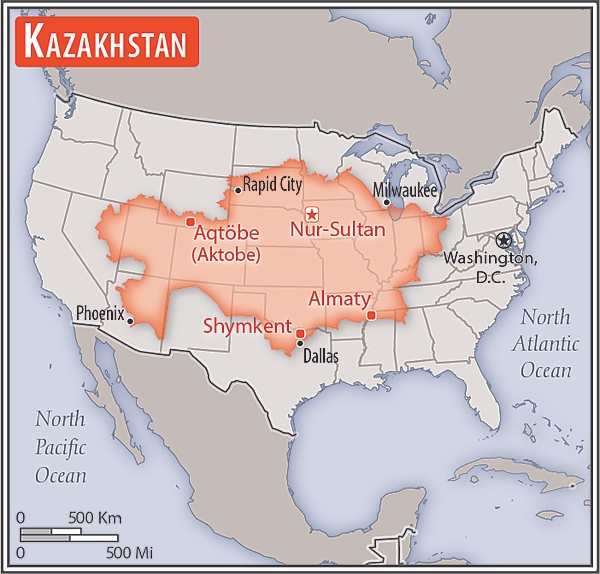
slightly less than four times the size of Texas
Area comparison map:
Land boundaries
total: 13,364 km
border countries (5): China 1,765 km; Kyrgyzstan 1,212 km; Russia 7,644 km; Turkmenistan 413 km; Uzbekistan 2,330 km
Coastline
0 km (landlocked); note – Kazakhstan borders the Aral Sea, now split into two bodies of water (1,070 km), and the Caspian Sea (1,894 km)
Maritime claims
none (landlocked)
Climate
continental, cold winters and hot summers, arid and semiarid
Terrain
vast flat steppe extending from the Volga in the west to the Altai Mountains in the east and from the plains of western Siberia in the north to oases and deserts of Central Asia in the south
Elevation
highest point: Pik Khan-Tengri 7,010 m
note – the northern most 7,000 meter peak in the World
lowest point: Qauyndy Oyysy -132 m
mean elevation: 387 m
Natural resources
major deposits of petroleum, natural gas, coal, iron ore, manganese, chrome ore, nickel, cobalt, copper, molybdenum, lead, zinc, bauxite, gold, uranium
Land use
agricultural land: 79.4% (2022 est.)
arable land: 11% (2022 est.)
permanent crops: 0% (2022 est.)
permanent pasture: 68.3% (2022 est.)
forest: 1.3% (2022 est.)
other: 19.3% (2022 est.)
Irrigated land
17,794 sq km (2022)
Major lakes (area sq km)
fresh water lake(s): Ozero Balkhash – 22,000 sq km; Ozero Zaysan – 1,800 sq km
salt water lake(s): Caspian Sea (shared with Iran, Azerbaijan, Turkmenistan, and Russia) – 374,000 sq km; Aral Sea (north) – 3,300 sq km; Ozero Alakol – 2,650 sq km; Ozero Teniz 1,590 sq km; Ozero Seletytenzi – 780 sq km; Ozero Sasykkol – 740 sq km
Major rivers (by length in km)
Syr Darya river mouth (shared with Kyrgyzstan [s], Uzbekistan, and Tajikistan) – 3,078 km
note: [s] after country name indicates river source; [m] after country name indicates river mouth
Major watersheds (area sq km)
Internal (endorheic basin) drainage: Tarim Basin (1,152,448 sq km), Amu Darya (534,739 sq km), Syr Darya (782,617 sq km), Lake Balkash (510,015 sq km)
Population distribution
most of the country displays a low population density, particularly the interior; population clusters appear in urban agglomerations in the far northern and southern portions of the country
Natural hazards
earthquakes in the south; mudslides around Almaty
Geography – note
world’s largest landlocked country and one of only two landlocked countries in the world that extends into two continents (the other is Azerbaijan); Russia leases approximately 6,000 sq km (2,317 sq mi) of territory enclosing the Baikonur Cosmodrome
People and Society
Population
total: 20,260,006 (2024 est.)
male: 9,817,172
female: 10,442,834
comparison rankings: total 64; female 63; male 64
Nationality
noun: Kazakhstani(s)
adjective: Kazakhstani
Ethnic groups
Kazakh 71%, Russian 14.9%, Uzbek 3.3%, Ukrainian 1.9%, Uyghurs 1.5%, German 1.1%, Tatar 1.1%, other 4.9%, unspecified 0.3% (2023 est.)
Languages
Kazakh (official, Qazaq) 80.1%, Russian 83.7%, English 35.1% (2021 est.)
major-language sample(s):
Әлемдік деректер кітабы, негізгі ақпараттың таптырмайтын көзі. (Kazakh)
Книга фактов о мире – незаменимый источник базовой информации. (Russian)
The World Factbook, the indispensable source for basic information.
note: percentages are based on population that understands the spoken language
Kazakh audio sample:
Russian audio sample:
Religions
Muslim 69.3%, Christian 17.2% (Orthodox 17%, other 0.2%), Buddhism 0.1%, other 0.1%, non-believers 2.3%, unspecified 11% (2021 est.)
Age structure
0-14 years: 27.6% (male 2,883,200/female 2,712,772)
15-64 years: 62.8% (male 6,233,881/female 6,486,019)
65 years and over: 9.6% (2024 est.) (male 700,091/female 1,244,043)
2024 population pyramid:

Dependency ratios
total dependency ratio: 59.3 (2024 est.)
youth dependency ratio: 44 (2024 est.)
elderly dependency ratio: 15.3 (2024 est.)
potential support ratio: 6.5 (2024 est.)
Median age
total: 31.9 years (2024 est.)
male: 30 years
female: 33.8 years
comparison ranking: total 121
Population growth rate
0.86% (2024 est.)
comparison ranking: 106
Birth rate
17.2 births/1,000 population (2024 est.)
comparison ranking: 89
Death rate
8.1 deaths/1,000 population (2024 est.)
comparison ranking: 84
Net migration rate
-0.4 migrant(s)/1,000 population (2024 est.)
comparison ranking: 117
Population distribution
most of the country displays a low population density, particularly the interior; population clusters appear in urban agglomerations in the far northern and southern portions of the country
Urbanization
urban population: 58.2% of total population (2023)
rate of urbanization: 1.19% annual rate of change (2020-25 est.)
Major urban areas – population
1.987 million Almaty, 1.291 million NUR-SULTAN (capital), 1.155 million Shimkent (2023)
Sex ratio
at birth: 1.07 male(s)/female
0-14 years: 1.06 male(s)/female
15-64 years: 0.96 male(s)/female
65 years and over: 0.56 male(s)/female
total population: 0.94 male(s)/female (2024 est.)
Mother’s mean age at first birth
28.9 years (2019 est.)
Maternal mortality ratio
13 deaths/100,000 live births (2020 est.)
comparison ranking: 139
Infant mortality rate
total: 8 deaths/1,000 live births (2024 est.)
male: 8.9 deaths/1,000 live births
female: 7 deaths/1,000 live births
comparison ranking: total 146
Life expectancy at birth
total population: 73.3 years (2024 est.)
male: 69 years
female: 77.9 years
comparison ranking: total population 151
Total fertility rate
2.58 children born/woman (2024 est.)
comparison ranking: 66
Gross reproduction rate
1.25 (2024 est.)
Contraceptive prevalence rate
53% (2018)
note: percent of women aged 18-49
Drinking water source
improved:
urban: 100% of population
rural: 93.8% of population
total: 97.4% of population
unimproved:
urban: 0% of population
rural: 6.2% of population
total: 2.6% of population (2020 est.)
Health expenditure
3.9% of GDP (2021)
10.6% of national budget (2022 est.)
Physician density
3.75 physicians/1,000 population (2023)
Hospital bed density
6.7 beds/1,000 population (2020 est.)
Sanitation facility access
improved:
urban: 99.9% of population
rural: 99.9% of population
total: 99.9% of population
unimproved:
urban: 0.1% of population
rural: 0.1% of population
total: 0.1% of population (2020 est.)
Obesity – adult prevalence rate
21% (2016)
comparison ranking: 94
Alcohol consumption per capita
total: 3.73 liters of pure alcohol (2019 est.)
beer: 2.52 liters of pure alcohol (2019 est.)
wine: 0.16 liters of pure alcohol (2019 est.)
spirits: 1.05 liters of pure alcohol (2019 est.)
other alcohols: 0 liters of pure alcohol (2019 est.)
comparison ranking: total 100
Tobacco use
total: 20.1% (2025 est.)
male: 35.7% (2025 est.)
female: 6.3% (2025 est.)
comparison ranking: total 68
Children under the age of 5 years underweight
2% (2015)
comparison ranking: 97
Currently married women (ages 15-49)
61.8% (2023 est.)
Child marriage
women married by age 15: 0.2% (2015)
women married by age 18: 7% (2015)
Education expenditure
4.9% of GDP (2023 est.)
19.9% national budget (2023 est.)
comparison ranking: Education expenditure (% GDP) 68
Literacy
total population: 99.8%
male: 99.8%
female: 99.7% (2018)
School life expectancy (primary to tertiary education)
total: 16 years
male: 15 years
female: 16 years (2020)
Environment
Environment – current issues
radioactive or toxic chemical sites from former defense industries; severe industrial pollution in some cities; air and soil pollution (including dust storms) from chemical pesticides and natural salts left after two rivers were diverted; soil pollution from overuse of agricultural chemicals; salination from infrastructure and irrigation practices; water pollution; desertification
Environment – international agreements
party to: Air Pollution, Antarctic Treaty, Biodiversity, Climate Change, Climate Change-Kyoto Protocol, Climate Change-Paris Agreement, Comprehensive Nuclear Test Ban, Desertification, Endangered Species, Environmental Modification, Hazardous Wastes, Ozone Layer Protection, Ship Pollution, Wetlands
signed, but not ratified: none of the selected agreements
Climate
continental, cold winters and hot summers, arid and semiarid
Land use
agricultural land: 79.4% (2022 est.)
arable land: 11% (2022 est.)
permanent crops: 0% (2022 est.)
permanent pasture: 68.3% (2022 est.)
forest: 1.3% (2022 est.)
other: 19.3% (2022 est.)
Urbanization
urban population: 58.2% of total population (2023)
rate of urbanization: 1.19% annual rate of change (2020-25 est.)
Air pollutants
particulate matter emissions: 26.5 micrograms per cubic meter (2019 est.)
carbon dioxide emissions: 247.21 megatons (2016 est.)
methane emissions: 45.03 megatons (2020 est.)
Waste and recycling
municipal solid waste generated annually: 4,659,740 tons (2012 est.)
municipal solid waste recycled annually: 136,064 tons (2012 est.)
percent of municipal solid waste recycled: 2.9% (2012 est.)
Major lakes (area sq km)
fresh water lake(s): Ozero Balkhash – 22,000 sq km; Ozero Zaysan – 1,800 sq km
salt water lake(s): Caspian Sea (shared with Iran, Azerbaijan, Turkmenistan, and Russia) – 374,000 sq km; Aral Sea (north) – 3,300 sq km; Ozero Alakol – 2,650 sq km; Ozero Teniz 1,590 sq km; Ozero Seletytenzi – 780 sq km; Ozero Sasykkol – 740 sq km
Major rivers (by length in km)
Syr Darya river mouth (shared with Kyrgyzstan [s], Uzbekistan, and Tajikistan) – 3,078 km
note: [s] after country name indicates river source; [m] after country name indicates river mouth
Major watersheds (area sq km)
Internal (endorheic basin) drainage: Tarim Basin (1,152,448 sq km), Amu Darya (534,739 sq km), Syr Darya (782,617 sq km), Lake Balkash (510,015 sq km)
Total water withdrawal
municipal: 4.62 billion cubic meters (2020 est.)
industrial: 4.54 billion cubic meters (2020 est.)
agricultural: 15.4 billion cubic meters (2020 est.)
Total renewable water resources
108.41 billion cubic meters (2020 est.)
Government
Country name
conventional long form: Republic of Kazakhstan
conventional short form: Kazakhstan
local long form: Qazaqstan Respublikasy
local short form: Qazaqstan
former: Kazakh Soviet Socialist Republic
etymology: the name may derive from the Turkic word kazak, meaning “nomad;” the Persian suffix –stan means “place of” or “country”
Government type
presidential republic
Capital
name: Astana
geographic coordinates: 51 10 N, 71 25 E
time difference: UTC+5 (10 hours ahead of Washington, DC, during Standard Time)
time zone note: On 1 March 2024, Kazakhstan moved from using two time zones to one
etymology: the name means “capital city” in Kazakh
note: founded in 1830 as Akmoly, the capital city became Akmolinsk in 1832, Tselinograd in 1961, Akmola (Aqmola) in 1992, Astana in 1998, and Nur-Sultan in 2019; the latest name change back to Astana in 2022 occurred just three and a half years after the city was renamed to honor a former president, who subsequently fell out of favor
Administrative divisions
17 provinces (oblystar, singular – oblys) and 4 cities* (qalalar, singular – qala); Abay (Semey), Almaty (Qonaev), Almaty*, Aqmola (Kokshetau), Aqtobe, Astana*, Atyrau, Batys Qazaqstan [West Kazakhstan] (Oral), Bayqongyr*, Mangghystau (Aqtau), Pavlodar, Qaraghandy, Qostanay, Qyzylorda, Shyghys Qazaqstan [East Kazakhstan] (Oskemen), Shymkent*, Soltustik Qazaqstan [North Kazakhstan] (Petropavl), Turkistan, Ulytau (Zhezqazghan), Zhambyl (Taraz), Zhetisu (Taldyqorghan)
note 1: administrative divisions have the same names as their administrative centers; exceptions show the administrative center name in parentheses
note 2: in 1995, the Kazakh and Russian governments agreed that Russia would lease for 20 years an area of 6,000 sq km (2,317 sq mi) around the Baikonur space launch facilities and the city of Bayqongyr (Baikonur, formerly Leninsk); in 2004, the lease was extended to 2050
Legal system
civil law system influenced by Roman-Germanic law and by the theory and practice of the Russian Federation
Constitution
history: previous 1937, 1978 (pre-independence), 1993; latest approved by referendum 30 August 1995, effective 5 September 1995
amendment process: introduced by a referendum initiated by the president of the republic, on the recommendation of Parliament, or by the government; the president has the option of submitting draft amendments to Parliament or directly to a referendum; passage of amendments by Parliament requires four-fifths majority vote of both houses and the signature of the president; passage by referendum requires absolute majority vote by more than one half of the voters in at least two thirds of the oblasts, major cities, and the capital, followed by the signature of the president
International law organization participation
has not submitted an ICJ jurisdiction declaration; non-party state to the ICCt
Citizenship
citizenship by birth: no
citizenship by descent only: at least one parent must be a citizen of Kazakhstan
dual citizenship recognized: no
residency requirement for naturalization: 5 years
Suffrage
18 years of age; universal
Executive branch
chief of state: President Kasym-Zhomart TOKAYEV (since 20 March 2019)
head of government: Prime Minister Olzhas BEKTENOV (since 6 February 2024)
cabinet: the president appoints ministers based on the prime minister’s recommendations; the president has veto power over all appointments and independently appoints the ministers of defense, internal affairs, and foreign affairs
elections/appointments: president directly elected by simple majority popular vote for a single 7-year term (prior to September 2022, the president of Kazakhstan could serve up to two 5-year terms; legislation passed in September 2022 reduced the maximum number of terms to one 7-year term); election last held on 20 November 2022 (next to be held in 2029); prime minister and deputy prime ministers appointed by the president, approved by the Mazhilis
election results:
2024: Olzhas BEKTENOV elected as prime minister; 69-0 in parliament
2022: Kasym-Zhomart TOKAYEV reelected president; percent of vote – Kassym-Jomart TOKAYEV (Amanat) 81.3%, Zhiguli DAYRABAEV (Auyl) 3.4%, Qaraqat or Karakat ÄBDEN (KÄQŪA) 2.6%, Meyram KAZHYKEN (Amanat) 2.5%, Nurlan AUYESBAYEV (NSDP) 2.2%, Saltanat TURSYNBEKOVA (QA-DJ) 2.1%, other 5.8%
2019: Kasym-Zhomart TOKAYEV elected president; percent of vote – Kasym-Zhomart TOKAYEV (Amanat) 71%, Amirzhan KOSANOV (Ult Tagdyry) 16.2%, Daniya YESPAYEVA (Ak Zhol) 5.1%, other 7.7%
Legislative branch
legislature name: Parliament (Parlament)
legislative structure: bicameral
Legislative branch – lower chamber
chamber name: House of Representatives (Mazhilis)
number of seats: 98 (all directly elected)
electoral system: mixed system
scope of elections: full renewal
term in office: 5 years
most recent election date: 3/19/2023
parties elected and seats per party: Amanat party (62); Auyl party (8); Ak Zhol Democratic Party of Kazakhstan (6); Respublica (6); People’s Party of Kazakhstan (5); Independents (7); Other (4)
percentage of women in chamber: 18.4%
expected date of next election: March 2028
Legislative branch – upper chamber
chamber name: Senate
number of seats: 50 (40 indirectly elected; 10 appointed)
scope of elections: partial renewal
term in office: 6 years
most recent election date: 1/14/2023
percentage of women in chamber: 20%
expected date of next election: January 2026
Judicial branch
highest court(s): Supreme Court of the Republic (consists of 44 members); Constitutional Council (consists of the chairperson and 6 members)
judge selection and term of office: Supreme Court judges proposed by the president of the republic on recommendation of the Supreme Judicial Council and confirmed by the Senate; judges normally serve until age 65 but can be extended to age 70; Constitutional Council – the president of the republic, the Senate chairperson, and the Mazhilis chairperson each appoints 2 members for a 6-year term; chairperson of the Constitutional Council appointed by the president for a 6-year term
subordinate courts: regional and local courts
Political parties
Ak Zhol Democratic Party or Ak Zhol
Amanat Party (formerly Nur Otan (Radiant Fatherland))
Auyl People’s Democratic Patriotic Party or Auyl
Baytak (Boundless) Party
National Social Democratic Party or NSDP
People’s Democratic (Patriotic) Party or Auyl or AHDPP
People’s Party of Kazakhstan or PPK
Respublica
Diplomatic representation in the US
chief of mission: Ambassador Yerzhan ASHIKBAYEV (since 7 July 2021)
chancery: 1401 16th Street NW, Washington, DC 20036
telephone: [1] (202) 232-5488
FAX: [1] (202) 232-5845
email address and website:
[email protected]
https://www.gov.kz/memleket/entities/mfa-washington?lang=en
consulate(s) general: New York, San Francisco
Diplomatic representation from the US
chief of mission: Ambassador (vacant); Chargé d’Affaires Deborah ROBINSON (since January 2025)
embassy: Rakhymzhan Koshkarbayev Avenue, No. 3, Astana 010010
mailing address: 2230 Astana Place, Washington DC 20521-2230
telephone: [7] (7172) 70-21-00
FAX: [7] (7172) 54-09-14
email address and website:
[email protected]
https://kz.usembassy.gov/
consulate(s) general: Almaty
International organization participation
ADB, CICA, CIS, CSTO, EAEU, EAPC, EBRD, ECO, EITI (compliant country), FAO, GCTU, IAEA, IBRD, ICAO, ICC (NGOs), ICRM, IDA, IDB, IFAD, IFC, IFRCS, ILO, IMF, IMO, Interpol, IOC, IOM, IPU, ISO, ITSO, ITU, MIGA, MINURSO, NAM (observer), NSG, OAS (observer), OIC, OPCW, OSCE, PFP, SCO, UN, UNCTAD, UNESCO, UNHRC, UNIDO, UN Security Council (temporary), UNWTO, UPU, WCO, WFTU (NGOs), WHO, WIPO, WMO, WTO, ZC
Independence
16 December 1991 (from the Soviet Union)
National holiday
Independence Day, 16 December (1991)
Flag description
a gold sun with 32 rays above a soaring golden steppe eagle, both centered on a sky-blue background; the hoist side displays a national pattern called koshkar-muiz (the horns of the ram) in gold; the blue color has religious significance for the Turkic peoples and symbolizes cultural and ethnic unity, as well as sky and water; the sun stands for wealth and plenitude, with rays shaped like grain; the eagle has appeared on Kazakh tribal flags for centuries and represents freedom, power, and the flight to the future
National symbol(s)
golden eagle
National colors
blue, yellow
National anthem
name: “Menin Qazaqstanim” (My Kazakhstan)
lyrics/music: Zhumeken NAZHIMEDENOV and Nursultan NAZARBAYEV/Shamshi KALDAYAKOV
note: adopted 2006; President Nursultan NAZARBAYEV played a role in revising the lyrics
National heritage
total World Heritage Sites: 6 (3 cultural, 3 natural)
selected World Heritage Site locales: Mausoleum of Khoja Ahmed Yasawi (c); Petroglyphs at Tanbaly (c); Saryarka – Steppe and Lakes of Northern Kazakhstan (n); Silk Roads: the Chang’an-Tianshan Corridor (c); Western Tien-Shan (n); Cold Winter Deserts of Turan (n)
Economy
Economic overview
oil and gas giant, with growing international investment; domestic economy hit hard by COVID-19 disruptions; reforming civil society and improving business confidence; legacy state controls and Russian influence inhibit growth and autonomy
Real GDP (purchasing power parity)
$705.52 billion (2023 est.)
$671.285 billion (2022 est.)
$650.47 billion (2021 est.)
note: data in 2021 dollars
comparison ranking: 39
Real GDP growth rate
5.1% (2023 est.)
3.2% (2022 est.)
4.3% (2021 est.)
note: annual GDP % growth based on constant local currency
comparison ranking: 47
Real GDP per capita
$34,700 (2023 est.)
$33,500 (2022 est.)
$32,900 (2021 est.)
note: data in 2021 dollars
comparison ranking: 69
GDP (official exchange rate)
$262.642 billion (2023 est.)
note: data in current dollars at official exchange rate
Inflation rate (consumer prices)
4.9% (2024 est.)
14.7% (2023 est.)
15% (2022 est.)
note: annual % change based on consumer prices
comparison ranking: 149
GDP – composition, by sector of origin
agriculture: 3.9% (2023 est.)
industry: 32.3% (2023 est.)
services: 56.3% (2023 est.)
note: figures may not total 100% due to non-allocated consumption not captured in sector-reported data
comparison rankings: services 117; industry 52; agriculture 125
GDP – composition, by end use
household consumption: 51.3% (2023 est.)
government consumption: 11.1% (2023 est.)
investment in fixed capital: 26.4% (2023 est.)
investment in inventories: 3.3% (2023 est.)
exports of goods and services: 34.4% (2023 est.)
imports of goods and services: -27.4% (2023 est.)
note: figures may not total 100% due to rounding or gaps in data collection
Agricultural products
wheat, milk, barley, potatoes, watermelons, cantaloupes/melons, sunflower seeds, maize, onions, tomatoes (2023)
note: top ten agricultural products based on tonnage
Industries
oil, coal, iron ore, manganese, chromite, lead, zinc, copper, titanium, bauxite, gold, silver, phosphates, sulfur, uranium, iron and steel; tractors and other agricultural machinery, electric motors, construction materials
Industrial production growth rate
8.11% (2023 est.)
note: annual % change in industrial value added based on constant local currency
comparison ranking: 28
Labor force
10.285 million (2024 est.)
note: number of people ages 15 or older who are employed or seeking work
comparison ranking: 56
Unemployment rate
4.8% (2024 est.)
4.8% (2023 est.)
4.9% (2022 est.)
note: % of labor force seeking employment
comparison ranking: 91
Youth unemployment rate (ages 15-24)
total: 3.8% (2024 est.)
male: 3% (2024 est.)
female: 4.8% (2024 est.)
note: % of labor force ages 15-24 seeking employment
comparison ranking: total 181
Population below poverty line
5.2% (2022 est.)
note: % of population with income below national poverty line
Gini Index coefficient – distribution of family income
29.2 (2021 est.)
note: index (0-100) of income distribution; higher values represent greater inequality
comparison ranking: 131
Average household expenditures
on food: 50.4% of household expenditures (2023 est.)
on alcohol and tobacco: 2.2% of household expenditures (2023 est.)
Household income or consumption by percentage share
lowest 10%: 4.3% (2021 est.)
highest 10%: 24.8% (2021 est.)
note: % share of income accruing to lowest and highest 10% of population
Remittances
0.12% of GDP (2023 est.)
0.21% of GDP (2022 est.)
0.16% of GDP (2021 est.)
note: personal transfers and compensation between resident and non-resident individuals/households/entities
Budget
revenues: $39.879 billion (2022 est.)
expenditures: $36.451 billion (2022 est.)
note: central government revenues (excluding grants) and expenses converted to US dollars at average official exchange rate for year indicated
Public debt
20.8% of GDP (2023 est.)
note: central government debt as a % of GDP
comparison ranking: 183
Taxes and other revenues
11.9% (of GDP) (2023 est.)
note: central government tax revenue as a % of GDP
comparison ranking: 164
Current account balance
-$8.981 billion (2023 est.)
$6.435 billion (2022 est.)
-$2.679 billion (2021 est.)
note: balance of payments – net trade and primary/secondary income in current dollars
comparison ranking: 190
Exports
$90.915 billion (2023 est.)
$93.822 billion (2022 est.)
$71.726 billion (2021 est.)
note: balance of payments – exports of goods and services in current dollars
comparison ranking: 51
Exports – partners
China 16%, UK 15%, Russia 10%, Turkey 6%, Italy 5% (2023)
note: top five export partners based on percentage share of exports
Exports – commodities
crude petroleum, gold, radioactive chemicals, refined copper, copper ore (2023)
note: top five export commodities based on value in dollars
Imports
$72.993 billion (2023 est.)
$60.816 billion (2022 est.)
$49.597 billion (2021 est.)
note: balance of payments – imports of goods and services in current dollars
comparison ranking: 55
Imports – partners
China 28%, Russia 24%, Gambia, The 4%, Turkey 4%, USA 4% (2023)
note: top five import partners based on percentage share of imports
Imports – commodities
garments, cars, broadcasting equipment, vehicle bodies, packaged medicine (2023)
note: top five import commodities based on value in dollars
Reserves of foreign exchange and gold
$21.98 billion (2024 est.)
$35.965 billion (2023 est.)
$35.076 billion (2022 est.)
note: holdings of gold (year-end prices)/foreign exchange/special drawing rights in current dollars
comparison ranking: 59
Debt – external
$25.765 billion (2023 est.)
note: present value of external debt in current US dollars
comparison ranking: 29
Exchange rates
tenge (KZT) per US dollar –
Exchange rates:
468.962 (2024 est.)
456.165 (2023 est.)
460.165 (2022 est.)
425.908 (2021 est.)
412.953 (2020 est.)
Energy
Electricity access
electrification – total population: 100% (2022 est.)
Electricity
installed generating capacity: 27.624 million kW (2023 est.)
consumption: 106.201 billion kWh (2023 est.)
exports: 2.243 billion kWh (2023 est.)
imports: 3.694 billion kWh (2023 est.)
transmission/distribution losses: 9.439 billion kWh (2023 est.)
comparison rankings: transmission/distribution losses 181; imports 54; exports 55; consumption 34; installed generating capacity 40
Electricity generation sources
fossil fuels: 87.7% of total installed capacity (2023 est.)
solar: 1.9% of total installed capacity (2023 est.)
wind: 2.1% of total installed capacity (2023 est.)
hydroelectricity: 8.2% of total installed capacity (2023 est.)
Nuclear energy
Number of nuclear reactors permanently shut down: 1 (2025)
Coal
production: 120.279 million metric tons (2023 est.)
consumption: 86.349 million metric tons (2023 est.)
exports: 34.043 million metric tons (2023 est.)
imports: 114,000 metric tons (2023 est.)
proven reserves: 25.605 billion metric tons (2023 est.)
Petroleum
total petroleum production: 1.955 million bbl/day (2023 est.)
refined petroleum consumption: 386,000 bbl/day (2023 est.)
crude oil estimated reserves: 30 billion barrels (2021 est.)
Natural gas
production: 28.769 billion cubic meters (2023 est.)
consumption: 22.223 billion cubic meters (2023 est.)
exports: 7.071 billion cubic meters (2023 est.)
imports: 408.952 million cubic meters (2023 est.)
proven reserves: 2.407 trillion cubic meters (2021 est.)
Carbon dioxide emissions
269.83 million metric tonnes of CO2 (2023 est.)
from coal and metallurgical coke: 175.848 million metric tonnes of CO2 (2023 est.)
from petroleum and other liquids: 50.387 million metric tonnes of CO2 (2023 est.)
from consumed natural gas: 43.596 million metric tonnes of CO2 (2023 est.)
comparison ranking: total emissions 24
Energy consumption per capita
172.936 million Btu/person (2023 est.)
comparison ranking: 22
Communications
Telephones – fixed lines
total subscriptions: 2.574 million (2023 est.)
subscriptions per 100 inhabitants: 13 (2023 est.)
comparison ranking: total subscriptions 43
Telephones – mobile cellular
total subscriptions: 25.8 million (2023 est.)
subscriptions per 100 inhabitants: 130 (2022 est.)
comparison ranking: total subscriptions 53
Broadcast media
the state owns nearly all radio and TV transmission facilities and operates national TV and radio networks; there are 96 TV channels, and 4 state-run radio stations; some former state-owned media outlets have been privatized; households with satellite dishes have access to foreign media; small number of commercial radio stations; all media outlets have to register with the government (2018)
Internet country code
.kz
Internet users
percent of population: 93% (2023 est.)
Broadband – fixed subscriptions
total: 3.59 million (2023 est.)
subscriptions per 100 inhabitants: 18 (2023 est.)
comparison ranking: total 44
Transportation
Civil aircraft registration country code prefix
UP
Airports
132 (2025)
comparison ranking: 38
Heliports
32 (2025)
comparison ranking: 45
Railways
total: 16,636 km (2021)
broad gauge: 16,636 km (2021) 1.520-m gauge (4,237 km electrified)
Merchant marine
total: 122 (2023)
by type: general cargo 3, oil tanker 7, other 112
comparison ranking: total 82
Military and Security
Military and security forces
Armed Forces of the Republic of Kazakhstan: Land Forces (Army of Kazakhstan), Naval Forces, Air and Air Defense Forces
Ministry of Internal Affairs: National Police, National Guard
Committee for National Security (KNB): Border Guard Service (2025)
note: the National Guard is a gendarmerie type force administered by the Ministry of Internal Affairs, but also serves the Ministry of Defense; it is responsible for fighting crime, maintaining public order, and ensuring public safety; other duties include anti-terrorism operations, guarding prisons, riot control, and territorial defense in time of war
Military expenditures
0.9% of GDP (2024 est.)
1% of GDP (2023 est.)
0.9% of GDP (2022 est.)
1% of GDP (2021 est.)
1.1% of GDP (2020 est.)
Military and security service personnel strengths
available information varies widely; estimated 50,000 active Armed Forces; estimated 30,000 National Guard (2025)
Military equipment inventories and acquisitions
the Kazakh military’s inventory is comprised of mostly Russian and Soviet-era equipment; in recent years, other suppliers have included China, France, Israel, South Korea, and Turkey; Kazakhstan has a defense industry capable of assembling or producing such items as naval vessels, combat vehicles, helicopters, and radar systems (2025)
Military service age and obligation
men 18-27 are subject to conscription for 12-24 months; conscripts may be assigned to the Armed Forces, the National Guard, the Border Service, the State Security Service, or the Ministry of Emergency Situations; women may volunteer (2025)
note: as of 2022, more than 10,000 women served in the Armed Forces and the National Guard
Military – note
the military’s principal responsibilities are territorial defense while the National Police, National Guard, Committee for National Security, and Border Service have primary responsibility for internal security, although the military may provide assistance as required; the military also participates in humanitarian and peacekeeping operations; in 2008, Kazakhstan opened up Central Asia’s first peacekeeper training center for military personnel of Kazakhstan, NATO, and other partners
in 2022, Kazakhstan initiated a wide-ranging effort to enhance the country’s security sector, including organizational changes such as establishing new National Guard units, enhancing existing ones, and forming a special operations force, spending increases for equipment acquisitions, a new doctrine with renewed emphasis on defense of the border, and reforms to improve professionalism in the military
Kazakhstan has been a member of the Collective Security Treaty Organization (CSTO) since 1994 and has obligated troops to CSTO’s rapid reaction force; it also has a relationship with NATO focused on democratic, institutional, and defense reforms; relations with NATO started in 1992, and Kazakhstan joined NATO’s Partnership for Peace program in 1995; Kazakhstan’s armed forces were formed in 1992 following the breakup of the Soviet Union and the disbandment of the Soviet Turkestan Military District whose forces formed the core of the new Kazakh military (2023)
Space
Space agency/agencies
National Space Agency of the Republic of Kazakhstan (KazCosmos; established 2007) (2024)
Space launch site(s)
Baikonur Cosmodrome/Space Center (Baikonur) (2024)
note 1: the Baikonur cosmodrome and the surrounding area are leased and administered by Russia until 2050 for approximately $115 million/year; the cosmodrome was originally built by the Soviet Union in the mid-1950s and is the site of the World’s first successful satellite launch (Sputnik) in 1957; it is also the largest space launch facility in the World, comprising 15 launch pads for space launch vehicles, four launch pads for testing intercontinental ballistic missiles, more than 10 assembly and test facilities, and other infrastructure
note 2: in 2018, Kazakhstan and Russia agreed that Kazakhstan would build, maintain, and operate a new space launch facility (Baiterek) at the Baikonur space center (estimated to be ready for operations in 2025)
Space program overview
has an active and ambitious space program that originated with the former Soviet Union; focused on the acquisition and operation of satellites; builds (with foreign assistance) and operates communications, remote sensing (RS), and scientific satellites; building space infrastructure, such as launch and testing facilities, ground stations, and rocket manufacturing; has an astronaut (cosmonaut) program; has relations with a variety of foreign space agencies and industries, including those of China, France, Germany, India, Israel, Italy, Japan, Russia, Saudi Arabia, Sweden, Thailand, Turkey, Ukraine, UAE, and the UK; has state-owned and private companies that assist in the development and building of the country’s space program, including satellites, satellite payloads, and associated capabilities; they also work closely with foreign commercial entities (2024)
note: further details about the key activities, programs, and milestones of the country’s space program, as well as government spending estimates on the space sector, appear in the Space Programs reference guide
Transnational Issues
Refugees and internally displaced persons
stateless persons: 7,558 (2022)
Illicit drugs
part of the “Northern Route,” land drug trafficking route from Afghanistan to Russia and Europe; domestic manufacturing of synthetics increasing and domestic drug use trends to synthetic drugs outpacing heroin and cannabis;