


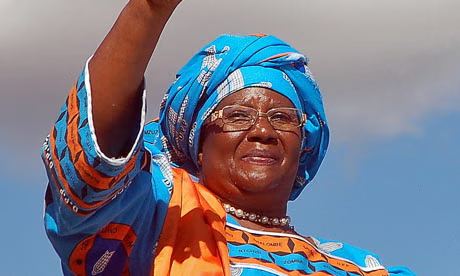
Joyce Hilda Mtila Banda (born April 12, 1950, Malemia, Nyasaland [now Malawi]) rose from modest beginnings to become the first woman president of Malawi and the first female head of state in Southern Africa.
Her early years were shaped by education and grassroots activism. Banda endured an abusive first marriage to Roy Kachale, an experience that profoundly influenced her later commitment to women’s rights and empowerment. After her divorce, she remarried Richard Banda, a barrister who became chief justice of Malawi (1992–2002) and supported her political career.
Banda later obtained a bachelor’s degree from Atlantic International University, an online institution based in the United States. Alongside her studies, she founded businesses and organizations, including a garment factory, a bakery, the National Association of Business Women, and the Joyce Banda Foundation, which promoted rural development and education.
Entry into Politics
In 2004, Banda was elected to Malawi’s National Assembly as a member of the United Democratic Front. She later joined the Democratic Progressive Party (DPP) and held several cabinet positions under President Bingu wa Mutharika, including minister of gender, child welfare, and community services and later minister of foreign affairs.
As minister, Banda initiated the Zero Tolerance Campaign Against Child Abuse and helped establish closer ties with China. In 2009, she became Malawi’s first female vice president after running as Mutharika’s deputy.
By 2010, internal disputes with the DPP leadership—particularly over succession plans—led to her expulsion from the party. Despite this, she retained her vice presidency and in 2011 founded the People’s Party (PP), positioning herself as the main opposition figure to Peter Mutharika.
Presidency (2012–2014)
When President Bingu wa Mutharika died unexpectedly in April 2012, attempts were made to block Banda’s succession. She overcame resistance and was sworn in as Malawi’s fourth president on April 7, 2012.
Her presidency coincided with a fragile economic and political climate. Banda implemented austerity measures to restore international donor confidence and revived foreign aid inflows. Her economic reforms doubled growth rates, but poverty remained widespread.
Banda made bold pledges to combat corruption, advance women’s rights, and repeal anti-homosexuality laws, though the latter remained controversial. She also sought to stabilize Malawi’s international relations, especially with donor countries.
Her administration was overshadowed by the “cash-gate” scandal (2013), a massive corruption case involving up to $250 million in stolen government funds. Although Banda dissolved her cabinet to safeguard the investigation, critics argued the scandal tainted her leadership.
In the 2014 elections, Banda faced Peter Mutharika and other rivals. The vote was marred by irregularities and disputes, and her attempt to annul the results was overturned by Malawi’s High Court. Mutharika won with 36.4 percent of the vote; Banda placed third with 20.2 percent.
Later Career and Awards
After leaving office, Banda remained active internationally as a women’s rights advocate. She continued her work through the Joyce Banda Foundation and spoke at global forums on democracy, gender equity, and development.
Among her honors, she received the Africa Prize for Leadership for the Sustainable End of Hunger (1997) and was ranked Africa’s third most powerful woman by Forbes (2011). In 2025, Banda returned to frontline politics as a candidate in Malawi’s presidential election scheduled for September.
Quick Facts
| Attribute | Details |
|---|---|
| Née | Joyce Hilda Mtila |
| Born | April 12, 1950, Malemia, Nyasaland [now Malawi] |
| Age | 75 (as of 2025) |
| Title / Office | Vice President (2009–12), President (2012–14), Malawi |
| Political Affiliation | Democratic Progressive Party; later founded the People’s Party |
| Notable For | First female president of Malawi and Southern Africa |
| Role In | Women’s rights movement |
| Awards | Africa Prize for Leadership (1997); Forbes ranking (2011) |


