


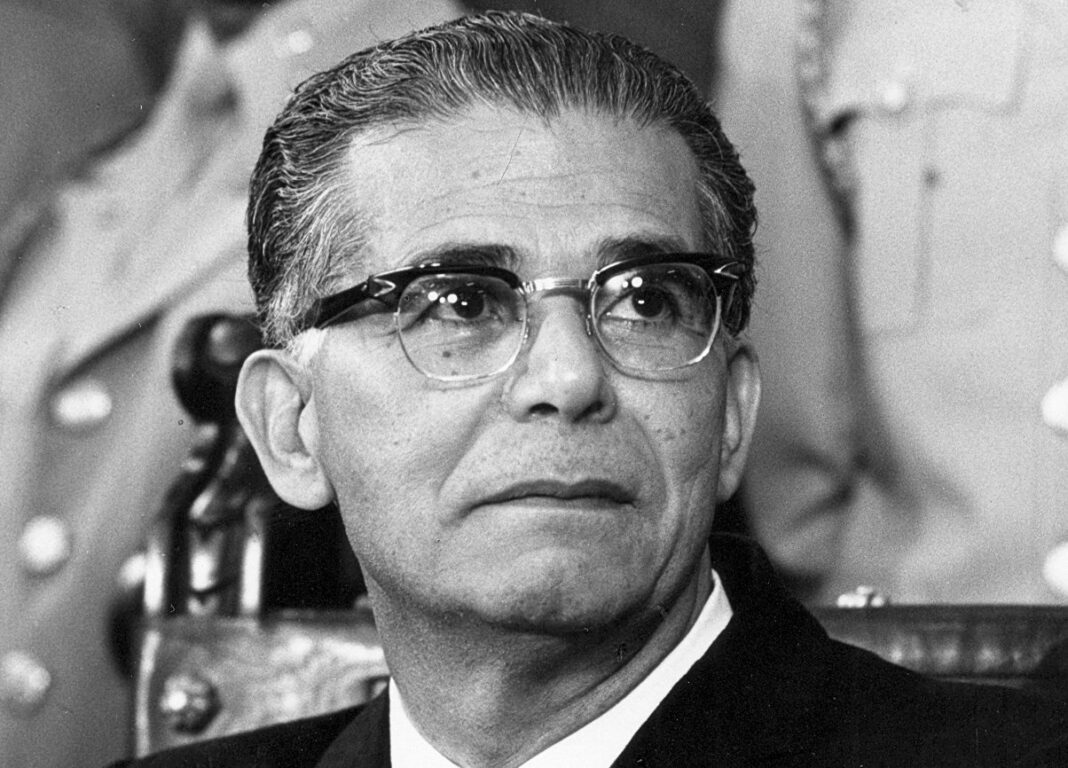
Joaquín Vidella Balaguer y Ricardo, born September 1, 1907, in Villa Bisonó, Dominican Republic, rose to prominence as a lawyer, writer, diplomat, and politician. He studied law at the University of Santo Domingo, before earning a doctorate from the University of Paris, laying the foundation for a long career in politics and public service.
From the early 1930s until the late 1950s, Balaguer occupied a variety of executive and diplomatic roles under the Trujillo regime. In 1957, as secretary of education under President Hector Trujillo, he established free universities and expanded the nation’s educational and cultural infrastructure.
Rise to Power under Trujillo
Balaguer was sworn in as vice president (1957–60) and then president in 1960 when Hector Trujillo stepped down due to illness. Despite holding the formal office, Balaguer wielded little real authority, as General Rafael Trujillo—Hector’s brother and dictator—retained ultimate control.
After Trujillo’s assassination in 1961, Balaguer attempted to liberalize the Dominican government. His cautious reforms convinced the Organization of American States (OAS) to lift sanctions imposed on the Trujillo dictatorship. However, his policies displeased both die-hard Trujillo loyalists and reformist factions. Widespread unrest and a military coup forced him to resign in 1962, after which he briefly went into exile in the United States.
Return and Long Presidency
Balaguer reemerged during the U.S. military intervention of 1965, positioning himself as a moderate choice in a divided country. In 1966, he won the presidency, presenting himself as a guarantor of peace and gradual reform. He maintained close ties with the business community and presided over steady economic growth, while carrying out limited social reforms.
Balaguer was reelected in 1970 and 1974, but his administrations were marred by political violence, corruption, assassinations of opponents, and electoral fraud. Defeated in 1978 by Silvestre Antonio Guzmán and again in 1982, he made a political comeback by winning the presidency in 1986, and he was reelected in 1990.
During his later terms, Balaguer oversaw an unprecedented public works program, building roads, bridges, schools, housing projects, and cultural institutions. While these projects modernized the Dominican Republic, they also left the economy heavily indebted. In 1994, amid allegations of fraud, he claimed victory once again, but international pressure forced him to cut his term short, serving only two years before leaving office in 1996.
Balaguer sought the presidency a final time in 2000, but his bid ended in defeat. His death on July 14, 2002, in Santo Domingo, closed the chapter on one of the most influential and controversial careers in Dominican politics.
Literary Contributions
Beyond politics, Balaguer was a prolific writer whose works reflected his interest in history, culture, and identity. His publications include:
- La realidad Dominicana (1947; Dominican Reality)
- Historia de la literatura Dominicana (1955; History of Dominican Literature)
These writings cemented his status not only as a political leader but also as a cultural voice in Latin America.
Quick Facts
| Attribute | Details |
|---|---|
| Full Name | Joaquín Vidella Balaguer y Ricardo |
| Born | September 1, 1907, Villa Bisonó, Dominican Republic |
| Died | July 14, 2002, Santo Domingo (aged 94) |
| Title / Office | Vice President (1957–60), President (1960–62, 1966–78, 1986–96) |
| Profession | Lawyer, diplomat, writer, politician |
| Notable Works | La realidad Dominicana (1947), Historia de la literatura Dominicana (1955) |
| Legacy | Guided Dominican Republic through modernization and turmoil, remembered as both a reformer and an authoritarian leader |




