Instagram end-to-end encryption is officially being removed, marking a sharp policy reversal from Meta’s earlier privacy push. Beginning May 8, encrypted chats on Instagram will no longer be supported, according to an update quietly added to the platform’s help documentation.
The move represents a significant shift in how Instagram handles private communications. Previously, end-to-end encryption ensured that only users in a conversation could access messages. After the change, Meta will technically be able to view and process those messages.
Instagram End-to-End Encryption Policy Shift
Instagram introduced end-to-end encryption as part of Meta’s broader privacy narrative. WhatsApp, another Meta platform, continues to use E2EE as a core security feature. Therefore, Instagram’s reversal raises immediate questions.
Unlike a public announcement, the change appeared in updated support pages. Users affected by the transition will receive instructions on how to download chats and media before encryption ends.
The timing suggests a calculated rollout. By avoiding a formal press release, Meta may be attempting to minimize public backlash.
Why Instagram End-to-End Encryption Matters
End-to-end encryption prevents platforms from accessing message content. It also limits exposure during government data requests. Once removed, message visibility shifts significantly.
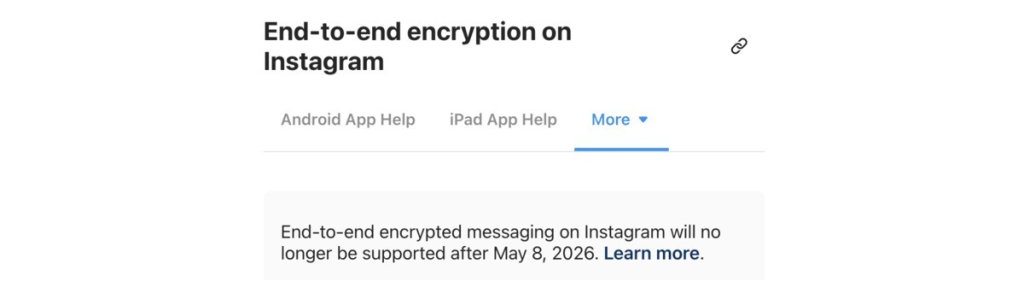
Meta states that from May 9 onward, encrypted chat protections will no longer apply on Instagram. Consequently, both the company and government agencies, subject to legal processes, could access message content.
Historically, encryption debates have intensified during periods of regulatory scrutiny. Governments often argue that encryption hampers investigations. Technology companies, however, frame encryption as essential to user privacy.
Instagram’s decision suggests shifting priorities. Whether that shift reflects regulatory pressure, moderation challenges or monetization strategy remains unclear.
Operational and Business Considerations
Instagram’s messaging ecosystem supports business communication, influencer outreach and brand collaborations. Removing E2EE may allow deeper integration with AI moderation tools and advertising analytics.
Encrypted systems restrict content scanning. Without encryption, Meta can potentially analyze conversations to improve content moderation and detect harmful behavior. However, such capability comes at a privacy cost.
Furthermore, advertising remains Meta’s core revenue engine. Although private messages are not typically used directly for ad targeting, broader data visibility strengthens algorithmic ecosystems.
Contrast with WhatsApp
WhatsApp remains firmly encrypted. That distinction may become strategically important. Privacy-conscious users could shift more sensitive conversations to WhatsApp.
However, Instagram’s audience skews younger and more content-driven. For many users, messaging functions supplement public sharing rather than replace secure communication platforms.
Global and African Implications
In many African markets, Instagram serves as a commercial tool. Small businesses use direct messages for orders and customer engagement. Therefore, changes to privacy architecture may affect trust.
Additionally, digital rights advocacy across Africa has grown stronger in recent years. Countries like Kenya and Nigeria have debated data protection frameworks. Instagram’s policy change may trigger renewed scrutiny of platform accountability.
Moreover, in regions with limited digital literacy, users may not fully understand encryption implications. Clear communication will be essential to avoid misinformation.
Regulatory Landscape and Data Access
Governments worldwide continue to push for greater access to digital communications. The European Union’s Digital Services Act and various national cybersecurity laws emphasize platform responsibility.
Removing Instagram end-to-end encryption could simplify compliance with lawful data requests. However, it also increases corporate data responsibility.
If data breaches occur, liability exposure may grow. Therefore, Meta must balance accessibility with enhanced security safeguards.
Why This Matters
Instagram end-to-end encryption was positioned as a privacy milestone. Its removal signals a recalibration of Meta’s risk tolerance and regulatory strategy.
For users, the change alters the privacy baseline. Conversations once shielded from platform access will no longer enjoy that protection.
In an era where digital trust defines platform loyalty, such shifts influence long-term user perception.
What Happens Next
Users with encrypted chats will receive instructions to download data before May 8. After that date, encrypted sessions will cease.
The broader question concerns future messaging strategy. Meta may introduce alternative safeguards or enhanced transparency tools.
Meanwhile, privacy advocates and regulators will closely monitor user response. The outcome may shape encryption debates across the tech industry.