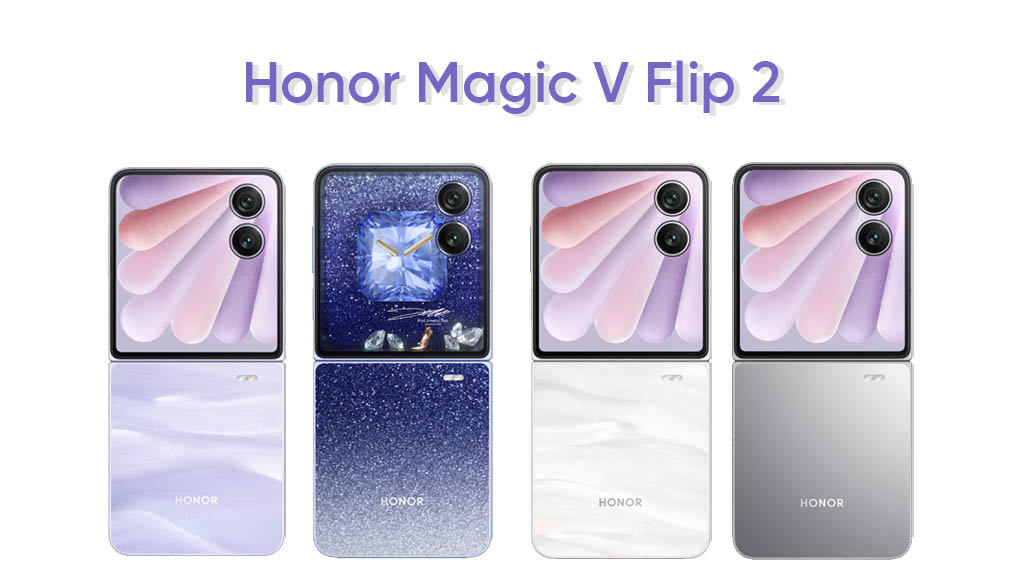
The Honor Magic V Flip 2 arrives in a foldable market that now feels more settled than experimental. Buyers know what a clamshell foldable should do by now. It should be compact when closed, usable on the outer screen, and dependable enough to work as a main phone. Honor’s second attempt takes that brief seriously, with meaningful upgrades in performance, battery size, durability, and camera hardware.
That said, this is not a universally easy recommendation. The hardware is strong, and in some areas it is stronger than more widely available rivals. However, the phone is currently limited to China, and that changes the buying equation. As a result, the Honor Magic V Flip 2 has to be judged both as a foldable on its own merits and as an imported product with practical compromises.
Specifications Table
| Category | Details |
|---|---|
| Display | Inner: 6.82-inch Foldable LTPO OLED, 1232 x 2868, 120Hz, Dolby Vision, HDR, 4320Hz PWM, up to 5000 nits peak; Cover: 4.0-inch LTPO OLED, 1200 x 1092, 120Hz, Dolby Vision, HDR, up to 3600 nits peak |
| Chipset | Qualcomm Snapdragon 8 Gen 3 (4nm), Adreno 750 |
| RAM & Storage | 256GB/12GB, 512GB/12GB, 1TB/12GB, 1TB/16GB |
| Rear Camera | 200MP main, f/1.9, OIS; 50MP ultrawide, f/2.0, AF |
| Front Camera | 50MP, f/2.0, AF |
| Battery | 5500mAh |
| Charging | 80W wired, 50W wireless, 5W reverse wired |
| OS | Android 15, MagicOS 9 |
| Build | Aluminum frame, UTG inner screen, IP58/IP59 water resistance |
| Connectivity | 5G, Wi-Fi 6, Bluetooth 5.4, NFC, dual nano-SIM, IR blaster |
Design and Build Quality
The Magic V Flip 2 does not try to reinvent the clamshell foldable shape. Instead, it focuses on refinement. That is the right move. The frame is aluminum, the hinge feels solid, and the device closes with the kind of assurance you want from a foldable that may be opened hundreds of times a day.
More importantly, Honor has improved durability in areas that matter. IP58 and IP59 protection are welcome additions in this class, because foldables still tend to trail regular flagships on durability. The company also claims the hinge and display structure can withstand 350,000 folds, and while that figure is hard to verify in normal use, the real takeaway is that this no longer feels like a fragile luxury device.
Compared to the first Magic V Flip, the new model is clearly more mature. The crease is effectively invisible when the display is open, and more importantly, it is hard to feel. That does not make the panel identical to a slab phone, but it narrows the gap enough that most users will stop noticing it after a few hours.
At 204g, the phone is not especially light for a flip-style foldable. You do notice the weight in the pocket and in prolonged one-handed use. Even so, that weight seems tied to a more ambitious battery than most rivals offer. In other words, the trade-off is understandable.
The outer design is also more confident than clever. The large 4-inch cover display dominates the front, the cameras sit prominently within the layout, and the matte finish helps grip. It does not feel slippery, and it does not really need a case to feel secure. That alone is a positive sign.
Display Performance
The Honor Magic V Flip 2 gets the basics right on both screens, and that matters more on a foldable than on a regular phone. The inner 6.82-inch LTPO OLED panel is sharp, bright, and easy to trust as the main display. The cover screen is not just a token extra. It is large enough and capable enough to handle real work.
Brightness is strong on both displays. In manual mode, both panels sit around the 820-nit mark, which is already good. Under auto brightness, the inner panel reaches about 1,786 nits, while the cover display peaks much higher at roughly 3,055 nits before settling down. In practice, this means the outer screen remains very legible outdoors, and that is important because a clamshell foldable lives or dies by how often you can avoid opening it.
Color rendering is also well judged. Dolby Vision support is present on both screens, contrast is strong, and black levels are exactly what you expect from a modern OLED. The inner panel’s fold line does not interfere with viewing in any meaningful way. Under harsh direct light you may still notice a slight difference in reflection across the crease area, but it is minor.
Honor Magic V Flip 2 Display Refresh Behavior
Both screens are LTPO panels with a 1Hz to 120Hz range. That gives the phone flexibility where it counts. Static content drops low, videos match the source frame rate properly, and scrolling feels smooth. Dynamic mode behaves sensibly, while High mode keeps things pinned closer to 120Hz for users who want maximum fluidity.
That said, there is a catch. Widevine remains at L3, so most streaming apps are limited to 480p playback. This is a serious weakness for a premium foldable. The hardware is good enough for high-end media use, but the DRM situation stops the device from taking full advantage of its displays in many mainstream streaming apps.
Outdoor usability is excellent. The cover display in particular stands out here. For checking notifications, maps, messages, or even simple app interactions in sunlight, it behaves more like a flagship outer panel than an accessory screen.
Performance and Benchmarks
The Snapdragon 8 Gen 3 is no longer the newest top-end chip, but it is still a high-end platform. In a normal flagship, it remains fast enough to feel excessive for most tasks. In a foldable, it is more than sufficient, at least at the start of a workload.
Benchmark results place the Magic V Flip 2 in the upper end of the compact foldable segment. CPU results are strong, GPU performance is solid, and storage performance benefits from fast UFS 4.0 configurations. There is no sign of sluggishness in day-to-day use. App launches are immediate, navigation is quick, and the cover screen transitions smoothly into the full interface when the phone is opened.
Honor Magic V Flip 2 Real-world Performance
In actual use, the phone feels fast. Multitasking is smooth, and MagicOS 9 handles split-screen and floating windows well. That matters because foldables invite more multitasking than slab phones do. Here, Honor has put the large internal display to good use.
Gaming starts well too. The Adreno 750 still has enough headroom for demanding titles, and short sessions are handled without drama. Casual games, camera use, messaging, browsing, and switching between several apps are easy work for this hardware.
The problem appears when the workload lasts longer. This is where the Magic V Flip 2 behaves like many compact foldables. Its form factor limits thermal headroom, and eventually that shows.
Honor Magic V Flip 2 Thermal Performance
Thermal throttling is the weakest part of the performance story. Sustained CPU performance drops sharply, and GPU retention is also limited after the first several minutes under load. That means the phone feels flagship-fast in bursts, but it cannot hold that level in longer gaming sessions or heavy benchmark loops.
This has practical consequences. For short gaming sessions, the phone is fine. For longer sessions, frame consistency drops and heat becomes noticeable. It is not a gaming-first device, even if the chipset sounds flagship on paper.
The good news is that everyday users may rarely hit this wall. Most people do not run prolonged stress tests. Still, it matters in a review because rivals such as the Motorola Razr 60 Ultra and Xiaomi Mix Flip 2 are starting to push harder on sustained performance. In that context, Honor is competitive, but not ahead.
Camera Performance
Honor has taken a different route from some competitors by leaning heavily on a high-resolution main sensor rather than adding a dedicated telephoto camera. That choice works better than expected in daylight, but it also creates clear limits once the light drops or zoom levels climb.
The camera setup is simple on paper. The 200MP main camera handles standard shots and in-sensor zoom duties. The 50MP ultrawide covers broader scenes and macro use. The 50MP selfie camera, helped by autofocus, is stronger than what many flip phones offer.
Honor Magic V Flip 2 Main Camera Analysis
The main camera is the strongest part of the system. At 1x, image quality is very good. Detail is high, dynamic range is wide, and color rendering is vivid without becoming completely unnatural. There is a clear processing style here, but it is controlled enough for everyday shooting.
At 2x, the phone still performs well. Detail remains strong, and the crop holds up better than expected. That makes the lack of a dedicated telephoto easier to accept in daily use. For portraits, street shots, and casual zoom, the main sensor carries the load effectively.
At 4x, things become less convincing. The results are still usable, and for a mainstream user they may look perfectly fine on the phone screen. However, close inspection shows that Honor is leaning heavily on processing. Foliage and fine textures can look overworked, and the extra zoom does not feel optically grounded in the way a real telephoto camera would.
HDR handling is generally good. Bright skies and shadow areas are both kept under control, and exposure decisions are usually sensible. Portraits also benefit from the main sensor’s size, producing natural separation and convincing blur even before software portrait effects step in.
Honor Magic V Flip 2 Low-light Performance
Low-light performance from the main camera is strong. Night shots retain fine detail, colors stay believable, and bright light sources are handled better than expected. Noise reduction is present, but it does not smear the image too aggressively at 1x.
At 2x, the quality drop is modest. That is a useful result because many buyers will use that crop level often. The 4x mode is another story. In low light, it behaves like what it is: a digital solution. Detail falls off, the image becomes more processed, and the results are much less dependable.
The ultrawide holds up reasonably well for a secondary camera. It does not deliver class-leading low-light quality, and some fine detail is lost to noise reduction, but the images remain clean and broadly usable. Colors stay consistent enough with the main camera, which helps the system feel coherent.
Honor Magic V Flip 2 Video Performance
Video is solid, though not class-leading. The main camera records sharp 4K footage with good color, realistic dynamic range, and low visible noise. Stabilization is consistently effective, and that helps the phone feel dependable for everyday video capture.
The limitation appears again with zoom. There is no convincing high-quality zoom video path beyond the main camera’s base view. Switch to 2x in video and the drop in detail is easy to spot. For users who care about mobile videography, that matters.
The ultrawide camera records acceptable footage, but it sits behind the main camera in detail and overall richness. That is common in this segment, though. The more important point is that stabilization works well across the system, and that makes handheld clips easier to trust.
Battery and Charging
Battery size is one of the Magic V Flip 2’s biggest advantages. At 5,500mAh, it offers more capacity than most direct flip-style rivals. That does not automatically make it the class leader in endurance, but it gives the phone a stronger base than many competitors start with.
In practice, battery life is good rather than exceptional. An active use score of 12 hours 43 minutes is respectable for a foldable, and the phone does well in calls, web browsing, and video streaming. Gaming endurance is more average, which fits the earlier thermal story.
For many users, that translates into a reliable full day, and in lighter use it can stretch further. In the foldable category, that is already a good outcome. Battery anxiety used to be a core weakness of clamshell foldables. Here, it is no longer a major concern.
Charging is also fast in practical terms. Reaching 70% in 30 minutes and taking roughly 46 minutes for a full charge is a strong result given the battery size. Wireless charging support at 50W is also a meaningful plus, because many flip phones still treat wireless charging as optional or slow.
Heat during charging appears controlled, and Honor includes useful battery preservation options. That matters for longevity, especially on a foldable that may be kept for several years.
Software and User Experience
MagicOS 9 on Android 15 is smooth and feature-rich. The interface is visually polished, animations are stable, and general responsiveness is good. Honor has also done solid work with multi-window behavior, which is important on a foldable where users are more likely to run two apps at once.
The cover screen experience is one of the better ones in the segment. Honor lets users enable a meaningful range of apps, not just widgets and canned shortcuts. That increases the practical value of the outer display and reduces the need to unfold the device for every small task.
There are, however, two caveats. First, the software support policy is unclear because the phone is aimed at China rather than global markets. Second, buyers outside China may face app or service inconsistencies depending on the unit they import and how it is configured. That uncertainty weakens the phone’s long-term appeal outside its intended market.
Bloatware is present, as expected on a China-focused device, though interface fluidity does not seem affected by it. The larger issue is predictability. With Samsung and Motorola, international buyers know what the software path looks like. With this Honor, that is much less certain.
Connectivity and Extras
Connectivity is broadly strong. You get 5G, Wi-Fi 6, Bluetooth 5.4, NFC, dual nano-SIM support, and an IR blaster. That is a useful set of extras, and the IR blaster remains a nice practical feature that some brands have abandoned.
The side-mounted fingerprint reader is reliable and well placed. On a foldable, this is often the better choice than an under-display solution. It works quickly and does not add complexity.
There are still a few missing pieces. There is no eSIM support, which will matter to frequent travelers. For a China-only model, that is not surprising, but for imported use it is a real limitation. USB specifics are not highlighted as a major feature either, so buyers looking for advanced desktop-style use should temper expectations.
Network compatibility also depends on regional band support, which makes importing riskier than buying a locally sold Samsung or Motorola foldable.
Audio and Multimedia
The stereo speakers are loud enough and score well for output level, but quality is merely average. Vocals are clear, treble is decent, yet bass response is limited. For videos, voice-heavy content, and casual gaming, the speakers are fine. For music, they are less impressive.
The bigger multimedia issue is not the speakers. It is the Widevine L3 DRM limitation. On a foldable with two HDR-capable OLED screens, streaming many services in SD is a poor fit. This directly affects the ownership experience. The displays are good enough to invite movie watching, but the content pipeline does not always match the hardware.
For gaming, the large internal display is enjoyable, and the cover screen can even run some apps and games well. Still, sustained heat and throttling mean this is better treated as a versatile daily phone than a serious gaming foldable.
Competition and Market Position
The Honor Magic V Flip 2 sits in a very competitive part of the foldable market. Against the Samsung Galaxy Z Flip7, it offers a larger battery, stronger main camera performance, and a more useful-feeling cover display. Samsung counters with wider availability, clearer software support, better resale confidence, and fewer import risks.
Against the Motorola Razr 60 Ultra, the Honor looks less elegant in software simplicity and may trail in sustained performance and battery efficiency. Motorola also has a cleaner global buying story. However, Honor fights back with a stronger main camera and a more aggressive overall hardware package.
The Xiaomi Mix Flip 2 is arguably the toughest hardware rival where both are available. Xiaomi’s newer chipset and likely stronger sustained performance make it a sharper option for performance-first buyers. Honor answers with a competitive camera setup, strong battery capacity, and a polished physical design.
In pure price-to-hardware terms, the Honor Magic V Flip 2 is positioned well. In pure ownership confidence, especially outside China, it is harder to recommend.
Verdict
The Honor Magic V Flip 2 is a very competent foldable. It has bright displays, a useful cover screen, a strong main camera, good battery life, and fast charging. It also feels durable enough to be taken seriously as a daily device rather than a novelty.
Its weaknesses are also clear. Sustained performance is limited by heat, streaming DRM support is poor for a premium product, and its China-only status changes the risk profile for buyers elsewhere. Those issues stop it short of being an easy top pick.
Why This Phone Matters in Africa
The Magic V Flip 2 matters in Africa because it highlights a tension that premium buyers across the region increasingly face. On one hand, it offers strong hardware value, excellent battery capacity, dual nano-SIM support, and cameras that are better than many compact foldables. Those are all practical strengths in markets where network switching, charging reliability, and day-long endurance matter.
On the other hand, after-sales support, repair access, and resale confidence matter just as much. In many African markets, Samsung devices hold value better and are easier to repair. Imported China-only foldables may look attractive at purchase, but parts availability, warranty limitations, and network band uncertainty can make ownership more complicated over time.
Pricing Sensitivity
Foldables remain expensive devices, and price sensitivity is sharper in African markets than in Europe or North America. A phone like this can make sense if priced below widely sold global rivals with similar storage. If the import premium pushes it near or above a Galaxy Z Flip7 or Motorola Razr 60 Ultra, the value case weakens fast.
That is because buyers are not only paying for hardware. They are also paying for access to support, repairs, resale demand, and reliable software updates. Those are areas where an imported China-exclusive device often loses ground.
Network Compatibility
The phone supports 5G and dual nano-SIM, which is useful in markets where users often keep separate lines for data and calls. However, network compatibility should be checked carefully before import. Band support can vary, and that matters for performance on local carriers.
The lack of eSIM is not necessarily a major problem in Africa today, since physical SIM remains common in many countries. In fact, dual physical SIM support may be more useful for many regional buyers. Still, those who travel often may miss eSIM flexibility.
Battery Reliability
Battery reliability is one of the phone’s strongest practical advantages. The large 5,500mAh cell is a meaningful benefit, especially in areas where users may spend long stretches on mobile data or go through inconsistent access to charging during the day.
Fast wired charging also reduces the inconvenience of topping up. Even if long-term battery health remains hard to judge in a new model, Honor at least includes the basic tools needed to manage charging behavior more conservatively.
Repair and Resale Value
Repairability is the biggest unknown. Foldables are harder to repair than normal phones, and imported units are usually harder still. Parts, hinge repairs, and display replacements may not be easy to source locally outside a few major cities. That risk cannot be ignored.
Resale value is also likely to be weaker than a Samsung equivalent. Brand recognition may be good, but market demand for a China-only foldable is narrower. Buyers looking at total cost of ownership should factor that in. A cheaper purchase price does not always mean lower long-term cost.
Final Thoughts
The Honor Magic V Flip 2 is best suited to buyers who want a premium clamshell foldable with a strong main camera, a genuinely useful outer display, and better battery capacity than most rivals. It is also a good fit for people who value dual physical SIM support and do not mind dealing with the extra complexity of an imported phone.
It is less suitable for buyers who want the safest long-term purchase. If software support clarity, repair access, streaming quality, and resale strength matter most, a Galaxy Z Flip7 or Motorola Razr 60 Ultra is the safer route. The Honor Magic V Flip 2 is a good foldable. It is just not the most practical foldable for everyone.
The Review
Honor Magic V Flip 2
The Honor Magic V Flip 2 has gotten almost everything right - catchy and durable design with impressive protection against the elements, superb screens, powerful hardware, properly good cameras, and reasonably long battery life with fast charging.Among the noteworthy features of this V Flip 2 are its design, bright screens, and impressive in-sensor zoom on the main camera.
PROS
- Durable design, likable looks.
- Bright screens, dynamic 1Hz-120Hz refresh rate, Dolby Vision.
- Solid battery life, fast to charge.
- Flagship-grade performance.
- Outstanding photo quality, excellent video stabilization.
- Feature-rich software package.
CONS
- China-exclusive.
- No Widevine L1 DRM means no high-res video streaming.
- The competition offers newer chipsets and sleeker designs.
- No eSIM support.
 Honor
Honor