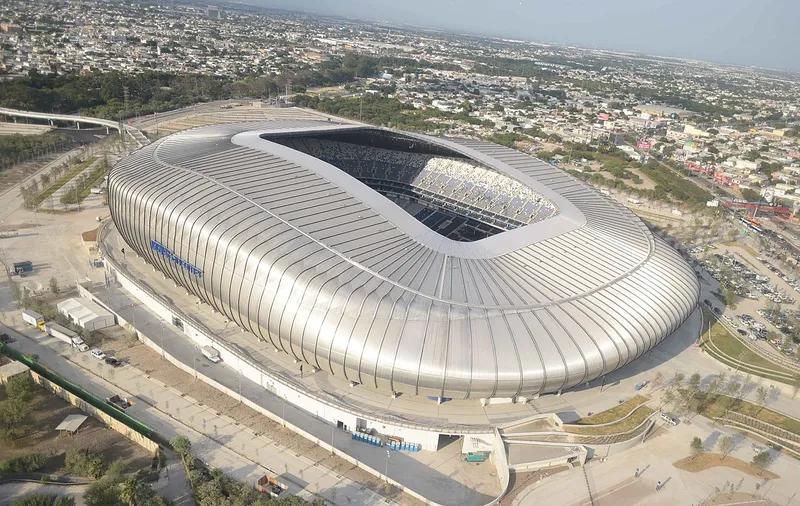
Estadio BBVA will be one of Mexico’s three FIFA World Cup 2026 venues, hosting four matches in Monterrey, Nuevo León, including a Round of 32 knockout fixture.
During the tournament, the venue will be called Estadio Monterrey because FIFA uses neutral venue names and removes commercial branding from World Cup stadiums. But to football fans in Mexico, this is Estadio BBVA: the home of CF Monterrey, one of the most modern stadiums in Latin America and one of the most visually striking venues in the tournament.
Opened in 2015, the stadium is known as El Gigante de Acero, or The Steel Giant. The nickname reflects both its metallic exterior and Monterrey’s identity as Mexico’s industrial steel capital. Its roofline was designed to echo the shape of Cerro de la Silla, the mountain that dominates the city skyline.
For World Cup 2026, Estadio BBVA will host three group-stage games and one Round of 32 match. Its schedule includes South Africa vs South Korea, giving the venue direct relevance for African football fans.
The stadium may be the smallest of Mexico’s three World Cup venues, but it is also the newest, most modern and most purpose-built for elite football.
Quick Facts About Estadio BBVA
| Fact | Detail |
|---|---|
| Stadium name | Estadio BBVA |
| FIFA World Cup name | Estadio Monterrey |
| Nickname | El Gigante de Acero |
| Location | Guadalupe, Monterrey metropolitan area, Nuevo León, Mexico |
| Address | Avenida Pablo Livas 2011, La Pastora, 67140 Guadalupe |
| Capacity | 53,500 |
| Opened | 2015 |
| Roof | Open with partial canopy |
| Surface | GrassMaster hybrid |
| Main tenant | CF Monterrey |
| Competition focus | FIFA World Cup 2026 |
| World Cup matches | 4 matches |
| Biggest match | Round of 32 |
| First World Cup match | June 14, 2026 |
| Known for | Cerro de la Silla views, steel design, Clásico Regio atmosphere and modern football layout |
Where Is Estadio BBVA?
Estadio BBVA is located in Guadalupe, a municipality within the Monterrey metropolitan area in Nuevo León, northern Mexico. The stadium sits east of central Monterrey and close to Cerro de la Silla, the famous saddle-shaped mountain that defines the city’s skyline.
The venue’s address is Avenida Pablo Livas 2011, La Pastora, 67140 Guadalupe. It is not in the exact centre of Monterrey, so visitors should plan transport carefully, especially on match days.
The stadium is about 8 miles from downtown Monterrey and around 22 minutes by car from General Mariano Escobedo International Airport in normal conditions.
For World Cup visitors, the location offers a strong mix of football, mountains, industrial history and northern Mexican culture. Monterrey is also one of Mexico’s most important business cities, with strong links to Texas and the wider North American economy.
History of Estadio BBVA
Estadio BBVA was built to replace Estadio Tecnológico, where CF Monterrey had played for more than six decades.
Rayados needed a modern home that matched the club’s ambition, fan base and commercial growth. Construction began in August 2011, and the stadium opened on August 2, 2015, with a match against Benfica in the Eusébio Cup.
Monterrey won that opening match 3-0, giving the new venue a perfect start.
The stadium quickly became one of the most admired football venues in the Americas. Its modern facilities, steep seating bowl, mountain views and intense derby atmosphere helped make it a landmark of Mexican football.
For World Cup 2026, Estadio BBVA will be only 11 years old, making it the youngest of Mexico’s three host stadiums. That contrasts strongly with Estadio Azteca, which opened in 1966 and carries decades of World Cup history.
Construction and Design
Estadio BBVA was designed by Populous, working with Mexican studio VFO and Federico Velasco. The stadium was built by a local construction joint venture involving Aceros Lozano, GGP and Maíz Mier.
The design reflects Monterrey’s identity. Steel and aluminium dominate the stadium’s look, connecting the building to the city’s industrial heritage. The roofline was shaped to mirror the jagged mountains around the city, especially Cerro de la Silla.
The stadium bowl is steep, with a 34-degree rake that brings fans close to the pitch. The front row is positioned as close to the field as FIFA allows. That creates a strong sense of pressure and intimacy, especially during big Liga MX matches.
The partial canopy extends over much of the seating area, providing shade while keeping the venue open and naturally ventilated.
This is a modern stadium built for football first. That makes it well suited for the World Cup.
Estadio BBVA and World Cup 2026
Estadio BBVA will host four FIFA World Cup 2026 matches.
The schedule includes three group-stage matches and one Round of 32 knockout fixture. The first match at the venue is scheduled for June 14, 2026.
The venue will be temporarily known as Estadio Monterrey during the tournament. That name will appear in FIFA broadcasts, ticketing, signage and official material.
Monterrey’s World Cup role is smaller than Mexico City’s, but still important. Estadio Azteca will host the Opening Match, while Estadio BBVA will give northern Mexico a modern football stage with knockout-round involvement.
The Round of 32 match on June 29 will be the stadium’s biggest fixture. It will decide which team continues into the deeper knockout rounds and which team leaves the tournament.
World Cup 2026 Matches at Estadio BBVA
| Date | Match |
| June 14, 2026 | UEFA Playoff B Winner vs Tunisia |
| June 20, 2026 | Tunisia vs Japan |
| June 24, 2026 | South Africa vs South Korea |
| June 29, 2026 | Round of 32 |
This schedule gives Estadio BBVA direct African relevance. Tunisia will play twice in Monterrey, while South Africa will face South Korea on June 24.
For Kenyan readers and African football fans, Monterrey will be one of the Mexican host cities to follow closely. Tunisia and South Africa represent different parts of African football, and both will face difficult tests in hot northern Mexican conditions.
The Round of 32 match will bring knockout pressure to Estadio Monterrey. By then, the World Cup will have moved beyond group-stage calculation, and every mistake could end a country’s tournament.
Why Estadio BBVA Was Chosen for a Round of 32 Match
Estadio BBVA was chosen for World Cup 2026 because it is modern, football-specific and visually distinctive.
The stadium may not have the huge capacity of Estadio Azteca, but it offers a strong match-day environment. Its steep seating bowl keeps fans close to the pitch, and its design makes the stadium feel intense even with a smaller capacity.
Monterrey is also important to Mexico’s national host plan. It is one of the country’s largest and most economically important cities. Its location in northern Mexico gives the tournament reach beyond Mexico City and Guadalajara.
The Round of 32 assignment shows FIFA’s trust in the venue’s football operations. Knockout matches require strong security, broadcast systems, pitch quality, hospitality and fan movement. Estadio BBVA was built with modern standards in mind.
GrassMaster Pitch and Playing Surface
Estadio BBVA uses a GrassMaster hybrid surface.
GrassMaster combines natural grass with synthetic reinforcement fibres, helping the pitch remain stable under heavy use. This is useful in a World Cup setting, where the surface must handle multiple matches, training demands and intense scrutiny.
The stadium also uses under-turf ventilation and water-management systems to help the pitch cope with Monterrey’s heat.
For players, the surface should support quick passing, secure footing and consistent ball movement. That will be important for teams such as Japan, Tunisia, South Africa and South Korea, where tactical structure and transitions could decide matches.
Because the venue already has a FIFA-ready hybrid system, it avoids some of the major pitch-conversion concerns seen at stadiums that normally use synthetic turf.
Monterrey Heat and Match Conditions
Heat will be one of the biggest World Cup storylines at Estadio BBVA.
Monterrey in June can be extremely hot, with temperatures regularly rising above 100°F. Even evening matches can feel heavy because of residual heat from the day.
The stadium’s partial canopy provides shade for many seats, but the venue is not fully enclosed or air-conditioned. Fans will need to prepare for sun, heat and long queues outside the stadium.
For players, heat can affect pressing, recovery, hydration and match tempo. Teams that manage the conditions better may gain a real advantage.
FIFA has scheduled most Monterrey matches for later times to reduce heat exposure, but the climate will still matter.
The Clásico Regio Atmosphere
Estadio BBVA is home to one of the fiercest derbies in Latin American football: the Clásico Regio between CF Monterrey and Tigres UANL.
When Rayados and Tigres meet, the stadium becomes a wall of noise, colour and tension. More than 50,000 fans fill the steep bowl, creating one of the most intense atmospheres in Liga MX.
That derby culture matters for the World Cup because it shows what the stadium can become when the crowd is fully engaged.
International fans visiting Estadio Monterrey should expect a football-first environment. This is not a general-purpose arena trying to become a soccer venue for a month. It is a stadium built for the sport.
Major Events Hosted at Estadio BBVA
Since opening in 2015, Estadio BBVA has hosted major football and entertainment events.
It has staged Liga MX finals, Clásico Regio matches, CONCACAF Champions League fixtures, Copa MX finals and Mexico national team games. These matches helped establish the stadium as one of Mexico’s leading football venues.
The stadium has also hosted major concerts, including large international tours that drew huge crowds over multiple nights.
Its combination of modern facilities and dramatic mountain setting has made it one of the most attractive event venues in Mexico.
The World Cup will be its biggest global stage yet.
Sustainability and LEED Silver Certification
Estadio BBVA is also known for its sustainability credentials.
It was the first football stadium in North America to earn LEED Silver certification. That recognition reflects features such as water management, under-turf ventilation and energy-efficient design.
Sustainability matters because World Cup venues must handle large crowds, energy use, waste and transport pressure. A modern stadium with environmental systems already built in is better prepared for that challenge.
The design also makes use of natural ventilation through its open structure and aluminium gill panels. That helps the stadium breathe in Monterrey’s hot climate.
Transport and Fan Access
Public transport to Estadio BBVA is workable, but fans should plan carefully.
The most practical option is Metrorrey Line 1 to Exposición station, followed by a walk of about 15 minutes to the stadium. On World Cup match days, the route will be crowded, so fans should arrive early.
Several bus routes from central Monterrey also serve the stadium area. However, buses can become crowded and slow during major events.
Fans should expect heavy congestion before and after matches. Leaving the stadium may take time, especially after the South Africa vs South Korea match and the Round of 32 fixture.
The safest strategy is to arrive early, avoid last-minute travel and follow official transport updates.
Driving and Parking
Driving to Estadio BBVA is possible, but match-day traffic can be difficult.
The stadium sits near Avenida Pablo Livas and has road connections into the wider Monterrey metro area. However, traffic around the venue can become heavy before kickoff and after full time.
Official parking is available, but spaces can fill quickly. Fans should avoid relying on street parking in nearby neighbourhoods and should use official or approved lots where possible.
For World Cup matches, parking rules may be stricter than regular club games. Fans should check official guidance before match day.
Anyone driving should budget extra time and avoid tight plans after the match.
Rideshare and Airport Access
Uber and DiDi operate in Monterrey and will be useful for World Cup visitors.
A ride from downtown Monterrey to the stadium is usually affordable in normal conditions, but prices can rise on match days because of demand. Drop-offs near the stadium may also be slow because of road closures and traffic controls.
A good approach is to get dropped off a few blocks from the stadium and walk the final stretch where safe and permitted. After the match, walking away from the busiest gates before requesting a ride may reduce wait times.
General Mariano Escobedo International Airport is the main airport for Monterrey. It is around 22 minutes from the stadium by car in normal traffic, but World Cup visitors should allow more time on match days.
Nearby Attractions
Monterrey gives World Cup visitors a strong mix of mountain scenery, industrial history and modern city life.
Cerro de la Silla is the city’s most famous natural landmark and is visible from the stadium area. Parque Fundidora, a former steel foundry turned urban park, will be an important World Cup gathering area and fan festival site.
Paseo Santa Lucía offers a scenic riverwalk connecting Fundidora Park with central Monterrey, while Macroplaza gives visitors access to museums, monuments and civic buildings.
Food is also a major part of the city’s identity. Monterrey is known for northern Mexican cuisine, including cabrito, grilled meats and regional dishes.
For fans travelling from abroad, Monterrey offers a different Mexico experience from Mexico City or Guadalajara.
What Fans Should Know Before Visiting
Fans attending World Cup matches at Estadio BBVA should prepare for heat, crowds and traffic.
The stadium is modern and comfortable, but Monterrey’s June climate can be demanding. Hydration, sunscreen, hats and light clothing will be important, especially before entering the stadium.
Public transport will be crowded, so fans should travel early. Driving and rideshare will also face congestion near the venue.
Security will follow FIFA standards. Fans should check official rules on bags, tickets, gate times and prohibited items before match day.
For South Africa vs South Korea and the Round of 32 match, crowds should be especially strong. Arriving early will make the experience much easier.
Why Estadio BBVA Matters to African Fans
Estadio BBVA will be one of the most important Mexican venues for African fans during World Cup 2026.
Tunisia will play twice in Monterrey, facing the UEFA Playoff B Winner on June 14 and Japan on June 20. South Africa will also play at the stadium against South Korea on June 24.
That gives Estadio Monterrey direct relevance to both North African and Southern African football storylines.
For Kenyan readers, the South Africa match will be especially important because Bafana Bafana will already have opened the tournament against Mexico at Estadio Azteca. Their match in Monterrey could become decisive in the group.
Tunisia’s games will also attract wide attention across Africa and the Arab world, especially against Japan, one of Asia’s strongest teams.
Why Estadio BBVA Is Important
Estadio BBVA is important because it gives World Cup 2026 a modern Mexican football venue with a strong local identity.
It does not have the age and mythology of Estadio Azteca, but it has something different: contemporary design, mountain scenery, steep stands, strong acoustics and a football-first layout.
The stadium reflects Monterrey itself. It is industrial, modern, ambitious and visually tied to the landscape.
The Round of 32 match gives the venue knockout-stage importance, while Tunisia and South Africa give it African relevance.
In a tournament full of massive NFL stadiums, Estadio BBVA will stand out as a true club football ground built around the sport.
Key Takeaways
- Estadio BBVA is located in Guadalupe, within the Monterrey metropolitan area.
- It will be called Estadio Monterrey during FIFA World Cup 2026.
- The stadium opened in 2015.
- It has a listed capacity of 53,500.
- It is home to CF Monterrey.
- The venue is nicknamed El Gigante de Acero.
- Estadio BBVA uses a GrassMaster hybrid pitch.
- It will host four World Cup 2026 matches.
- The first match is scheduled for June 14, 2026.
- The stadium will host a Round of 32 match on June 29, 2026.
- Tunisia will play twice at the venue.
- South Africa will face South Korea there on June 24.
- Monterrey heat will be a major factor for fans and players.
Frequently Asked Questions
Where is Estadio BBVA located?
Estadio BBVA is located at Avenida Pablo Livas 2011 in Guadalupe, Nuevo León, within the Monterrey metropolitan area.
What will Estadio BBVA be called during World Cup 2026?
During the tournament, Estadio BBVA will be called Estadio Monterrey because FIFA uses neutral venue names.
What is Estadio BBVA’s capacity?
Estadio BBVA has a listed capacity of 53,500.
When did Estadio BBVA open?
Estadio BBVA opened on August 2, 2015.
Which team plays at Estadio BBVA?
The stadium is home to CF Monterrey, also known as Rayados.
Why is Estadio BBVA called El Gigante de Acero?
It is called El Gigante de Acero, or The Steel Giant, because of its metallic design and Monterrey’s identity as Mexico’s steel and industrial capital.
How many World Cup 2026 matches will Estadio BBVA host?
Estadio BBVA will host four matches during FIFA World Cup 2026.
Will Estadio BBVA host a World Cup knockout match?
Yes. Estadio BBVA will host a Round of 32 match on June 29, 2026.
What African teams will play at Estadio BBVA?
Tunisia will play two matches at the venue, and South Africa will play South Korea there on June 24, 2026.
Is Estadio BBVA easy to reach by public transport?
Fans can use Metrorrey Line 1 to Exposición station, then walk to the stadium. Match-day crowds will be heavy, so early travel is recommended.
Conclusion
Estadio BBVA will give Monterrey a modern and visually powerful role in the FIFA World Cup 2026. With four matches, a Round of 32 fixture, steep stands, mountain views and a GrassMaster hybrid pitch, the stadium is one of Mexico’s most impressive football venues.
For African fans, Estadio Monterrey will be especially important because Tunisia and South Africa both play there. Those matches could shape African World Cup storylines before the knockout stage begins.
The stadium’s biggest challenges will be heat and transport. Fans should plan early, stay hydrated and prepare for Monterrey’s demanding June conditions.
On June 29, 2026, Estadio BBVA will host knockout football. El Gigante de Acero will have its biggest global moment yet.
Read Also: Estadio Azteca World Cup 2026 Guide: Capacity, Location, Matches and Opening Match Venue