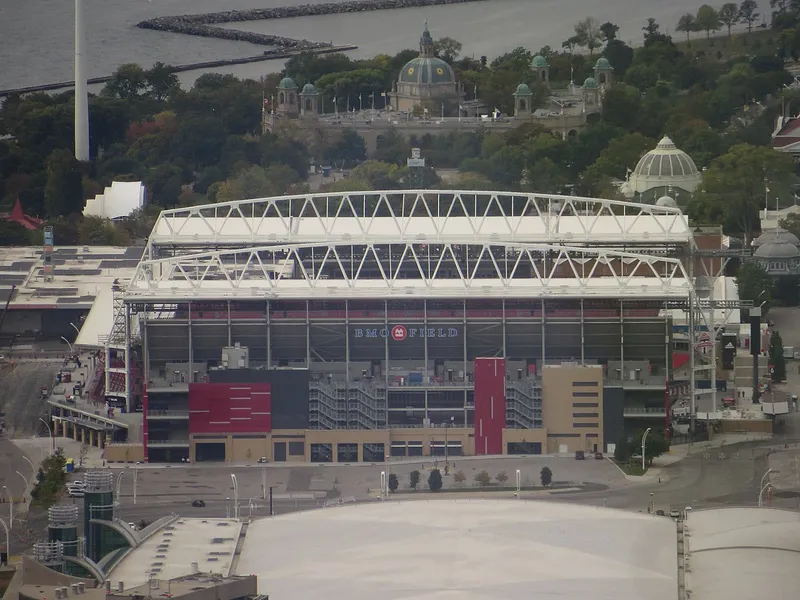
BMO Field will be one of Canada’s two host venues at the FIFA World Cup 2026, staging six matches in Toronto, Ontario, including Canada’s opening game and a Round of 32 knockout fixture.
During the tournament, the venue will be called Toronto Stadium because FIFA uses neutral venue names and removes commercial branding from World Cup stadiums. But to Canadian football fans, this is BMO Field: the home of Toronto FC, the Toronto Argonauts and the Canada men’s national team.
Opened in 2007, BMO Field was Canada’s first soccer-specific stadium. It began as a modest 20,000-seat venue but has grown into a major multi-sport stadium on Toronto’s Lake Ontario waterfront.
For World Cup 2026, the stadium is undergoing a major expansion that will raise tournament capacity to 45,736. That transformation will allow Toronto to host the first men’s FIFA World Cup match ever played on Canadian soil.
The venue’s match list gives it strong African relevance. Ghana, Ivory Coast and Senegal are all scheduled to play in Toronto, making BMO Field one of the most important venues for African fans during the tournament.
Quick Facts About BMO Field
| Fact | Detail |
|---|---|
| Stadium name | BMO Field |
| FIFA World Cup name | Toronto Stadium |
| Location | Toronto, Ontario, Canada |
| Address | 170 Princes’ Boulevard, Toronto, ON M6K 3C3 |
| Standard capacity | 30,000 |
| World Cup capacity | 45,736 |
| Opened | 2007 |
| Roof | Partial canopy |
| Surface | SISGrass hybrid, mostly natural grass |
| Main tenants | Toronto FC, Toronto Argonauts, Canada men’s national team |
| Competition focus | FIFA World Cup 2026 |
| World Cup matches | 6 matches |
| Biggest match | Canada’s opening match |
| First World Cup match | June 12, 2026 |
| Known for | Toronto FC supporters, Canada national team, waterfront location and multicultural atmosphere |
Where Is BMO Field?
BMO Field is located at Exhibition Place on Toronto’s waterfront, just west of downtown. The stadium sits near Lake Ontario, close to the CN Tower, Rogers Centre, Harbourfront, Liberty Village and the Entertainment District.
The location is one of BMO Field’s biggest advantages. Unlike many North American stadiums built in distant suburbs, this venue is close to the centre of one of the world’s most multicultural cities.
Fans can reach the stadium by GO Train, TTC streetcar, bus, walking routes, rideshare or car. Exhibition Station sits near the venue, giving matchgoers a fast rail connection from Union Station.
For World Cup visitors, BMO Field is one of the more convenient stadiums in the tournament. Fans staying downtown can reach it quickly, and those arriving through Toronto Pearson International Airport can connect via rail through Union Station.
History of BMO Field
BMO Field opened on April 28, 2007, as the home of Toronto FC, Canada’s first Major League Soccer club.
The stadium was built on the Exhibition Place grounds, a historic sports and events site that had already hosted several previous stadiums. BMO Field became the fifth stadium built on that same site.
Its early years were closely tied to the birth of modern Canadian soccer culture. Toronto FC struggled on the pitch, but supporters built one of the most passionate fan bases in Major League Soccer. The South End became known for drums, chants, flags and an atmosphere that helped change expectations for soccer support in North America.
BMO Field also hosted matches at the 2007 FIFA U-20 World Cup, including the final. That tournament helped establish the stadium as an international football venue.
Over time, the stadium expanded, added a canopy, improved facilities and became home to the Toronto Argonauts of the Canadian Football League.
Construction and Design
BMO Field was designed by Brisbin Brooks Beynon Architects, with engineering by Halcrow Yolles and construction by PCL Construction.
The original venue cost CAD$62.9 million and was built as a soccer-specific stadium. That was important because Canada did not previously have a modern national soccer home of this type.
The design was simple, open and intimate. Fans were close to the pitch, and the stadium quickly developed a strong supporter culture.
A major expansion between 2014 and 2016 changed the venue significantly. It added more seats, improved suites and clubs, extended the field for Canadian football and installed a partial canopy over the east, west and south stands.
That canopy helped modernise the stadium while keeping its open-air feel.
For World Cup 2026, another transformation is underway, adding temporary seats, new video boards, upgraded lighting, improved broadcast systems, modern player areas and a FIFA-standard pitch.
BMO Field and World Cup 2026
BMO Field will host six FIFA World Cup 2026 matches.
The schedule includes five group-stage games and one Round of 32 fixture. The first match at the venue will be Canada vs Bosnia and Herzegovina on June 12, 2026.
That match will be historic. It will be the first men’s FIFA World Cup match ever played in Canada. It will also be Canada’s opening match in a home World Cup, giving Toronto one of the most emotional fixtures of the group stage.
The venue will be temporarily called Toronto Stadium during the tournament. That name will be used in FIFA broadcasts, signage, tickets and official material.
Toronto will host matches from June 12 to July 2, ending with a Round of 32 match.
World Cup 2026 Matches at BMO Field
| Date | Match |
| June 12, 2026 | Canada vs Bosnia and Herzegovina |
| June 17, 2026 | Ghana vs Panama |
| June 20, 2026 | Germany vs Ivory Coast |
| June 23, 2026 | Panama vs Croatia |
| June 26, 2026 | Senegal vs FIFA Playoff Winner 2 |
| July 2, 2026 | Round of 32 |
This schedule gives BMO Field one of the strongest African storylines in the tournament. Ghana, Ivory Coast and Senegal will all play in Toronto.
For Kenyan readers and African football fans, Toronto Stadium will be a major venue to follow. Ghana vs Panama, Germany vs Ivory Coast and Senegal’s group-stage match could all shape African progress in the tournament.
Canada’s opening game will be the national headline, but the African fixtures give BMO Field wider global relevance.
Why BMO Field Was Chosen for Canada’s Opening Match
BMO Field was chosen for Canada’s opening match because it is the country’s most important soccer-specific stadium and the spiritual home of the modern Canadian men’s national team.
The stadium has hosted many of Canada’s biggest qualifying moments. On March 27, 2022, Canada beat Jamaica 4-0 at BMO Field to qualify for the FIFA World Cup for the first time in 36 years.
That moment turned the stadium into a symbol of Canada’s football rise. Hosting Canada’s first home World Cup match there gives the story a natural continuation.
Toronto also offers FIFA a huge international city, strong transport links, major hotels, global communities and a proven sports-event market.
Canada’s opening match at BMO Field will be more than a fixture. It will be a national celebration.
BMO Field Expansion for World Cup 2026
BMO Field’s standard capacity is around 30,000, which is too small for the men’s World Cup.
To meet FIFA requirements, the stadium is being expanded to 45,736 seats for the tournament. Temporary grandstands are being added at the north and south ends, while permanent upgrades are improving the stadium for future use.
The renovation includes new LED video boards, better lighting, upgraded sound systems, stronger Wi-Fi, improved broadcast facilities, new hospitality areas, expanded locker rooms and a new playing surface.
This expansion is one of the most important World Cup infrastructure projects in Canada. It allows Toronto to host six matches while leaving behind improvements that will benefit Toronto FC, the Argonauts and future national-team matches.
SISGrass Hybrid Pitch
BMO Field uses a SISGrass hybrid surface.
This system is mostly natural grass, reinforced with synthetic fibres stitched into the pitch. The reinforcement helps the surface recover more quickly and stay stable under heavy use.
That is important because BMO Field serves multiple tenants, including Toronto FC and the Toronto Argonauts. Soccer and Canadian football place different stresses on the surface.
The stadium originally opened with artificial turf, but players and supporters criticised it. Natural grass was installed before the 2010 season, improving the football experience.
For World Cup 2026, the pitch must meet FIFA standards for ball movement, footing, drainage and player safety. A strong surface will be especially important because the stadium will host six matches in a short tournament window.
Toronto Weather and Match Conditions
Toronto in June and early July is usually warm and comfortable, though humidity and rain are possible.
Daytime temperatures can be pleasant, and evening matches often offer good conditions for football. The stadium’s waterfront location may bring breezes from Lake Ontario, especially later in the day.
BMO Field is open-air with a partial canopy. Many fans will have some protection, but not every seat will be covered, especially with temporary World Cup seating.
Fans should prepare for sun, rain or cooler evening air. Light layers and weather awareness will help.
For players, Toronto’s conditions should be more manageable than extreme-heat venues in parts of Mexico and the southern United States.
Toronto’s Multicultural Football Atmosphere
Toronto is one of the most multicultural cities in the world, and that will shape BMO Field’s World Cup atmosphere.
The city has large communities connected to many competing nations. That means group-stage matches may feel like home games for both sides.
Ghanaian, Ivorian, Senegalese, Panamanian, Croatian, German, Bosnian and other communities all have roots in the Toronto region. Fans from across Canada will also travel to see the national team.
This makes BMO Field different from venues where organisers need to build atmosphere from scratch. Toronto already has the communities, football interest and supporter culture to make every match feel alive.
For African teams, this could be important. Ghana, Ivory Coast and Senegal are likely to find real support in the city.
Toronto FC and Supporter Culture
BMO Field is central to Toronto FC’s identity.
When the club joined MLS in 2007, it quickly built one of the league’s strongest supporter cultures despite poor early results. Groups in the South End brought songs, drums, banners and energy that helped reshape North American soccer culture.
That passion reached a peak in 2017 when Toronto FC won the MLS Cup at BMO Field, completing a historic domestic treble.
The stadium also became a fortress for Canada’s men’s national team during World Cup qualifying. Cold-weather matches, loud support and a growing national-team identity made the venue a key part of Canada’s football rise.
World Cup 2026 will bring that local soccer culture to a global audience.
Major Events Hosted at BMO Field
BMO Field has hosted major soccer, Canadian football and international events since opening.
It staged matches at the 2007 FIFA U-20 World Cup, including the final won by Argentina. It has also hosted CONCACAF Gold Cup matches, Canada national-team fixtures and Toronto FC finals.
The stadium hosted the 2016 MLS Cup Final and the 2017 MLS Cup Final, with Toronto FC winning the latter against the Seattle Sounders.
The Toronto Argonauts also use the venue, and the stadium has hosted Grey Cup events after its expansion for Canadian football.
These events helped prove BMO Field can operate at a high level, even before its World Cup expansion.
Transport and Fan Access
BMO Field has strong public transport access.
The GO Train from Union Station to Exhibition Station is one of the fastest ways to reach the stadium. The ride takes only a few minutes, and the station is close to the venue.
TTC streetcars also serve Exhibition Place. The 509 Harbourfront streetcar runs from Union Station, while the 511 Bathurst streetcar connects from Bathurst Station. The 29 Dufferin bus also serves the area.
For World Cup matches, public transport will be strongly recommended. Driving will be difficult because of traffic, parking demand and other events around Exhibition Place.
Fans should arrive early, especially for Canada’s opening match and the Round of 32 fixture.
Driving and Parking
Driving to BMO Field is possible, but it will not be the best option for many World Cup fans.
The stadium sits near the Gardiner Expressway and Lake Shore Boulevard, which can become congested during major events. Exhibition Place has parking, but spaces are limited compared with demand for a World Cup match.
Parking should be pre-planned and pre-paid where possible. Fans should not assume they can arrive close to kickoff and easily find space.
Because Toronto has strong transit links to the stadium, many visitors will be better served by rail, streetcar or walking routes from downtown.
For World Cup 2026, driving should be treated as a backup option rather than the main plan.
Airport Access
Toronto Pearson International Airport will be the main arrival point for international World Cup visitors.
The UP Express train connects Pearson Airport to Union Station in downtown Toronto. From there, fans can take the GO Train to Exhibition Station or use TTC streetcars to reach BMO Field.
This gives Toronto one of the more practical airport-to-stadium routes in the tournament, even though a transfer is required.
Billy Bishop Toronto City Airport is much closer to the stadium but handles smaller regional flights. It may be useful for visitors arriving from nearby Canadian or U.S. cities.
Fans arriving on match day should still allow generous time for immigration, luggage, transport, security screening and crowd movement.
Walking from Downtown
One of BMO Field’s best features is that it is walkable from parts of downtown Toronto.
Fans staying near the Entertainment District, CN Tower, Rogers Centre, Harbourfront or Liberty Village can walk to the stadium in around 25 to 30 minutes.
The waterfront route is especially attractive in good weather, with views of Lake Ontario and the city skyline. For summer World Cup matches, that walk could become part of the match-day experience.
Walking also helps fans avoid crowded trains or traffic after the match. Many supporters may choose to walk back toward downtown restaurants, hotels and gathering areas.
Nearby Attractions
BMO Field’s location gives World Cup visitors access to several major Toronto attractions.
The CN Tower is one of Canada’s most recognisable landmarks and is visible from parts of the stadium. Rogers Centre, home of the Toronto Blue Jays, sits nearby and may offer baseball options for fans staying longer.
Ripley’s Aquarium of Canada, Harbourfront Centre, Trillium Park and the Toronto Islands are also close. Liberty Village offers restaurants, bars and pre-match gathering spots.
For food, culture and nightlife, downtown Toronto gives visitors many options before and after matches.
This makes BMO Field one of the tournament’s most visitor-friendly venues.
What Fans Should Know Before Visiting
Fans attending World Cup matches at BMO Field should plan for crowds, transit pressure and security screening.
Public transport is the best option for most visitors. The GO Train, TTC streetcars and buses connect the stadium to downtown and other parts of the city.
Arriving early is important, especially for Canada’s opening match. FIFA security checks can take time, and the expanded stadium layout may create new crowd-flow patterns.
The stadium is open-air with partial cover. Fans should check the weather and prepare for sun, rain or cooler evening conditions.
For matches involving Ghana, Ivory Coast and Senegal, expect passionate communities to create strong African support in the stands.
Why BMO Field Matters to African Fans
BMO Field will be one of the most important World Cup 2026 venues for African fans.
Ghana will face Panama in Toronto on June 17. Ivory Coast will play Germany on June 20. Senegal will play its final listed group-stage match at the venue on June 26.
That gives Toronto direct connections to West African football and continental World Cup storylines.
Ghana, Ivory Coast and Senegal all carry major African football history. Each team has passionate supporters, strong diaspora communities and the ability to produce tournament-defining moments.
For Kenyan readers, BMO Field should be followed closely because African teams could shape the group-stage picture there. If one of those teams advances, Toronto may become part of a major African World Cup story.
Why BMO Field Is Important
BMO Field is important because it gives Canada its first men’s World Cup stage.
The stadium began as Canada’s first soccer-specific venue and grew alongside Toronto FC, Canadian supporter culture and the national team’s rise. In 2026, it will host the country’s opening match at a home World Cup.
That makes the venue symbolic as well as practical.
The expansion to 45,736 seats shows how far the stadium has come. The match schedule gives it Canadian, African and global relevance. The Round of 32 fixture ensures Toronto remains part of the tournament beyond the group stage.
BMO Field may not be the largest World Cup venue, but it will be one of the most meaningful for Canadian football.
Key Takeaways
- BMO Field is located at Exhibition Place in Toronto.
- It will be called Toronto Stadium during FIFA World Cup 2026.
- The stadium opened in 2007.
- It has a standard capacity of 30,000.
- World Cup capacity will rise to 45,736.
- It is home to Toronto FC, the Toronto Argonauts and Canada’s men’s national team.
- The venue uses a SISGrass hybrid surface.
- BMO Field will host six World Cup 2026 matches.
- Canada’s opening match will be played there on June 12, 2026.
- The stadium will host a Round of 32 match on July 2, 2026.
- Ghana, Ivory Coast and Senegal will all play in Toronto.
- Public transport is strongly recommended for match days.
Frequently Asked Questions
Where is BMO Field located?
BMO Field is located at 170 Princes’ Boulevard at Exhibition Place in Toronto, Ontario, near the Lake Ontario waterfront.
What will BMO Field be called during World Cup 2026?
During the tournament, BMO Field will be called Toronto Stadium because FIFA uses neutral venue names.
What is BMO Field’s capacity?
BMO Field has a standard capacity of about 30,000, but it will expand to 45,736 for FIFA World Cup 2026.
When did BMO Field open?
BMO Field opened on April 28, 2007.
Which teams play at BMO Field?
The stadium is home to Toronto FC, the Toronto Argonauts and the Canada men’s national team.
How many World Cup 2026 matches will BMO Field host?
BMO Field will host six matches during FIFA World Cup 2026.
What is the first World Cup match at BMO Field?
Canada will play Bosnia and Herzegovina at BMO Field on June 12, 2026.
Will BMO Field host a World Cup knockout match?
Yes. BMO Field will host a Round of 32 match on July 2, 2026.
What African teams will play at BMO Field?
Ghana, Ivory Coast and Senegal are scheduled to play group-stage matches at BMO Field.
Is BMO Field easy to reach by public transport?
Yes. Fans can use GO Train service to Exhibition Station, TTC streetcars to Exhibition Loop and several bus routes serving Exhibition Place.
Conclusion
BMO Field will be one of the most meaningful venues at the FIFA World Cup 2026. It will host Canada’s first men’s World Cup match on home soil, five group-stage games and a Round of 32 fixture in Toronto.
The stadium’s expansion to 45,736 seats marks a major step for Canadian soccer infrastructure. Its location at Exhibition Place, strong transit links and waterfront setting make it one of the most accessible venues in the tournament.
For African fans, BMO Field will be especially important because Ghana, Ivory Coast and Senegal all play there. Those matches could shape Africa’s group-stage story in Canada.
On June 12, 2026, BMO Field will become the centre of Canadian football history. Toronto Stadium will not be the biggest venue in the World Cup, but it may be one of the most emotional.
Read Also: Estadio Akron World Cup 2026 Guide: Capacity, Location, Matches and Group-Stage Venue