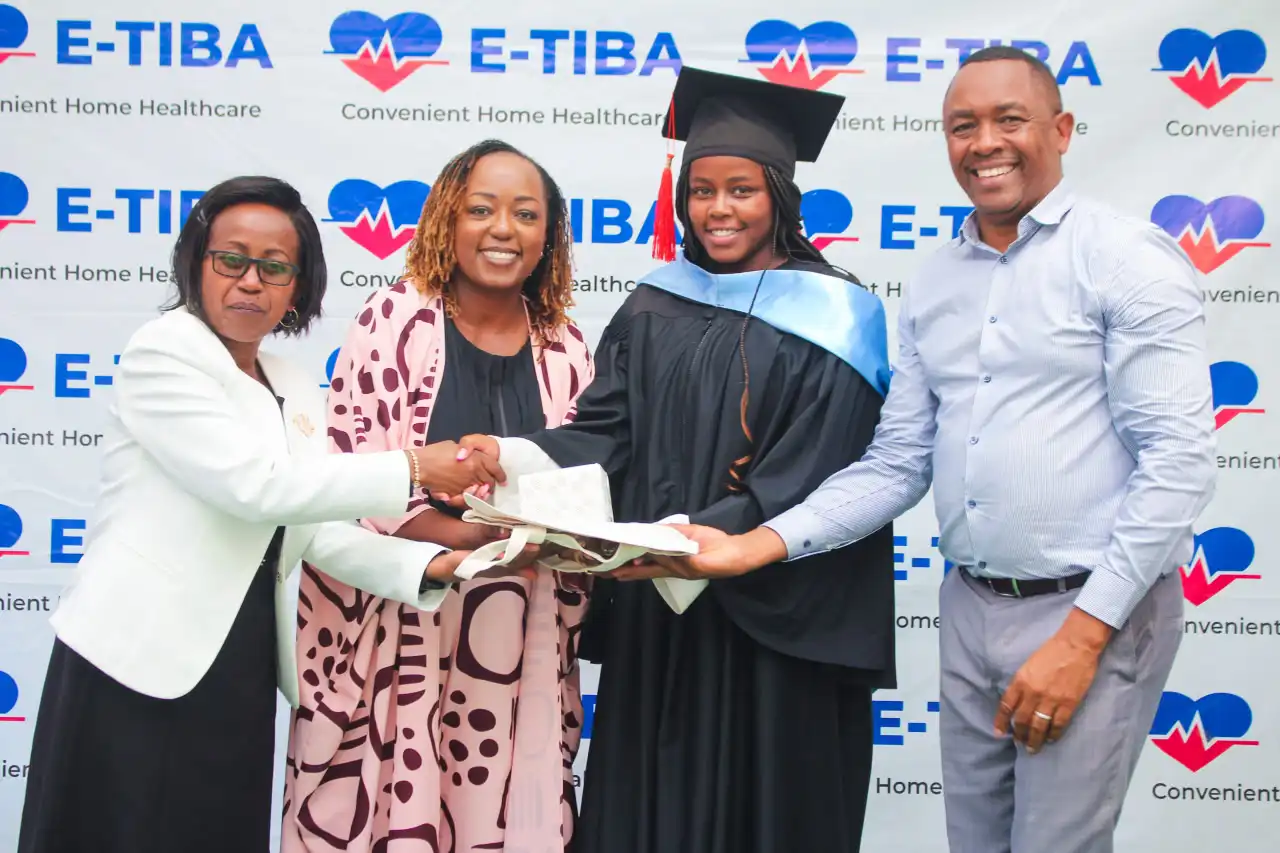
E-tiba funding highlights the growth of a Kenyan healthtech company focused on making home healthcare easier to access. Founded in Nairobi in 2018, E-tiba connects patients to caregivers through digital channels, including USSD, mobile app, and web-based access.
The company operates in home care, health and medical services, patient care, and digital healthcare. Its business model is built around a practical need: many families require reliable care for older relatives, patients recovering from illness, people with disabilities, and individuals who need regular medical support at home.
E-tiba describes itself as a convenient home healthcare platform. Public company information states that it connects patients with caregivers through USSD code, mobile app, and web access. Its website also presents E-tiba as a provider of home-based care services, including nursing support, therapy, general health procedures, medical equipment, and specialized care.
For Kenya’s healthtech market, E-tiba is part of a wider shift toward decentralized care. Instead of treating hospitals and clinics as the only access points, platforms like E-tiba are trying to bring qualified caregivers closer to patients at home.
What Is E-tiba?
E-tiba is a Nairobi-based digital health platform founded in 2018. It connects patients to caregivers using mobile and web-based technology.
The company’s model combines healthcare access, home-based services, caregiver matching, and digital booking. Its public profiles describe it as a medical digital platform that connects patients to caregivers via USSD code, mobile application, and web approach.
E-tiba’s home-based care services include support for patients who need care outside hospital settings. Its website highlights services such as HIV home-based care, therapy, general health procedures, and medical equipment support.
| Category | Role in E-tiba’s Model |
|---|---|
| Home Care | Provides healthcare services in the patient’s home. |
| Health/Medical | Operates in healthcare delivery and patient support. |
| Patient Care | Focuses on direct support for individuals and families. |
| Digital Health | Uses USSD, mobile, and web tools to connect patients and caregivers. |
| Caregiver Marketplace | Helps patients find professional care providers. |
E-tiba’s approach is especially relevant in markets where families may struggle to find trusted caregivers quickly. By using technology, the platform can help reduce the friction involved in locating, booking, and coordinating home healthcare.
Why E-tiba Funding Matters
E-tiba funding matters because home healthcare is becoming more important in Kenya and across Africa. As populations grow, urban households become busier, and healthcare costs rise, many families need alternatives to long hospital stays.
Home-based care can help patients recover in familiar surroundings while reducing the pressure on hospitals. It can also support older people, people with chronic conditions, and patients who need regular check-ins or procedures.
The need is practical. A family may need a nurse for wound care, a therapist after an injury, a caregiver for an elderly relative, or medical support for a patient who cannot easily travel. Without a reliable platform, finding the right caregiver can be stressful and risky.
E-tiba’s model addresses that gap by using technology to connect patients with care providers. Its use of USSD is especially important because not every patient or family member has a smartphone or stable internet access. A platform that works through mobile, web, and USSD can reach a wider audience.
Funding helps E-tiba build that access layer, improve its technology, train or onboard caregivers, expand services, and reach more families.
Full List of E-tiba Funding Rounds
E-tiba has attracted support from incubation, banking, venture, and innovation ecosystem partners. Some funding rounds are listed without disclosed amounts.
| Investor or Partner | Announced Date | Amount | Funding Type | Strategic Value |
| Strathmore Incubation Centre, @iBizAfrica | Nov 2025 | Undisclosed | Seed | Provides incubation, mentorship, ecosystem access, and early-stage support. |
| Standard Chartered Kenya | Nov 2025 | Undisclosed | Seed | Adds financial-sector credibility and startup support. |
| SC Ventures by Standard Chartered | Nov 2025 | Undisclosed | Grant | Supports innovation and digital business growth. |
| Standard Chartered | Nov 2025 | Undisclosed | Grant | Provides institutional support for early-stage development. |
| TechBridgeHub | Jan 2022 | $100k | Pre-seed | Supports early product development and market validation. |
The funding record shows a young company still in the early capital-building stage. E-tiba’s largest disclosed amount is the $100,000 pre-seed funding linked to TechBridgeHub in January 2022.
E-tiba Funding Timeline
2018: Founded in Nairobi
E-tiba was founded in Nairobi in 2018. Its founding period is important because Kenya’s digital health market was beginning to attract more attention from entrepreneurs, hospitals, insurers, and technology platforms.
The company entered the market with a clear problem to solve: patients needed easier access to caregivers, and caregivers needed better ways to connect with families looking for home-based services.
2022: TechBridgeHub Pre-Seed Support
In January 2022, E-tiba received $100,000 in pre-seed funding from TechBridgeHub. This funding likely supported early product development, customer validation, and service expansion.
For a home healthcare platform, pre-seed funding can be especially important. The company must build technology, onboard caregivers, develop trust, manage quality control, and reach patients. Unlike a simple consumer app, healthcare platforms must balance growth with safety, reliability, and service quality.
2025: Standard Chartered and iBizAfrica Support
In November 2025, E-tiba received listed support from Strathmore Incubation Centre, @iBizAfrica, Standard Chartered Kenya, SC Ventures by Standard Chartered, and Standard Chartered.
This support strengthened the company’s startup ecosystem backing. Strathmore’s @iBizAfrica is known as an entrepreneurship and innovation hub, while Standard Chartered and SC Ventures bring financial-sector visibility and innovation network access.
For E-tiba, this type of support can be useful beyond funding. Healthcare startups often need mentorship, partnerships, compliance guidance, market exposure, and business development networks.
Biggest E-tiba Funding Rounds by Known Value
Only one disclosed amount appears in the available funding history.
| Rank | Investor or Partner | Date | Amount | Funding Type |
| 1 | TechBridgeHub | Jan 2022 | $100k | Pre-seed |
| 2 | Strathmore Incubation Centre, @iBizAfrica | Nov 2025 | Undisclosed | Seed |
| 3 | Standard Chartered Kenya | Nov 2025 | Undisclosed | Seed |
| 4 | SC Ventures by Standard Chartered | Nov 2025 | Undisclosed | Grant |
| 5 | Standard Chartered | Nov 2025 | Undisclosed | Grant |
The known funding record suggests that E-tiba is still in an early stage of business development. Its strategic challenge is to turn early support into a scalable healthcare service model.
Most Common Funding Categories
E-tiba’s funding categories show a mix of startup support and early financing.
| Funding Category | Role in E-tiba’s Growth |
| Pre-seed | Supports early product development and validation. |
| Seed | Helps build operations, partnerships, and growth capacity. |
| Grant | Provides non-dilutive support for innovation and market development. |
| Incubation Support | Offers mentorship, business development, and startup ecosystem access. |
This mix is common for early-stage healthtech companies. Healthcare platforms often need patient trust, caregiver networks, operational systems, and partnerships before they can scale commercially.
Strategic Lessons From E-tiba Funding
Healthcare Access Must Meet Patients Where They Are
E-tiba’s use of USSD, mobile app, and web access is strategically important. A digital health company in Kenya cannot assume every user has the same device, internet connection, or level of digital literacy.
USSD can help reach people who use basic mobile phones. Mobile apps can serve smartphone users. Web access can support families, institutions, and caregivers who prefer browser-based interaction.
This multi-channel model improves accessibility.
Home-Based Care Solves a Real Family Problem
E-tiba is not solving an abstract technology problem. It is addressing a daily healthcare need for families.
Many households need caregivers for elderly relatives, patients recovering after hospital discharge, people living with chronic conditions, or patients needing therapy. Finding reliable care can be difficult, especially when families do not know whom to trust.
A platform that helps identify and coordinate caregivers can reduce stress and improve continuity of care.
Trust Is the Core Product
In healthcare, trust is as important as technology. Patients and families need confidence that caregivers are qualified, reliable, and compassionate.
E-tiba’s long-term success will depend on how well it manages caregiver quality, patient safety, service consistency, and response time.
How E-tiba Funding Fits Its Business Model
E-tiba funding fits directly into the company’s business model because home healthcare platforms require both digital and physical execution.
The digital side includes mobile access, USSD systems, web tools, booking workflows, patient records, communication, and possibly payments. The physical side includes caregiver onboarding, service delivery, patient visits, quality assurance, and customer support.
Funding helps connect these two sides.
A platform like E-tiba cannot scale only by building an app. It must also ensure that trained caregivers are available, patients are matched appropriately, services are delivered reliably, and families feel safe using the platform.
This makes E-tiba a hybrid business. It is partly a digital health platform and partly a healthcare operations company.
Financial and Ownership Context
E-tiba’s available funding profile is early-stage. The company has listed pre-seed funding, seed support, grants, and incubation support. The only disclosed cash amount in the available history is $100,000 from TechBridgeHub.
The company’s later support from Standard Chartered-linked entities and Strathmore Incubation Centre, @iBizAfrica suggests growing ecosystem recognition. However, because most amounts are undisclosed, it is important not to overstate the company’s financial scale.
E-tiba should be viewed as an emerging healthtech company rather than a mature healthcare corporation. Its future growth will depend on patient adoption, caregiver supply, service quality, partnerships, and funding access.
Competitive Impact of E-tiba Funding
E-tiba funding can strengthen the company’s competitive position in Kenya’s home healthcare market.
First, funding supports technology development. A smooth booking process, reliable caregiver profiles, and accessible communication channels can improve patient experience.
Second, funding can help E-tiba onboard more caregivers. A home care platform becomes more useful when patients can find qualified care providers in their area.
Third, ecosystem partners can improve credibility. Support from recognizable institutions can help build trust with families, healthcare workers, and potential partners.
Fourth, funding can help E-tiba expand service categories. Home care can include nursing, therapy, general procedures, chronic care support, post-hospital care, and medical equipment services.
However, competition may come from hospitals, clinics, traditional home care agencies, informal caregivers, and other digital health platforms. E-tiba must prove that its platform offers safety, convenience, and value.
Advantages of the Funding Strategy
Stronger Technology Development
Pre-seed and seed support can help E-tiba improve its USSD, mobile, and web systems. Better technology can make booking and coordination easier for patients and caregivers.
Wider Caregiver Network
Funding can support caregiver onboarding, verification, training, and management. This is essential for quality and trust.
Improved Market Credibility
Support from institutions such as Standard Chartered and Strathmore’s @iBizAfrica can help E-tiba gain visibility and confidence in the market.
Better Access for Patients
By supporting USSD, mobile, and web access, E-tiba can serve different patient groups, including those with limited internet access.
Potential for Partnerships
Healthcare startups often grow through partnerships with hospitals, insurers, employers, NGOs, and county health systems. Funding and incubation support can help open those doors.
Disadvantages of the Funding Strategy
Limited Disclosed Capital
The available funding record shows only one disclosed amount. If funding remains limited, growth may be slower than competitors with larger capital bases.
Healthcare Quality Risk
If caregiver quality is inconsistent, patient trust can be damaged. Healthtech companies must manage safety and service quality carefully.
Operational Complexity
Home healthcare is operationally demanding. Scheduling, travel, patient needs, caregiver availability, and emergency situations can make service delivery difficult.
Regulatory and Compliance Requirements
Healthcare services are sensitive and regulated. E-tiba must pay attention to licensing, caregiver qualifications, patient privacy, and medical safety.
Trust Barrier
Families may hesitate to invite caregivers into their homes unless the platform provides strong verification, transparency, and accountability.
Case Studies of Major E-tiba Funding Rounds
TechBridgeHub Pre-Seed Funding
The $100,000 pre-seed funding from TechBridgeHub was the most clearly disclosed early capital in E-tiba’s funding history. This support likely helped the company move from idea and early operations into stronger product validation.
For a home healthcare startup, pre-seed funding can be used to test whether patients will use the platform, whether caregivers will join it, and whether the service model works in real-life conditions.
Standard Chartered Kenya Seed Support
Standard Chartered Kenya’s listed seed support in November 2025 gave E-tiba additional institutional recognition. Bank-linked startup support can help young companies improve governance, financial planning, and business development.
For E-tiba, this type of backing could be useful as the company works to build trust in a sensitive sector.
SC Ventures Grant Support
SC Ventures by Standard Chartered is linked to grant support for E-tiba. Grant funding can be valuable because it may support innovation without adding immediate repayment pressure.
For healthtech startups, grants can help fund product development, market testing, training, and service improvements.
Strathmore Incubation Centre, @iBizAfrica
Strathmore’s @iBizAfrica support gives E-tiba access to a recognized Kenyan innovation ecosystem. Incubation support can help founders refine business models, connect with mentors, prepare for investors, and improve operational structure.
For early-stage healthcare companies, this kind of ecosystem support can be as important as money.
Common Mistakes When Analyzing E-tiba Funding
Treating E-tiba as Only an App
E-tiba is not just an app. It is a digital healthcare platform that must coordinate real caregivers, real patients, and real medical needs.
Ignoring USSD Access
USSD matters because it expands access beyond smartphone users. In healthtech, accessibility can determine whether a platform reaches underserved users.
Overlooking Caregiver Quality
A home healthcare platform is only as strong as its caregivers. Verification, training, supervision, and accountability are critical.
Assuming Funding Equals Scale
Early funding does not automatically mean national scale. E-tiba must still grow its caregiver network, serve more patients, and prove repeat demand.
Underestimating Trust
Healthcare decisions are personal. Families must trust the platform before they allow caregivers into their homes.
Lessons for Business Owners and Investors
E-tiba offers several useful lessons for founders, investors, and healthcare operators.
First, strong startups solve practical problems. E-tiba focuses on the real difficulty families face when looking for reliable home care.
Second, access channels matter. By using USSD, mobile app, and web access, E-tiba can serve a broader market than a smartphone-only platform.
Third, healthcare technology must be matched with operational excellence. The best digital interface will fail if care delivery is poor.
Fourth, trust is the foundation of healthcare growth. Every caregiver interaction affects the brand.
Finally, early-stage funding is useful when it helps a company validate the model, improve quality, and build partnerships.
Key Takeaways
- E-tiba is a Nairobi-based healthtech company founded in 2018.
- The company provides convenient home healthcare services.
- E-tiba connects patients to caregivers through USSD, mobile app, and web access.
- Its sectors include home care, health and medical services, and patient care.
- E-tiba’s services include home-based care, therapy, general health procedures, and medical equipment support.
- The company received $100,000 in pre-seed funding from TechBridgeHub in January 2022.
- E-tiba later received listed support from Standard Chartered-linked entities and Strathmore’s @iBizAfrica in November 2025.
- Its business model depends on trust, caregiver quality, accessibility, and operational reliability.
- USSD access gives E-tiba a broader reach than app-only health platforms.
- The company’s main risks include limited disclosed capital, regulatory requirements, service quality, and patient trust.
- E-tiba funding reflects growing interest in home-based healthcare and digital health access in Kenya.
Frequently Asked Questions
What is E-tiba?
E-tiba is a Nairobi-based digital health platform that connects patients to caregivers for convenient home healthcare services.
What does E-tiba do?
E-tiba helps patients access caregivers through USSD, mobile app, and web-based platforms.
When was E-tiba founded?
E-tiba was founded in 2018.
Where is E-tiba based?
E-tiba is based in Nairobi, Kenya.
What is E-tiba funding?
E-tiba funding refers to the company’s pre-seed, seed, grant, and incubation support from investors and ecosystem partners.
How much funding has E-tiba raised?
The largest disclosed amount in the available funding history is $100,000 in pre-seed funding from TechBridgeHub in January 2022.
Who has supported E-tiba?
E-tiba has received listed support from TechBridgeHub, Strathmore Incubation Centre @iBizAfrica, Standard Chartered Kenya, SC Ventures by Standard Chartered, and Standard Chartered.
What services does E-tiba offer?
E-tiba offers home-based care services, including nursing support, therapy, general health procedures, medical equipment support, and specialized care.
Why is E-tiba important?
E-tiba is important because it helps families access home healthcare more conveniently through digital and mobile channels.
Is E-tiba only available through a smartphone app?
No. E-tiba is described as using USSD code, mobile app, and web access, which can help serve users with different levels of digital access.
What risks does E-tiba face?
E-tiba faces risks related to caregiver quality, healthcare regulation, patient trust, operational complexity, and limited disclosed funding.
Conclusion
E-tiba funding shows how an emerging Kenyan healthtech company is trying to make home healthcare more convenient, accessible, and digitally coordinated. Founded in Nairobi in 2018, E-tiba connects patients to caregivers through USSD, mobile app, and web-based access.
The company’s model addresses a real family need. Many patients require care at home, whether because of age, disability, illness, recovery, or chronic conditions. E-tiba’s platform aims to make that care easier to find and manage.
Its funding history remains early-stage, with $100,000 in disclosed pre-seed funding from TechBridgeHub and later listed support from Standard Chartered-linked entities and Strathmore’s @iBizAfrica. That support gives the company a foundation, but long-term success will depend on execution.
For E-tiba, the challenge is not only to build technology. It must build trust, verify caregivers, maintain quality, protect patients, and create a reliable healthcare experience. If it succeeds, E-tiba could become an important part of Kenya’s growing home-based care and digital health ecosystem.
E-tiba funding is therefore more than a startup capital story. It is a signal of how healthcare delivery in Kenya is gradually moving beyond hospital walls and into more flexible, patient-centered models.
Disclaimer: This article is for informational and educational purposes only. It is not investment advice, financial advice, or a recommendation to buy or sell any security. Always conduct your own research and consider speaking with a qualified financial adviser before making investment decisions.
Read Also: Lami InsurTech Funding: How the Kenyan Startup Is Building Insurance Infrastructure for Africa