Burma is home to ethnic Burmans and scores of other ethnic and religious minority groups that have resisted external efforts to consolidate control of the country throughout its history. Britain conquered Burma over a period extending from the 1820s to the 1880s and administered it as a province of India until 1937, when Burma became a self-governing colony. Burma gained full independence in 1948. In 1962, General NE WIN seized power and ruled the country until 1988 when a new military regime took control.
In 1990, the military regime permitted an election but then rejected the results after the main opposition National League for Democracy (NLD) and its leader AUNG SAN SUU KYI (ASSK) won in a landslide. The military regime placed ASSK under house arrest until 2010. In 2007, rising fuel prices in Burma led pro-democracy activists and Buddhist monks to launch a “Saffron Revolution” consisting of large protests against the regime, which violently suppressed the movement. The regime prevented new elections until it had drafted a constitution designed to preserve the military’s political control; it passed the new constitution in its 2008 referendum. The regime conducted an election in 2010, but the NLD boycotted the vote, and the military’s political proxy, the Union Solidarity and Development Party, easily won; international observers denounced the election as flawed.
Burma nonetheless began a halting process of political and economic reforms. ASSK’s return to government in 2012 eventually led to the NLD’s sweeping victory in the 2015 election. With ASSK as the de facto head of state, Burma’s first credibly elected civilian government drew international criticism for blocking investigations into Burma’s military operations — which the US Department of State determined constituted genocide — against its ethnic Rohingya population. When the 2020 elections resulted in further NLD gains, the military denounced the vote as fraudulent. In 2021, the military’s senior leader General MIN AUNG HLAING launched a coup that returned Burma to authoritarian rule, with military crackdowns that undid reforms and resulted in the detention of ASSK and thousands of pro-democracy actors.
Pro-democracy organizations have formed in the wake of the coup, including the National Unity Government (NUG). Members of the NUG include representatives from the NLD, ethnic minority groups, and civil society. In 2021, the NUG announced the formation of armed militias called the People’s Defense Forces (PDF) and an insurgency against the military junta. As of 2024, PDF units across the country continued to fight the regime with varying levels of support from and cooperation with the NUG and other anti-regime organizations, including armed ethnic groups that have been fighting the central government for decades.
Geography
Location
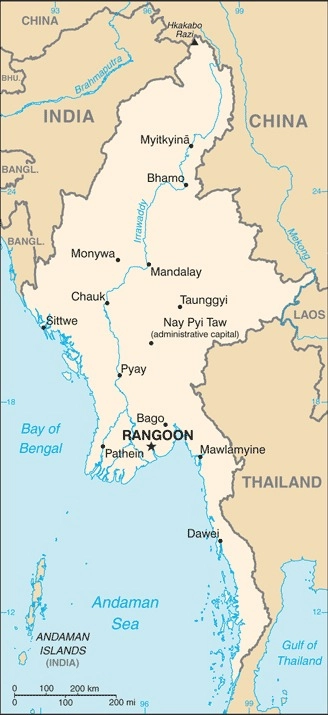
Southeastern Asia, bordering the Andaman Sea and the Bay of Bengal, between Bangladesh and Thailand
Geographic coordinates
22 00 N, 98 00 E
Map references
Southeast Asia
Area
total : 676,578 sq km
land: 653,508 sq km
water: 23,070 sq km
comparison ranking: total 42
Area – comparative
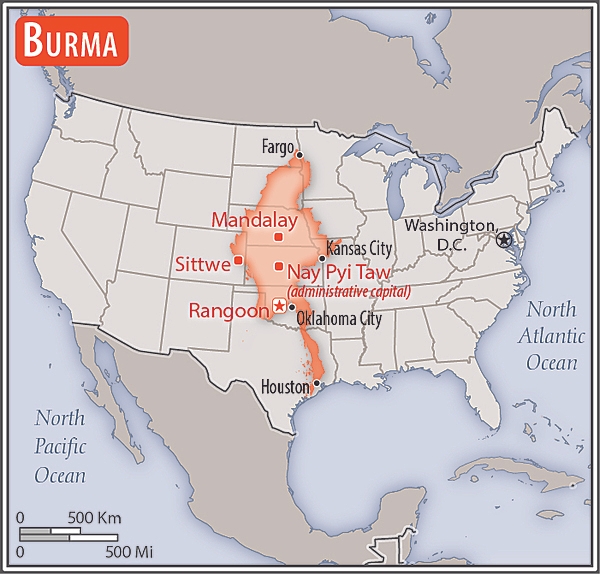
slightly smaller than Texas
Area comparison map:
Land boundaries
total: 6,522 km
border countries (5): Bangladesh 271 km; China 2,129 km; India 1,468 km; Laos 238 km; Thailand 2,416 km
Coastline
1,930 km
Maritime claims
territorial sea: 12 nm
contiguous zone: 24 nm
exclusive economic zone: 200 nm
continental shelf: 200 nm or to the edge of the continental margin
Climate
tropical monsoon; cloudy, rainy, hot, humid summers (southwest monsoon, June to September); less cloudy, scant rainfall, mild temperatures, lower humidity during winter (northeast monsoon, December to April)
Terrain
central lowlands ringed by steep, rugged highlands
Elevation
highest point: Gamlang Razi 5,870 m
lowest point: Andaman Sea/Bay of Bengal 0 m
mean elevation: 702 m
Natural resources
petroleum, timber, tin, antimony, zinc, copper, tungsten, lead, coal, marble, limestone, precious stones, natural gas, hydropower, arable land
Land use
agricultural land: 19.9% (2022 est.)
arable land: 16.8% (2022 est.)
permanent crops: 2.3% (2022 est.)
permanent pasture: 0.7% (2022 est.)
forest: 42.8% (2022 est.)
other: 37.3% (2022 est.)
Irrigated land
17,140 sq km (2020)
Major rivers (by length in km)
Mekong (shared with China [s], Laos, Thailand, Cambodia, and Vietnam [m]) – 4,350 km; Salween river mouth (shared with China [s] and Thailand) – 3,060 km; Irrawaddy river mouth (shared with China [s]) – 2,809 km; Chindwin – 1,158 km
note: [s] after country name indicates river source; [m] after country name indicates river mouth
Major watersheds (area sq km)
Indian Ocean drainage: Brahmaputra (651,335 sq km), Ganges (1,016,124 sq km), Irrawaddy (413,710 sq km), Salween (271,914 sq km)
Pacific Ocean drainage: Mekong (805,604 sq km)
Population distribution
population concentrated along coastal areas and in general proximity to the shores of the Irrawaddy River; the extreme north is relatively underpopulated
Natural hazards
destructive earthquakes and cyclones; flooding and landslides common during rainy season (June to September); periodic droughts
Geography – note
strategic location near major Indian Ocean shipping lanes; the north-south flowing Irrawaddy River is the country’s largest and most important commercial waterway
People and Society
Population
total: 57,527,139 (2024 est.)
male: 28,387,831
female: 29,139,308
comparison rankings: total 27; female 27; male 27
Nationality
noun: Burmese (singular and plural)
adjective: Burmese
Ethnic groups
Burman (Bamar) 68%, Shan 9%, Karen 7%, Rakhine 4%, Chinese 3%, Indian 2%, Mon 2%, other 5%
note: the largest ethnic group — the Burman (or Bamar) — dominate politics, and the military ranks are largely drawn from this ethnic group; the Burman mainly populate the central parts of the country, while various ethnic minorities have traditionally lived in the peripheral regions that surround the plains in a horseshoe shape; the government recognizes 135 indigenous ethnic groups
Languages
Burmese (official)
major-language sample(s):
ကမ္ဘာ့အချက်အလက်စာအုပ်- အခြေခံအချက်အလက်တွေအတွက် မရှိမဖြစ်တဲ့ အရင်းအမြစ် (Burmese)
The World Factbook, the indispensable source for basic information.
note: minority ethnic groups use their own languages
Religions
Buddhist 87.9%, Christian 6.2%, Muslim 4.3%, Animist 0.8%, Hindu 0.5%, other 0.2%, none 0.1% (2014 est.)
note: religion estimate is based on the 2014 national census, including an estimate for the non-enumerated population of Rakhine State, which is assumed to mainly affiliate with the Islamic faith; as of December 2019, Muslims probably make up less than 3% of Burma’s total population due to the large outmigration of the Rohingya population since 2017
Age structure
0-14 years: 24.4% (male 7,197,177/female 6,843,879)
15-64 years: 68.5% (male 19,420,361/female 19,998,625)
65 years and over: 7.1% (2024 est.) (male 1,770,293/female 2,296,804)
2024 population pyramid:

Dependency ratios
total dependency ratio: 45.9 (2024 est.)
youth dependency ratio: 35.6 (2024 est.)
elderly dependency ratio: 10.3 (2024 est.)
potential support ratio: 9.7 (2024 est.)
Median age
total: 30.8 years (2024 est.)
male: 29.9 years
female: 31.6 years
comparison ranking: total 131
Population growth rate
0.71% (2024 est.)
comparison ranking: 123
Birth rate
15.7 births/1,000 population (2024 est.)
comparison ranking: 103
Death rate
7.3 deaths/1,000 population (2024 est.)
comparison ranking: 108
Net migration rate
-1.4 migrant(s)/1,000 population (2024 est.)
comparison ranking: 155
Population distribution
population concentrated along coastal areas and in general proximity to the shores of the Irrawaddy River; the extreme north is relatively underpopulated
Urbanization
urban population: 32.1% of total population (2023)
rate of urbanization: 1.85% annual rate of change (2020-25 est.)
Major urban areas – population
5.610 million RANGOON (Yangon) (capital), 1.532 million Mandalay (2023)
Sex ratio
at birth: 1.06 male(s)/female
0-14 years: 1.05 male(s)/female
15-64 years: 0.97 male(s)/female
65 years and over: 0.77 male(s)/female
total population: 0.97 male(s)/female (2024 est.)
Mother’s mean age at first birth
24.7 years (2015/16 est.)
note: data represents median age at first birth among women 25-49
Maternal mortality ratio
179 deaths/100,000 live births (2020 est.)
comparison ranking: 50
Infant mortality rate
total: 32.1 deaths/1,000 live births (2024 est.)
male: 35.4 deaths/1,000 live births
female: 28.5 deaths/1,000 live births
comparison ranking: total 42
Life expectancy at birth
total population: 70.3 years (2024 est.)
male: 68.5 years
female: 72.1 years
comparison ranking: total population 177
Total fertility rate
1.97 children born/woman (2024 est.)
comparison ranking: 109
Gross reproduction rate
0.96 (2024 est.)
Contraceptive prevalence rate
52.2% (2015/16)
Drinking water source
improved:
urban: 95.4% of population
rural: 80.7% of population
total: 85.3% of population
unimproved:
urban: 4.6% of population
rural: 19.3% of population
total: 14.7% of population (2020 est.)
Health expenditure
5.6% of GDP (2021)
2.5% of national budget (2022 est.)
Physician density
0.76 physicians/1,000 population (2019)
Hospital bed density
1.1 beds/1,000 population (2020 est.)
Sanitation facility access
improved:
urban: 93.9% of population
rural: 81.3% of population
total: 85.2% of population
unimproved:
urban: 6.1% of population
rural: 18.7% of population
total: 14.8% of population (2020 est.)
Obesity – adult prevalence rate
5.8% (2016)
comparison ranking: 173
Alcohol consumption per capita
total: 2.06 liters of pure alcohol (2019 est.)
beer: 0.5 liters of pure alcohol (2019 est.)
wine: 0.02 liters of pure alcohol (2019 est.)
spirits: 1.55 liters of pure alcohol (2019 est.)
other alcohols: 0 liters of pure alcohol (2019 est.)
comparison ranking: total 128
Tobacco use
total: 42.2% (2025 est.)
male: 68.1% (2025 est.)
female: 17.1% (2025 est.)
comparison ranking: total 2
Children under the age of 5 years underweight
19.1% (2018)
comparison ranking: 16
Currently married women (ages 15-49)
57.5% (2023 est.)
Child marriage
women married by age 15: 1.9% (2016)
women married by age 18: 16% (2016)
men married by age 18: 5% (2016)
Education expenditure
2% of GDP (2019 est.)
9.8% national budget (2019 est.)
comparison ranking: Education expenditure (% GDP) 182
Literacy
total population: 89% (2019 est.)
male: 92% (2019 est.)
female: 86% (2019 est.)
note: most public schools were closed immediately after the coup in 2021, and attendance has remained low since schools reopened; literacy is expected to decline from 2019 to 2023
School life expectancy (primary to tertiary education)
total: 11 years
male: 10 years
female: 11 years (2018)
Environment
Environment – current issues
deforestation; industrial pollution of air, soil, and water; inadequate sanitation and water treatment; rapid depletion of the country’s natural resources
Environment – international agreements
party to: Biodiversity, Climate Change, Climate Change-Kyoto Protocol, Climate Change-Paris Agreement, Comprehensive Nuclear Test Ban, Desertification, Endangered Species, Hazardous Wastes, Law of the Sea, Nuclear Test Ban, Ozone Layer Protection, Ship Pollution, Tropical Timber 2006, Wetlands
signed, but not ratified: none of the selected agreements
Climate
tropical monsoon; cloudy, rainy, hot, humid summers (southwest monsoon, June to September); less cloudy, scant rainfall, mild temperatures, lower humidity during winter (northeast monsoon, December to April)
Land use
agricultural land: 19.9% (2022 est.)
arable land: 16.8% (2022 est.)
permanent crops: 2.3% (2022 est.)
permanent pasture: 0.7% (2022 est.)
forest: 42.8% (2022 est.)
other: 37.3% (2022 est.)
Urbanization
urban population: 32.1% of total population (2023)
rate of urbanization: 1.85% annual rate of change (2020-25 est.)
Air pollutants
particulate matter emissions: 27.16 micrograms per cubic meter (2019 est.)
carbon dioxide emissions: 25.28 megatons (2016 est.)
methane emissions: 42.2 megatons (2020 est.)
Waste and recycling
municipal solid waste generated annually: 4,677,307 tons (2000 est.)
Major rivers (by length in km)
Mekong (shared with China [s], Laos, Thailand, Cambodia, and Vietnam [m]) – 4,350 km; Salween river mouth (shared with China [s] and Thailand) – 3,060 km; Irrawaddy river mouth (shared with China [s]) – 2,809 km; Chindwin – 1,158 km
note: [s] after country name indicates river source; [m] after country name indicates river mouth
Major watersheds (area sq km)
Indian Ocean drainage: Brahmaputra (651,335 sq km), Ganges (1,016,124 sq km), Irrawaddy (413,710 sq km), Salween (271,914 sq km)
Pacific Ocean drainage: Mekong (805,604 sq km)
Total water withdrawal
municipal: 3.32 billion cubic meters (2019 est.)
industrial: 500 million cubic meters (2019 est.)
agricultural: 29.57 billion cubic meters (2019 est.)
Total renewable water resources
1.2 trillion cubic meters (2020 est.)
Government
Country name
conventional long form: Union of Burma
conventional short form: Burma
local long form: Pyidaungzu Thammada Myanma Naingngandaw (translated as the Republic of the Union of Myanmar)
local short form: Myanma Naingngandaw
former: Socialist Republic of the Union of Burma, Union of Myanmar
etymology: both “Burma” and “Myanmar” derive from the name of the majority Burman (Bamar) ethnic group, with the term myanma, or “the strong,” being the group’s name for itself
note: since 1989 the military authorities in Burma and the deposed parliamentary government have promoted the name Myanmar as a conventional name for their state; the US Government has not officially adopted the name
Government type
military regime
Capital
name: Rangoon (aka Yangon, continues to be recognized as the primary Burmese capital by the US Government); Nay Pyi Taw is the administrative capital
geographic coordinates: 16 48 N, 96 10 E
time difference: UTC+6.5 (11.5 hours ahead of Washington, DC, during Standard Time)
etymology: Rangoon/Yangon derives from the Burmese words yan and koun, commonly translated as “end of strife”; Nay Pyi Taw translates as “abode of kings”
Administrative divisions
7 regions (taing-myar, singular – taing), 7 states (pyi ne-myar, singular – pyi ne), 1 union territory
regions: Ayeyarwady (Irrawaddy), Bago, Magway, Mandalay, Sagaing, Tanintharyi, Yangon (Rangoon)
states: Chin, Kachin, Kayah, Karen, Mon, Rakhine, Shan
union territory: Nay Pyi Taw
Legal system
mixed legal system of English common law (as introduced in codifications designed for colonial India) and customary law
Constitution
history: previous 1947, 1974 (suspended until 2008); latest drafted 9 April 2008, approved by referendum 29 May 2008
amendment process: proposals require at least 20% approval by the Assembly of the Union membership; passage of amendments to sections of the constitution on basic principles, government structure, branches of government, state emergencies, and amendment procedures requires 75% approval by the Assembly and approval in a referendum by absolute majority of registered voters; passage of amendments to other sections requires only 75% Assembly approval; military granted 25% of parliamentary seats by default
International law organization participation
has not submitted an ICJ jurisdiction declaration; non-party state to the ICCt
Citizenship
citizenship by birth: no
citizenship by descent only: both parents must be citizens of Burma
dual citizenship recognized: no
residency requirement for naturalization: none
note: an applicant for naturalization must be the child or spouse of a citizen
Suffrage
18 years of age; universal
Executive branch
chief of state: Prime Minister, State Administration Council Chair, Sr. Gen. MIN AUNG HLAING (since 1 August 2021)
head of government: Prime Minister, State Administration Council Chair, Sr. Gen. MIN AUNG HLAING (since 1 August 2021)
cabinet: Cabinet appointments shared by the president and the commander-in-chief
elections/appointments: prior to the military takeover in 2021, president was indirectly elected by simple majority vote by the full Assembly of the Union from among 3 vice-presidential candidates nominated by the Presidential Electoral College (consists of members of the lower and upper houses and military members); the other 2 candidates become vice presidents (president elected for a 5-year term); general election last held on 8 November 2020; the military junta has pledged to hold new general elections but has repeatedly announced delays
election results:
2020: the National League for Democracy (NLD) won 396 seats across both houses — well above the 322 required for a parliamentary majority — but on 1 February 2021, the military claimed the results of the election were illegitimate and deposed State Counsellor AUNG SAN SUU KYI and President WIN MYINT of the NLD, causing military-affiliated Vice President MYINT SWE (USDP) to become acting president; MYINT SWE subsequently handed power to coup leader MIN AUNG HLAING; WIN MYINT and other key leaders of the ruling NLD party were placed under arrest after the military takeover
2018: WIN MYINT elected president in an indirect by-election held on 28 March 2018 after the resignation of HTIN KYAW; Assembly of the Union vote for president – WIN MYINT (NLD) 403, MYINT SWE (USDP) 211, HENRY VAN THIO (NLD) 18, 4 votes canceled (636 votes cast)
state counsellor: State Counselor AUNG SAN SUU KYI (since 6 April 2016); note – under arrest since 1 February 2021; formerly served as Minister of Foreign Affairs and Minister for the Office of the President
note 1: the military took over the government on 1 February 2021 and declared a state of emergency; they replaced the Cabinet with the State Administrative Council (SAC), which is the official name of the military government in Burma
note 2: prior to the military takeover, the state counsellor served the equivalent term of the president and was similar to a prime minister
Legislative branch
legislature name: Assembly of the Union (Pyidaungsu Hluttaw)
legislative structure: bicameral
note 1: the Assembly of the Union was dissolved on 1 February 2021 after a military coup led by Sr. General MIN AUNG HLAING; it was replaced by the State Administration Council
note 2: the military junta overturned the results of the 8 November legislative elections
Judicial branch
highest court(s): Supreme Court of the Union (consists of the chief justice and 7-11 judges)
judge selection and term of office: chief justice and judges nominated by the president, with approval of the Lower House, and appointed by the president; judges normally serve until mandatory retirement at age 70
subordinate courts: High Courts of the Region; High Courts of the State; Court of the Self-Administered Division; Court of the Self-Administered Zone; district and township courts; special courts (for juvenile, municipal, and traffic offenses); courts martial
Political parties
Arakan National Party or ANP
Democratic Party or DP
Kayah State Democratic Party or KySDP
Kayin People’s Party or KPP
Kokang Democracy and Unity Party or KDUP
La Hu National Development Party or LHNDP
Lisu National Development Party or LNDP
Mon Unity Party (formed in 2019 from the All Mon Region Democracy Party and Mon National Party)
National Democratic Force or NDF
National League for Democracy or NLD
National Unity Party or NUP
Pa-O National Organization or PNO
People’s Party
Shan Nationalities Democratic Party or SNDP
Shan Nationalities League for Democracy or SNLD
Ta’ang National Party or TNP
Tai-Leng Nationalities Development Party or TNDP
Union Solidarity and Development Party or USDP
Unity and Democracy Party of Kachin State or UDPKS
Wa Democratic Party or WDP
Wa National Unity Party or WNUP
Zomi Congress for Democracy or ZCD
note: more than 90 political parties participated in the 2020 elections; political parties continued to function after the 2021 coup, although some political leaders have been arrested by the military regime; in 2023, the regime announced a new law with several rules and restrictions on political parties and their ability to participate in elections; dozens of parties refused to comply with the new rules; the regime’s election commission has subsequently banned more than 80 political parties, including the National League for Democracy
Diplomatic representation in the US
chief of mission: Ambassador (vacant); Chargé d’Affaires THET WIN (since 22 June 2022)
chancery: 2300 S Street NW, Washington, DC 20008
telephone: [1] (202) 332-3344
FAX: [1] (202) 332-4351
email address and website:
[email protected]
https://www.mewashingtondc.org/
consulate(s) general: Los Angeles
Diplomatic representation from the US
chief of mission: Ambassador (vacant); Chargé d’Affaires Susan STEVENSON (since 10 July 2023)
embassy: 110 University Avenue, Kamayut Township, Rangoon
mailing address: 4250 Rangoon Place, Washington DC 20521-4250
telephone: [95] (1) 753-6509
FAX: [95] (1) 751-1069
email address and website:
[email protected]
https://mm.usembassy.gov/
International organization participation
ADB, ARF, ASEAN, BIMSTEC, CP, EAS, EITI (candidate country), FAO, G-77, IAEA, IBRD, ICAO, ICRM, IDA, IFAD, IFC, IFRCS, IHO, ILO, IMF, IMO, Interpol, IOC, IOM, IPU, ISO (correspondent), ITU, ITUC (NGOs), NAM, OPCW (signatory), SAARC (observer), UN, UNCTAD, UNESCO, UNIDO, UNWTO, UPU, WCO, WHO, WIPO, WMO, WTO
Independence
4 January 1948 (from the UK)
National holiday
Independence Day, 4 January (1948); Union Day, 12 February (1947)
Flag description
three equal horizontal stripes of yellow (top), green, and red; centered on the green band is a white five-pointed star that overlaps onto the adjacent colored stripes; the design revives the triband colors that Burma used from 1943 to 1945, during the Japanese occupation
National symbol(s)
chinthe (mythical lion)
National colors
yellow, green, red, white
National anthem
name: “Kaba Ma Kyei” (Till the End of the World, Myanmar)
lyrics/music: SAYA TIN
note: adopted 1948; Burma is among a handful of non-European nations that have anthems rooted in indigenous traditions; the beginning portion of the anthem is a traditional Burmese anthem before transitioning into a Western-style orchestrated work
National heritage
total World Heritage Sites: 2 (both cultural)
selected World Heritage Site locales: Pyu Ancient Cities; Bagan
Economy
Economic overview
prior to COVID-19 and the February 2021 military coup, massive declines in poverty, rapid economic growth, and improving social welfare; underdevelopment, climate change, and unequal investment threaten progress and sustainability planning; since coup, foreign assistance has ceased from most funding sources
Real GDP (purchasing power parity)
$290.381 billion (2023 est.)
$287.624 billion (2022 est.)
$276.462 billion (2021 est.)
note: data in 2021 dollars
comparison ranking: 62
Real GDP growth rate
0.96% (2023 est.)
4.04% (2022 est.)
-12.02% (2021 est.)
note: annual GDP % growth based on constant local currency
comparison ranking: 167
Real GDP per capita
$5,400 (2023 est.)
$5,400 (2022 est.)
$5,200 (2021 est.)
note: data in 2021 dollars
comparison ranking: 176
GDP (official exchange rate)
$66.758 billion (2023 est.)
note: data in current dollars at official exchange rate
Inflation rate (consumer prices)
8.8% (2019 est.)
6.9% (2018 est.)
4.6% (2017 est.)
note: annual % change based on consumer prices
comparison ranking: 179
GDP – composition, by sector of origin
agriculture: 22.7% (2023 est.)
industry: 37.6% (2023 est.)
services: 39.7% (2023 est.)
note: figures may not total 100% due to non-allocated consumption not captured in sector-reported data
comparison rankings: services 198; industry 32; agriculture 27
GDP – composition, by end use
household consumption: 59.2% (2017 est.)
government consumption: 13.8% (2017 est.)
investment in fixed capital: 33.5% (2017 est.)
investment in inventories: 1.5% (2017 est.)
exports of goods and services: 21.4% (2017 est.)
imports of goods and services: -28.6% (2017 est.)
Agricultural products
rice, sugarcane, vegetables, beans, maize, groundnuts, plantains, fruits, coconuts, onions (2023)
note: top ten agricultural products based on tonnage
Industries
agricultural processing; wood and wood products; copper, tin, tungsten, iron; cement, construction materials; pharmaceuticals; fertilizer; oil and natural gas; garments; jade and gems
Industrial production growth rate
0.02% (2023 est.)
note: annual % change in industrial value added based on constant local currency
comparison ranking: 147
Labor force
22.742 million (2024 est.)
note: number of people ages 15 or older who are employed or seeking work
comparison ranking: 31
Unemployment rate
3% (2024 est.)
3% (2023 est.)
3.1% (2022 est.)
note: % of labor force seeking employment
comparison ranking: 43
Youth unemployment rate (ages 15-24)
total: 10% (2024 est.)
male: 10.5% (2024 est.)
female: 9.4% (2024 est.)
note: % of labor force ages 15-24 seeking employment
comparison ranking: total 127
Population below poverty line
24.8% (2017 est.)
note: % of population with income below national poverty line
Gini Index coefficient – distribution of family income
30.7 (2017 est.)
note: index (0-100) of income distribution; higher values represent greater inequality
comparison ranking: 121
Average household expenditures
on food: 53.9% of household expenditures (2023 est.)
on alcohol and tobacco: 0.5% of household expenditures (2023 est.)
Household income or consumption by percentage share
lowest 10%: 3.8% (2017 est.)
highest 10%: 25.5% (2017 est.)
note: % share of income accruing to lowest and highest 10% of population
Remittances
1.65% of GDP (2023 est.)
2.03% of GDP (2022 est.)
1.93% of GDP (2021 est.)
note: personal transfers and compensation between resident and non-resident individuals/households/entities
Budget
revenues: $10.945 billion (2019 est.)
expenditures: $10.22 billion (2019 est.)
note: central government revenues (excluding grants) and expenses converted to US dollars at average official exchange rate for year indicated
Public debt
33.6% of GDP (2017 est.)
comparison ranking: 158
Taxes and other revenues
6% (of GDP) (2019 est.)
note: central government tax revenue as a % of GDP
comparison ranking: 197
Current account balance
$67.72 million (2019 est.)
-$2.561 billion (2018 est.)
-$4.917 billion (2017 est.)
note: balance of payments – net trade and primary/secondary income in current dollars
comparison ranking: 80
Exports
$20.4 billion (2021 est.)
$17.523 billion (2019 est.)
$15.728 billion (2018 est.)
note: balance of payments – exports of goods and services in current dollars
comparison ranking: 91
Exports – partners
China 32%, Thailand 16%, Japan 7%, Germany 6%, India 5% (2023)
note: top five export partners based on percentage share of exports
Exports – commodities
garments, natural gas, dried legumes, rare-earth metal compounds, precious stones (2023)
note: top five export commodities based on value in dollars
Imports
$23.1 billion (2021 est.)
$17.356 billion (2019 est.)
$18.664 billion (2018 est.)
note: balance of payments – imports of goods and services in current dollars
comparison ranking: 89
Imports – partners
China 40%, Thailand 18%, Singapore 15%, Indonesia 4%, Malaysia 4% (2023)
note: top five import partners based on percentage share of imports
Imports – commodities
refined petroleum, synthetic fabric, fertilizers, crude petroleum, fabric (2023)
note: top five import commodities based on value in dollars
Reserves of foreign exchange and gold
$9.338 billion (2023 est.)
$8.182 billion (2022 est.)
$9.103 billion (2021 est.)
note: holdings of gold (year-end prices)/foreign exchange/special drawing rights in current dollars
comparison ranking: 81
Debt – external
$8.748 billion (2023 est.)
note: present value of external debt in current US dollars
comparison ranking: 53
Exchange rates
kyats (MMK) per US dollar –
Exchange rates:
2,100 (2023 est.)
1,932.543 (2022 est.)
1,615.367 (2021 est.)
1,381.619 (2020 est.)
1,518.255 (2019 est.)
Energy
Electricity access
electrification – total population: 73.7% (2022 est.)
electrification – urban areas: 93.9%
electrification – rural areas: 62.8%
Electricity
installed generating capacity: 7.419 million kW (2023 est.)
consumption: 23.625 billion kWh (2023 est.)
exports: 200 million kWh (2023 est.)
transmission/distribution losses: 1.855 billion kWh (2023 est.)
comparison rankings: transmission/distribution losses 120; exports 85; consumption 72; installed generating capacity 75
Electricity generation sources
fossil fuels: 61.8% of total installed capacity (2023 est.)
solar: 0.4% of total installed capacity (2023 est.)
hydroelectricity: 36.7% of total installed capacity (2023 est.)
biomass and waste: 1% of total installed capacity (2023 est.)
Coal
production: 1.031 million metric tons (2023 est.)
consumption: 907,000 metric tons (2023 est.)
exports: 221,000 metric tons (2023 est.)
imports: 67,000 metric tons (2023 est.)
proven reserves: 252 million metric tons (2023 est.)
Petroleum
total petroleum production: 7,000 bbl/day (2023 est.)
refined petroleum consumption: 122,000 bbl/day (2023 est.)
crude oil estimated reserves: 139 million barrels (2021 est.)
Natural gas
production: 13.549 billion cubic meters (2023 est.)
consumption: 4.241 billion cubic meters (2023 est.)
exports: 9.29 billion cubic meters (2023 est.)
imports: 219.822 million cubic meters (2021 est.)
proven reserves: 637.129 billion cubic meters (2021 est.)
Carbon dioxide emissions
27.005 million metric tonnes of CO2 (2023 est.)
from coal and metallurgical coke: 1.24 million metric tonnes of CO2 (2023 est.)
from petroleum and other liquids: 17.39 million metric tonnes of CO2 (2023 est.)
from consumed natural gas: 8.376 million metric tonnes of CO2 (2023 est.)
comparison ranking: total emissions 76
Energy consumption per capita
8.384 million Btu/person (2023 est.)
comparison ranking: 156
Communications
Telephones – fixed lines
total subscriptions: 588,000 (2023 est.)
subscriptions per 100 inhabitants: 1 (2023 est.) less than 1
comparison ranking: total subscriptions 86
Telephones – mobile cellular
total subscriptions: 65.5 million (2023 est.)
subscriptions per 100 inhabitants: 107 (2022 est.)
comparison ranking: total subscriptions 28
Broadcast media
government controls all domestic broadcast media; 2 state-controlled TV stations, with 1 controlled by the armed forces; 2 pay-TV stations are joint state-private ventures; 1 state-controlled radio station; 9 FM stations are joint state-private ventures; several international broadcasts are available in some areas; the Voice of America (VOA), Radio Free Asia (RFA), BBC Burmese service, the Democratic Voice of Burma (DVB), and Radio Australia use shortwave to broadcast; VOA, RFA, and DVB produce daily TV news programs that are transmitted by satellite; in 2017, the government granted licenses to 5 private broadcasters for digital free-to-air TV channels to be operated in partnership with government-owned Myanmar Radio and Television (MRTV); after the 2021 military coup, the regime revoked the media licenses of most independent outlets, including the free-to-air licenses for DVB and Mizzima (2022)
Internet country code
.mm
Internet users
percent of population: 59% (2023 est.)
Broadband – fixed subscriptions
total: 1.51 million (2023 est.)
subscriptions per 100 inhabitants: 3 (2023 est.)
comparison ranking: total 70
Transportation
Civil aircraft registration country code prefix
XY
Airports
74 (2025)
comparison ranking: 70
Heliports
6 (2025)
comparison ranking: 93
Railways
total: 5,031 km (2008)
narrow gauge: 5,031 km (2008) 1.000-m gauge
Merchant marine
total: 101 (2023)
by type: bulk carrier 1, general cargo 44, oil tanker 5, other 51
comparison ranking: total 89
Ports
total ports: 7 (2024)
large: 0
medium: 0
small: 5
very small: 2
ports with oil terminals: 3
key ports: Bassein, Mergui, Moulmein Harbor, Rangoon, Sittwe
Military and Security
Military and security forces
Burmese Defense Service (aka Armed Forces of Burma, Myanmar Army, Royal Armed Forces, the Tatmadaw, or the Sit-Tat): Army (Tatmadaw Kyi), Navy (Tatmadaw Yay), Air Force (Tatmadaw Lay); People’s Militia
Ministry of Home Affairs: Burma (People’s) Police Force, Border Guard Forces/Police (2025)
note 1: under the 2008 constitution, the Tatmadaw was given control over the appointments of senior officials to lead the Ministry of Defense, the Ministry of Border Affairs, and the Ministry of Home Affairs; in 2022, a new law gave the commander-in-chief of the Tatmadaw the authority to appoint or remove the head of the police force
note 2: the military is supported by pro-government militias; some are integrated within the Tatmadaw’s command structure as Border Guard Forces, which are organized as battalions with a mix of militia forces, ethnic armed groups, and government soldiers that are armed, supplied, and paid by the Tatmadaw; other pro-military government militias are not integrated within the Tatmadaw command structure but receive direction and some support from the military and are recognized as government militias; a third type of pro-government militias are small community-based units that are armed, coordinated, and trained by local Tatmadaw forces and activated as needed
Military expenditures
3.9% of GDP (2023 est.)
3.6% of GDP (2022 est.)
3.5% of GDP (2021 est.)
3% of GDP (2020 est.)
4.1% of GDP (2019 est.)
Military and security service personnel strengths
information varies; estimated 150,000 active military personnel (2025)
note: the Tatmadaw has reportedly suffered heavy personnel losses in the ongoing fighting against anti-regime forces
Military equipment inventories and acquisitions
the Burmese military’s inventory is comprised mostly of older Chinese and Russian/Soviet-era weapons and equipment with a smaller mix of more modern acquisitions, mostly from China and Russia; Burma’s defense industry is involved in shipbuilding and the production of ground force equipment based largely on Chinese and Russian designs (2024)
Military service age and obligation
18-35 years of age (men) and 18-27 years of age (women) for voluntary and conscripted military service; 24-month service obligation; conscripted professional men (ages 18-45) and women (ages 18-35), including doctors, engineers, and mechanics, serve up to 36 months; service terms may be extended to 60 months in an officially declared emergency (2024)
note: in February 2024, the military government announced that the People’s Military Service Law requiring mandatory military service would go into effect; the Service Law was first introduced in 2010 but had not previously been enforced; the military government also said that it intended to call up about 60,000 men and women annually for mandatory service; during the ongoing insurgency, the military has recruited men 18-60 to serve in local militias
Military – note
since the country’s founding, the Tatmadaw has been deeply involved in domestic politics and the national economy; it ran the country for five decades following a military coup in 1962; prior to the most recent coup in 2021, the military already controlled three key security ministries (Defense, Border, and Home Affairs), one of two vice presidential appointments, 25% of the parliamentary seats, and had a proxy political party, the Union Solidarity and Development Party (USDP); it owns and operates two business conglomerates that have over 100 subsidiaries; the business activities of these conglomerates include banking and insurance, hotels, tourism, jade and ruby mining, timber, construction, real estate, and the production of palm oil, sugar, soap, cement, beverages, drinking water, coal, and gas; some of the companies supply goods and services to the military, such as food, clothing, insurance, and cellphone service; the military also manages a film industry, publishing houses, and television stations
the Tatmadaw’s primary operational focus is internal security, and it is conducting counterinsurgency operations against anti-regime forces that launched an armed rebellion following the 2021 coup and an array of ethnic armed groups (EAGs), some of which have considerable conventional military capabilities; as of 2024, the Tatmadaw was reportedly engaged in combat operations in 10 of its 14 regional commands
EAGs have been fighting for self-rule against the Burmese Government since 1948; they range in strength from a few hundred fighters up to an estimated 30,000; some are organized along military lines with “brigades” and “divisions” and armed with heavy weaponry, including artillery; they control large tracts of the country’s territory, primarily in the border regions; key groups include the United Wa State Army, Karen National Union, Kachin Independence Army, Arakan Army, Ta’ang National Liberation Army, and the Myanmar Nationalities Democratic Alliance Army
the opposition National Unity Government claims its armed wing, the People’s Defense Force (PDF), has more than 60,000 fighters loosely organized into battalions; in addition, several EAGs have cooperated with the NUG and supported local PDF groups (2024)
Transnational Issues
Refugees and internally displaced persons
IDPs: 1.975 million (government offensives against armed ethnic minority groups near its borders with China and Thailand, natural disasters, forced land evictions) (2023)
stateless persons: 600,000 (2022); note – Rohingya Muslims, living predominantly in Rakhine State, are Burma’s main group of stateless people; the Burmese Government does not recognize the Rohingya as a “national race” and stripped them of their citizenship under the 1982 Citizenship Law, categorizing them as “non-nationals” or “foreign residents;” under the Rakhine State Action Plan drafted in October 2014, the Rohingya must demonstrate their family has lived in Burma for at least 60 years to qualify for a lesser naturalized citizenship and the classification of Bengali or be put in detention camps and face deportation; native-born but non-indigenous people, such as Indians, are also stateless; the Burmese Government does not grant citizenship to children born outside of the country to Burmese parents who left the country illegally or fled persecution, such as those born in Thailand; the number of stateless persons has decreased dramatically because hundreds of thousands of Rohingya have fled to Bangladesh since 25 August 2017 to escape violence
Trafficking in persons
tier rating: Tier 3 — Burma does not fully meet the minimum standards for the elimination of trafficking and is not making significant efforts to do so, therefore, Burma remained on Tier 3; for more details, go to: https://www.state.gov/reports/2024-trafficking-in-persons-report/burma/
Illicit drugs
source of precursor or essential chemicals used in the production of illicit narcotics; narcotics produced in Burma trafficked throughout the region, with routes extending beyond Southeast Asia to Australia, New Zealand, and Japan; largest opium poppy cultivator globally with an estimated 47,100 hectares grown in 2023; not a major source or transit country for drugs entering the United States; domestic consumption of synthetic drug cocktails such as Yaba, “Happy Water,” and “Wei Tiong” (mixtures of drugs including caffeine, methamphetamine, tramadol, and MDMA) popular among the younger population and domestic drug consumption substantial and widespread. (2021)