Basra International Stadium is the centerpiece of Basra Sports City and one of the Middle East’s most ambitious sporting developments. Located in the southern outskirts of Basra, the 65,000-seat arena opened on 12 October 2013 and represents a major investment in Iraq’s sports infrastructure. Basra International Stadium was designed by 360 Architecture and constructed by Abdullah Al-Jiburi Contracting Company, forming the focal point of a multi-venue complex valued at $550 million.
Stadium Details
| Feature | Information |
|---|---|
| Name | Basra International Stadium (Basra Sports City Main Stadium) |
| Capacity | 65,000 |
| Country | Iraq |
| City | Basra |
| Home Clubs | — |
| Inauguration | 12 October 2013 |
| Construction | 15 July 2009 – October 2013 |
| Cost | $550 million |
| Designer | 360 Architecture |
| Contractor | Abdullah Al-Jiburi Contracting Company |
| Complex Features | Multiple stadiums, training pitches, hotels, indoor facilities |
Origins and Construction of Basra Sports City
The concept of Basra Sports City emerged from Iraq’s goal to create a multi-purpose sports hub capable of hosting major international events. Construction began in July 2009 on a vast site in the southern outskirts of Basra. The project involved two main stadiums—a proposed 80,000-seat Olympic stadium later scaled down to 65,000, and a 20,000-seat secondary venue—along with four training pitches, indoor sports buildings, medical centers, and a series of hotels.
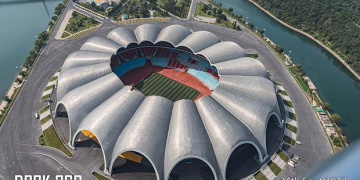
The complex includes large artificial ponds surrounding the stadiums. When viewed from above, these ponds form the shape of Iraq’s map, symbolizing unity and national pride. This striking visual element set the tone for an architectural project designed to combine symbolism with modern engineering.
Architectural Design and Structural Features
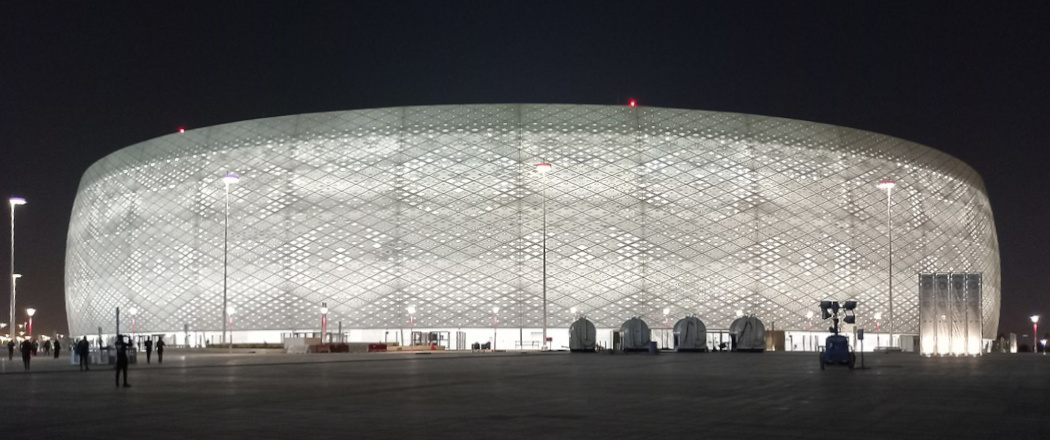
Basra International Stadium was designed by the U.S.-based firm 360 Architecture. Its exterior is wrapped in 45,000 square meters of synthetic cladding formed into rhythmic, interlocking panels. These panels blend with the steel columns, giving the stadium a sculpted, layered appearance inspired by traditional Middle Eastern motifs.
The structural system relies on approximately 19,000 tons of steel, supporting both the external cladding and the expansive roof. Beneath this steel envelope lies a two-tier seating bowl, providing accommodation for 65,000 spectators. Two large screens sit atop the stands, enhancing visibility and match-day presentation.
The architectural form emphasizes durability and visual impact, making Basra International Stadium one of Iraq’s most recognizable sporting landmarks.
Project Delays and Revised Timelines
Although the project was originally scheduled for completion in 32 months, several design modifications and logistical challenges caused major delays. Plans for an early 2012 opening were shifted to early 2013, and the final inauguration occurred on 12 October 2013, even though some elements remained unfinished. This prolonged timeline reflects the complexities of executing large-scale infrastructure projects during periods of national reconstruction.
Opening Ceremony and Early Controversies
The stadium’s opening drew a full-capacity crowd of 65,000 spectators, marking a major moment for Basra and Iraqi sports. However, the event was overshadowed by controversy.
FIFA objected to the participation of Egyptian and Syrian teams in the inaugural friendly tournament, yet the matches continued despite the concerns. During the ceremony, a major power failure caused a prolonged blackout, highlighting the absence of a functioning backup generator—a critical oversight for a venue of such scale.
Following the event, spectators posted photos showing broken seats across multiple sections of the stadium. Reports suggested that some seats were dangerously fragile, and allegations emerged that seat failures may have contributed to the death of a young attendee who suffered fatal injuries after falling. These reports sparked widespread criticism and prompted calls for improved safety measures.
Role in Iraq’s Sporting Future
Despite its difficult debut, Basra International Stadium remains a key infrastructural asset. As the largest modern stadium in southern Iraq, it hosts major domestic fixtures, national team events, and international competitions. Its position within Basra Sports City gives it access to training grounds, athlete facilities, and future expansion areas.
The facility symbolizes Iraq’s determination to rebuild robust sports venues capable of hosting regional and global events. Its architectural ambition and large-scale planning mark a significant step in Iraq’s re-emergence in international sport.