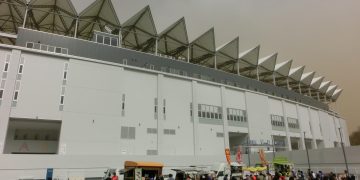
Al-Shaab Stadium is one of Iraq’s most historic sports venues and a landmark deeply woven into the cultural and athletic identity of Baghdad. Located in the capital and inaugurated on 6 November 1966, Al-Shaab Stadium served as the home of the Iraq national football team for nearly five decades. Al-Shaab Stadium remains a symbol of resilience, national pride, and sporting heritage.
Stadium Details
| Feature | Information |
|---|---|
| Name | Al-Shaab Stadium (Al-Sha’ab International Stadium) |
| Capacity | 34,200 |
| Country | Iraq |
| City | Baghdad |
| Home Club | Al-Shorta SC |
| Inauguration | 6 November 1966 |
| Construction | 1960–1966 |
| Cost | IQD 1.2 million |
| Designers | Francisco Keil do Amaral, Carlos Manuel Ramos |
| Contractor | Tahsin Nu’man Rif’at |
| Ownership | Government of Iraq |
| Former Capacity | 35,700 |
| Total Area | 200,000 m² |
Origins and Foundation of the Stadium Project
The idea for Al-Shaab Stadium emerged from a 1959 initiative of the Calouste Gulbenkian Foundation, which proposed investing a portion of its oil revenue grants into major cultural projects in Baghdad. These included the National Museum, National Theater, Medical City, and the future stadium.
Prime Minister Abd al-Karim Qasim announced the construction of the venue on 21 April 1960 before a crowd of 15,000. He envisioned a national stadium worthy of Iraq’s ambitions, initially planned to hold 50,000 spectators. Construction formally started in 1960, with the government aiming to create one of the Middle East’s largest and most modern sports arenas of the era.
Design, Architecture, and Facilities
Designed by Portuguese architects Francisco Keil do Amaral and Carlos Manuel Ramos, Al-Shaab Stadium was among the region’s most advanced stadiums upon completion. The facility covered 200,000 square meters, featuring:
- An athletics track with Tartan surface
- Lighting towers rising 55 meters
- A park area covering 40,000 square meters
- Parking for 4,000 cars
- Two training stadiums
- Courts for basketball, volleyball, handball, and tennis
- An Olympic swimming pool
This extensive complex made Al-Shaab a multi-sport center, not merely a football ground. It reflected Baghdad’s aspiration to become a regional hub for sport and culture.
Grand Opening and Early Sporting Glory
The stadium opened on 6 November 1966 with a historic match between SL Benfica of Portugal and a Baghdad XI team composed of the city’s best players. A crowd of 60,000 attended the event—nearly double today’s capacity.
Benfica scored first through José Augusto Torres. Baghdad equalized early in the second half with a goal by Qasim Mahmoud, before Domiciano Cavém sealed the 2–1 win for the visitors in the 80th minute.
For decades, Al-Shaab Stadium hosted major continental and regional competitions, including:
- 5th Arabian Gulf Cup
- 1972 Palestine Cup
- World Military Cup (1968, 1972)
- 1982 Arab Club Champions Cup final
- 1985 Arab Club Champions Cup tournament in full
The stadium thus became central to Iraq’s football prestige.
Crisis, War Damage, and Reconstruction
On 9 April 2003, during the Battle of Baghdad, Al-Shaab Stadium suffered extensive damage when bombed by the U.S. Air Force. Large craters appeared on the pitch and most of the seating was destroyed. The stadium was later used as an airstrip by U.S. forces until 2004.
The Coalition Provisional Authority announced $3 million for repairs, and the stadium officially reopened on 12 June 2005. Although usable again, Iraq’s national team could not play home matches there during the Iraqi Civil War due to safety concerns.
After years away, Iraq finally returned to Al-Shaab Stadium on 13 July 2009 with a 4–0 victory over Palestine in an international friendly. This moment marked a symbolic renewal of national sporting pride.
Modern Role and Cultural Importance
Today, Al-Shaab Stadium remains a key venue for Baghdad and a home ground for Al-Shorta SC. Its legacy as the “People’s Stadium” endures because of its deep historical ties, resilient reconstruction, and role in defining Iraqi football identity.
The stadium stands as a testament to the endurance of Iraqi sport through political upheavals, wars, and cultural change. Al-Shaab Stadium continues to serve as a gathering place for supporters and a symbol of unity in Baghdad.