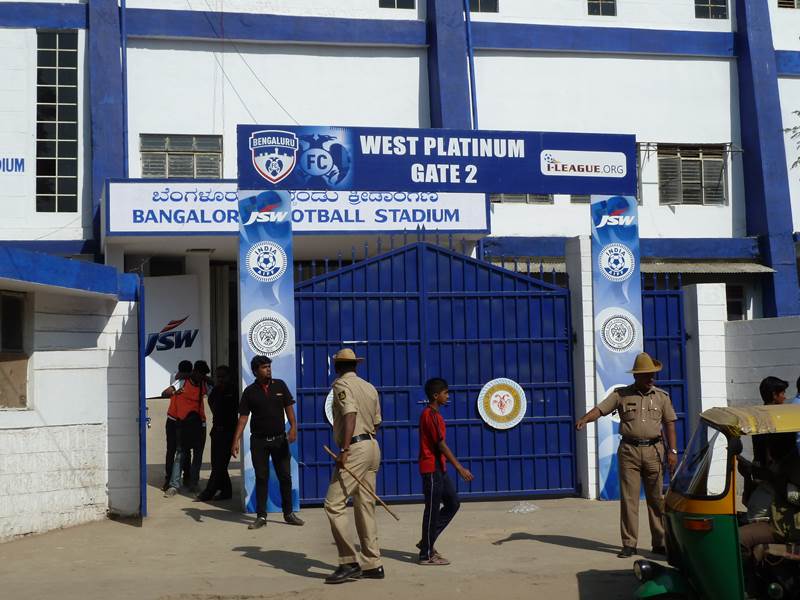
Bangalore Football Stadium, located in Ashok Nagar, Bangalore, has long been an iconic venue for football and sporting events in India. Inaugurated in 1970, this stadium was initially designed to host 90,000 spectators, though financial and construction issues meant that the full vision was never realized. Despite its challenges, the stadium has become a pivotal location for football in Bangalore and across India, hosting national and international tournaments, including the I-League.
History and Construction Challenges
The construction of Bangalore Football Stadium began in the late 1960s, with an ambitious plan to replicate the grandeur of the Estádio do Maracanã in Brazil, aiming for a capacity of 90,000. However, due to financial issues, corruption, and theft of construction materials, the project was delayed, and the stadium’s final design did not live up to its original scope.
Instead of the envisioned multi-tiered structure, only a single-tiered stand was built, and the full capacity was never achieved. The Karnataka State Football Association (KSFA) was forced to sell land behind the stadium, leading to the construction of additional stands but ultimately leaving the stadium with an incomplete and dilapidated appearance.
Despite these setbacks, the stadium became a key venue for local and national football matches.
Renovation and Football’s Return
The stadium underwent renovations in 2009-2011, including a new playing field and upgrades to facilities. However, the main stand had to be dismantled in the early 21st century due to safety concerns. After the 2009-2011 renovation, the stadium was home to the I-League 2 club, Sudeva Delhi FC and later hosted I-League matches for Bengaluru FC, including their first I-League match in 2014.
Role in Indian Football
The Bangalore Football Stadium has hosted numerous significant matches in the history of Indian football, including the AFC Youth Championship in 2006 and various national football tournaments like the Santosh Trophy and Federation Cup. Its location in Bangalore, with its rich footballing culture, has made it a key venue for the development of football in the state of Karnataka and India as a whole.
In 2014, Bengaluru FC made their debut in the Indian Super League, marking a significant milestone for both the club and the stadium. The stadium hosted Bengaluru FC’s first-ever match against Mohun Bagan, a memorable encounter that ended in a 1-1 draw, with the stadium nearly full.
Future of Bangalore Football Stadium
Despite its significance, the Bangalore Football Stadium faced multiple challenges in terms of modernization. In 2013, FIFA confirmed that India would host the 2017 FIFA U-17 World Cup, and Bangalore was selected as one of the potential host cities. However, plans for a new stadium to replace the old venue were announced, with construction set to begin after the 2013–2014 I-League season. As of 2023, the plans to demolish the existing structure and build a new stadium have been postponed, with an anticipated completion date of 2027.
Conclusion
Bangalore Football Stadium stands as a symbol of India’s football history, having hosted countless matches, tournaments, and significant events. Its legacy, from humble beginnings to modern renovations, continues to contribute to Indian football, especially in the Bangalore region. As the city looks to modernize and enhance its football infrastructure, the future of the stadium remains a promising part of India’s sporting landscape.