


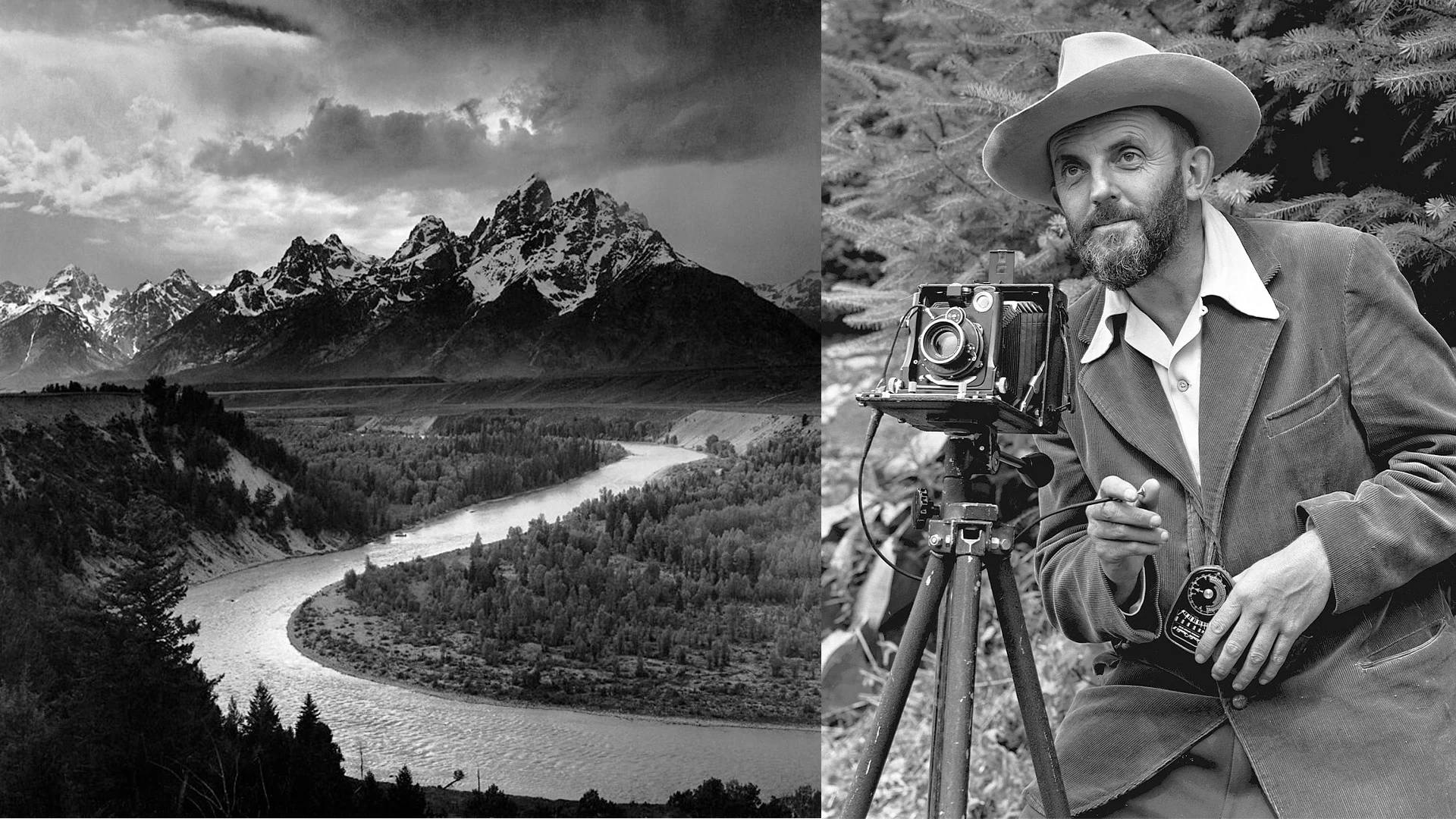
Ansel Easton Adams (February 20, 1902 – April 22, 1984) was an American photographer and environmentalist renowned for his black-and-white images of the American West. His photographs of Yosemite National Park, the Sierra Nevada, and other natural landscapes became iconic representations of America’s wilderness. Adams co-founded Group f/64, promoted the concept of “pure” photography, and alongside Fred Archer, developed the Zone System, a method for achieving precise tonal control in photographic prints.
Beyond photography, Adams was a lifelong advocate for conservation, using his art to campaign for the protection of America’s national parks. In recognition of his influence, he received the Presidential Medal of Freedom in 1980.
Early Life
Adams was born in San Francisco, California, to Charles Hitchcock Adams and Olive Bray. A childhood accident during the 1906 San Francisco earthquake left him with a permanently crooked nose, which became a defining feature. A restless and curious child, Adams found solace in exploring the Golden Gate area and observing nature.
Educated through a mix of private schooling and tutoring, Adams developed a strong interest in astronomy and music, originally aspiring to be a classical pianist. His father instilled in him the writings of Ralph Waldo Emerson, shaping his philosophy of living in harmony with nature.
In 1916, at age 14, Adams received a Kodak Brownie camera during a family trip to Yosemite National Park. This trip sparked his passion for photography, an interest that would define his life’s work.
Early Career and Group f/64
Adams’s first photographs were published in 1921, and by the mid-1920s he was experimenting with pictorialism, a soft-focus style. By 1927, however, he had embraced sharp focus and tonal precision, producing his famous image Monolith, the Face of Half Dome.
In 1932, he joined photographers Edward Weston and Imogen Cunningham in founding Group f/64, which promoted “straight” photography, emphasizing clarity, detail, and the full tonal range. Their work rejected pictorialist traditions and established photography as an art form in its own right.
Photographic Innovation
Adams, with Fred Archer, devised the Zone System, a technical method for controlling exposure, development, and printing to achieve precise tonal gradations. This system became a cornerstone of fine-art photography and remains influential today.
He also authored several instructional books, including Making a Photograph (1935) and The Print (1950), which guided generations of photographers.
Conservation Work
A dedicated member of the Sierra Club from age 17, Adams served on its board for 37 years. His photography was central to environmental campaigns, including the push to establish Kings Canyon National Park.
His images, such as Clearing Winter Storm and The Tetons and the Snake River, became powerful visual arguments for conservation, blending artistry with advocacy.
Later Career
By the 1940s, Adams had achieved national recognition. His 1941 image Moonrise, Hernandez, New Mexico became one of the most celebrated photographs of the 20th century. Throughout his career, Adams worked on government commissions, commercial projects, and art exhibitions, all while teaching workshops and mentoring younger photographers.
In 1975, he co-founded the Center for Creative Photography at the University of Arizona, which now houses much of his archive. His reputation grew internationally, with exhibitions at the Metropolitan Museum of Art and inclusion in major photography collections.
Awards and Legacy
Adams received numerous honors, including:
- Presidential Medal of Freedom (1980)
- John Muir Award from the Sierra Club (1963)
- Induction into the International Photography Hall of Fame (1984)
His name lives on in landmarks such as the Ansel Adams Wilderness and Mount Ansel Adams in California.
Adams died in 1984 in Monterey, California. His ashes were scattered in Yosemite, the place that inspired his life’s work.
Notable Works
- Monolith, the Face of Half Dome (1927)
- Clearing Winter Storm, Yosemite Valley (c. 1937)
- Moonrise, Hernandez, New Mexico (1941)
- The Tetons and the Snake River (1942)
- Winter Sunrise, Sierra Nevada (1944)
- Moon and Half Dome (1960)
Published Works
Adams authored several influential books on photography, including:
- Making a Photograph (1935)
- The Negative (1948)
- The Print (1950)
- Images 1923–1974 (1974)
- Yosemite and the Range of Light (1979)
Legacy
Ansel Adams is remembered as both a master of black-and-white photography and a passionate advocate for the environment. His ability to merge art with activism elevated photography into fine art and preserved America’s natural heritage for future generations.


