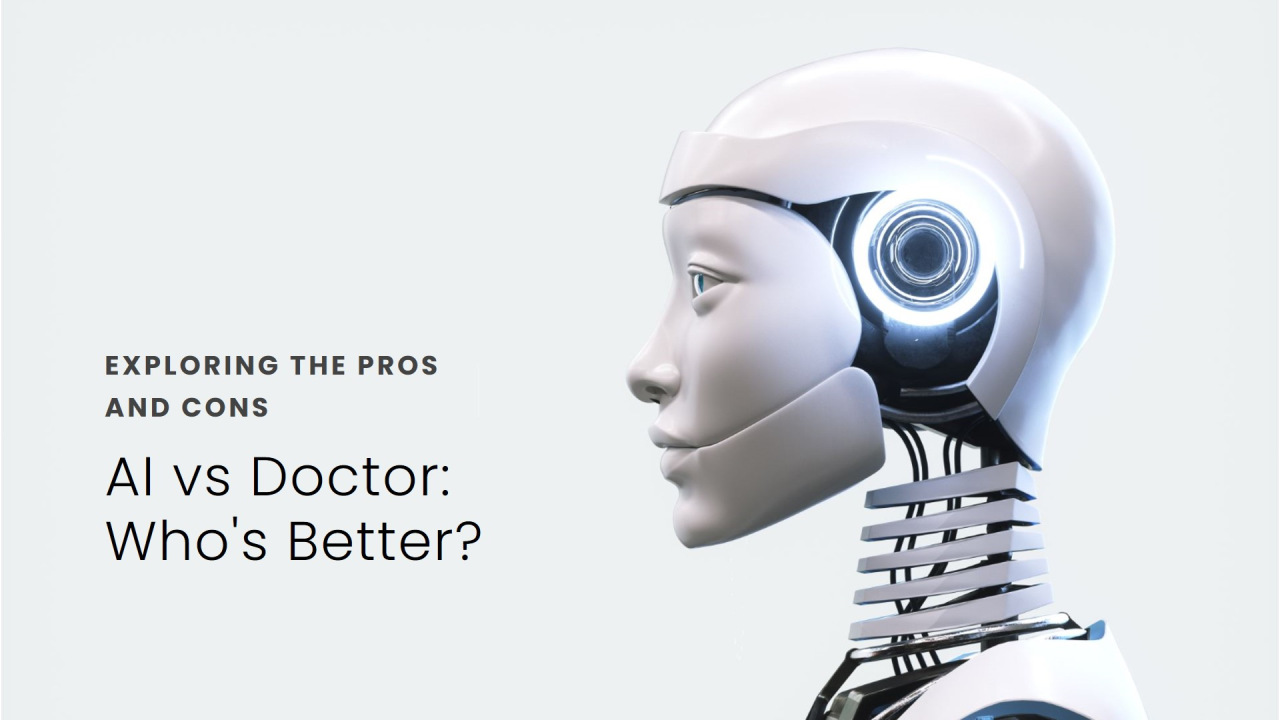
🩺 AI vs. Doctors: Complement or Competition in 2025?
As AI becomes more powerful in diagnosing diseases, analyzing patient data, and generating treatment plans, a pressing question arises: AI vs. doctors—complement or competition?
In 2025, the answer is clear: AI is transforming medicine, but not by replacing doctors. It’s enhancing their capabilities and helping deliver more efficient, accurate, and accessible care.
Here’s how AI fits into the healthcare ecosystem—and where doctors remain essential.
🤖 What AI Does Well in Medicine
Artificial intelligence excels at:
- Analyzing large datasets (lab results, imaging, genomics)
- Identifying patterns in diagnostics faster than humans
- Automating repetitive tasks (scheduling, documentation)
- Predicting outcomes using machine learning models
AI tools like PathAI, Google Med-PaLM, and Aidoc are proving invaluable in radiology, oncology, and pathology.
✅ AI Strength: Speed, accuracy, and scalability in data-driven tasks.
👩⚕️ What Doctors Do Best
Human clinicians offer what AI cannot:
- Empathy and emotional intelligence
- Contextual understanding of patient history and lifestyle
- Ethical decision-making in nuanced situations
- Human-to-human communication and trust-building
A machine might recommend a treatment—but only a human can explain it with compassion.
✅ Doctor Strength: Holistic care, personal insight, and patient relationships.
🤝 AI and Doctors as a Collaborative Team
Rather than competing, AI and doctors are forming hybrid teams, where:
- AI assists with diagnosis and triage
- Doctors confirm, interpret, and personalize treatment
- Admin work is automated, freeing up time for patient care
- AI suggests research or clinical trial matches during consultations
✅ Result: Greater efficiency and better outcomes—together.
⚖️ Limitations of AI in Medicine
AI has its challenges:
- Lack of emotional understanding
- Difficulty explaining decisions (“black box” models)
- Risk of bias if trained on skewed data
- Inability to act independently in emergencies
That’s why human oversight remains essential—AI is a tool, not a replacement.
🧠 Real-World Examples of AI + Doctor Collaboration
- Radiologists use AI to pre-screen scans and flag anomalies
- Primary care doctors use AI for predictive patient monitoring
- Surgeons leverage AI-powered robots for precision procedures
- Mental health professionals integrate AI chatbots for daily support
🧬 In every case, the doctor makes the final call.
📦 Summary Table: AI vs. Doctors – Strengths Compared
| Function | AI Strengths | Doctor Strengths |
|---|---|---|
| Data Analysis | Rapid, accurate processing | Interpretation with context |
| Diagnosis Support | Pattern recognition from vast data | Clinical judgment and experience |
| Patient Communication | Limited to scripted responses | Empathy, listening, reassurance |
| Treatment Planning | Suggests options based on data | Adapts plan to patient needs |
| Ethics & Human Touch | None | Essential |
🎯 Final Thoughts on AI vs. Doctors: Complement or Competition?
AI vs. doctors: complement or competition? In 2025, it’s not a rivalry—it’s a relationship. AI enhances clinical efficiency and diagnostic accuracy, while doctors bring empathy, intuition, and critical thinking.
Together, they form the future of patient-centered, tech-enhanced care.