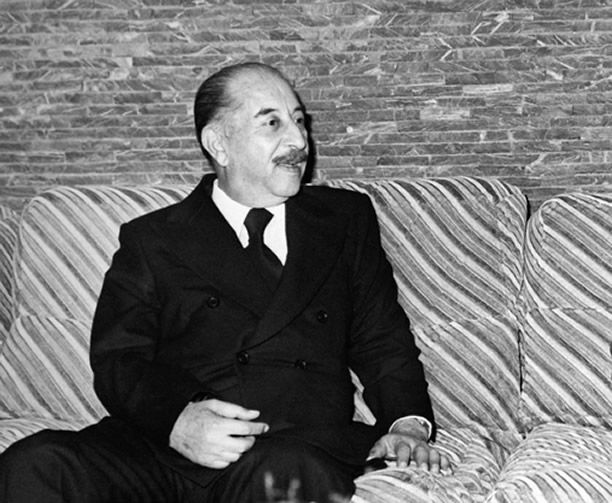
Aḥmad Ḥasan al-Bakr was born in 1914 in Tikrīt, Iraq, into a modest family. Before entering politics, he worked as a primary-school teacher for six years. In 1938, he enrolled in the Iraqi Military Academy, where he trained as an officer. Al-Bakr’s career gained momentum after he joined the Baʿath Party, an Arab nationalist and socialist movement committed to unifying the Arab world.
By 1959, his revolutionary activities forced him into early retirement from the Iraqi army. However, his political influence within the Baʿathist movement remained strong. Al-Bakr played a central role in shaping the group’s strategy to seize power in Iraq.
Rise to Power
Following the Baʿath coup of 1963, al-Bakr briefly served as prime minister for 10 months. The Baʿathists were ousted later that year, but al-Bakr continued plotting their return to power. On July 17, 1968, the Baʿath Party successfully staged another coup, this time deposing President ʿAbd al-Raḥmān ʿĀrif. Al-Bakr assumed the presidency, marking the beginning of a decade-long rule.
His leadership, however, was closely linked with that of Ṣaddām Ḥussein, who gradually consolidated power during al-Bakr’s presidency.
Presidency (1968–1979)
Al-Bakr’s presidency was characterized by an assertive foreign policy, which often left Iraq isolated from moderate Arab states. He maintained an uncompromising stance against Israel and rejected diplomatic solutions to the Arab–Israeli conflict.
Domestically, al-Bakr struggled with Kurdish uprisings in northern Iraq. His border disputes with Iran complicated efforts to resolve the Kurdish issue, though the 1975 Algiers Agreement temporarily secured peace by granting Iran concessions in exchange for ending its support to Kurdish rebels.
Economically, al-Bakr initially pursued continuity with Iraq’s previous five-year plan, but rising oil revenues in the 1970s allowed his government to invest heavily in industrialization and infrastructure. Iraq’s economy modernized rapidly, though corruption and authoritarianism remained entrenched.
By 1976, after suffering a heart attack, al-Bakr began delegating significant responsibilities to Ṣaddām Ḥussein, who emerged as the regime’s de facto leader. On July 16, 1979, al-Bakr formally resigned, handing power to Saddam Hussein, who quickly consolidated full control of Iraq.
Legacy
Aḥmad Ḥasan al-Bakr is remembered as the leader who reestablished Baʿathist dominance in Iraq and set the stage for Saddam Hussein’s authoritarian rule. While his tenure oversaw industrial growth and greater oil wealth, it was also marked by political repression, strained regional relations, and authoritarian consolidation.
Al-Bakr died in Baghdad on October 4, 1982, at the age of 68, leaving behind a legacy of both modernization and dictatorship.
Quick Facts
| Attribute | Details |
|---|---|
| Full Name | Aḥmad Ḥasan al-Bakr |
| Born | 1914, Tikrīt, Iraq |
| Died | October 4, 1982, Baghdad (aged 68) |
| Title / Office | President of Iraq (1968–79), Prime Minister (1963) |
| Political Affiliation | Baʿath Party |
| Major Achievements | Oversaw oil-driven economic expansion; signed the 1975 Algiers Agreement |
| Downfall | Stepped down in 1979 due to ill health, succeeded by Saddam Hussein |
| Legacy | Brought stability and modernization but paved the way for authoritarian rule under Saddam Hussein |