


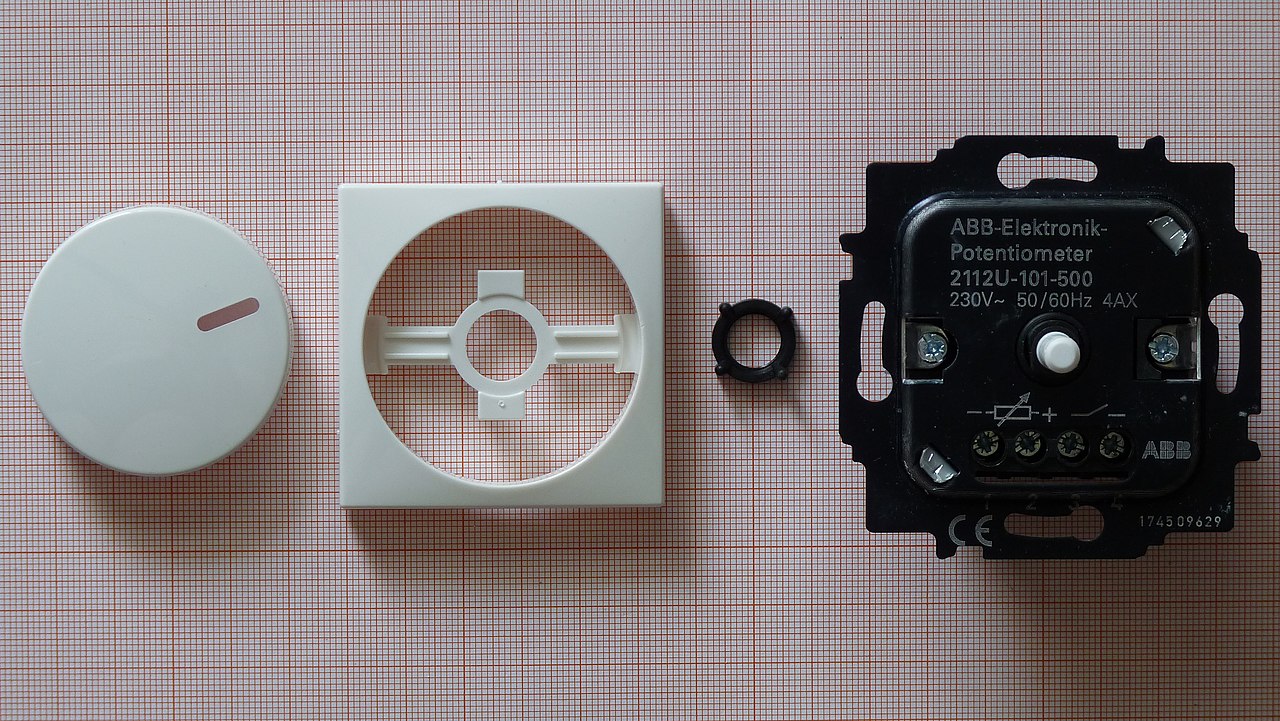
0–10 V lighting control is one of the earliest and simplest electronic lighting control systems, originally developed for fluorescent dimming. It operates using a DC voltage signal that varies between 0 volts (minimum light) and 10 volts (maximum light), allowing analog control of light intensity. The system is recognized in two main configurations: current sourcing and current sinking.
While initially developed for commercial and theatrical lighting, 0–10 V control remains widely used today in industrial, architectural, and LED lighting systems for its reliability and ease of use.
Current Sourcing
In current sourcing, the controller sends a voltage between 0 and 10 V to the lighting fixture. The light output scales accordingly:
- 10 V corresponds to 100% brightness,
- 0 V corresponds to 0% brightness (light off).
Intermediate voltages produce dimmed lighting proportional to the voltage value. The system allows manufacturers to define custom dimming curves — linear for voltage, perceived light, or power. Receivers typically have an input impedance of 100±20 kΩ, ensuring minimal current draw (around 1 mW at 10 V).
This system was once standard in production lighting before being replaced by multiplexed analog systems such as D54 and AMX192, and later by digital standards like DMX512. However, 0–10 V dimming made a resurgence in the 2010s, particularly with LED flat panel fixtures and commercial lighting systems.
Current Sinking
In current sinking systems, the ballast or LED driver provides a 10 V DC supply, and the controller sinks current to adjust the light level. When the controller returns:
- 10 V, the light is fully bright;
- 0 V, the light is at minimum or off.
This configuration creates a fail-safe mode — if the control wire is severed or the controller fails, the fixture defaults to full brightness.
Control can be achieved with a variable resistor or a pulse width modulation (PWM) signal. PWM-based controllers switch rapidly between on and off states, producing effective dimming without precision resistance values. However, not all LED fixtures respond well to PWM, as some drivers react slowly or inconsistently to changing signals.
Modern Usage and Design
0–10 V control systems are frequently implemented in dimming fluorescent ballasts and LED drivers. Depending on the fixture, dimming ranges often extend from 100% down to about 10%, below which an external relay or switch may be needed to turn off the light entirely. Some modern controllers include built-in relays or Blink’n’Dim adapters, which interpret short power blinks to create corresponding 0–10 V signals for dimming.
Advantages and Disadvantages
Advantages
- Simplicity: Easy to understand, install, and troubleshoot.
- Low Current: Typical current draw of ~1 mA allows long cable runs with minimal voltage drop.
- Compatibility: Works with a wide range of fluorescent and LED drivers.
- Reliability: Proven analog system with decades of usage in the lighting industry.
Disadvantages
- Wiring Complexity: Requires one wire per channel plus a common return, leading to hundreds of wires in large systems.
- Voltage Drop: Long cable runs can cause voltage loss, requiring recalibration for accurate dimming.
- Signal Interference: Capacitive coupling from AC lines can cause flickering; shielded cables are recommended when running parallel to power lines.
- Limited Digital Control: Unlike DALI or DMX512, 0–10 V systems cannot provide addressable or feedback control.
Applications
0–10 V lighting control remains popular in:
- Commercial and industrial facilities,
- Architectural installations,
- Theatrical and stage environments, and
- Energy-efficient LED retrofits.
Its analog nature, robustness, and low cost ensure its continued relevance even amid modern digital lighting protocols like DALI and DMX.


