


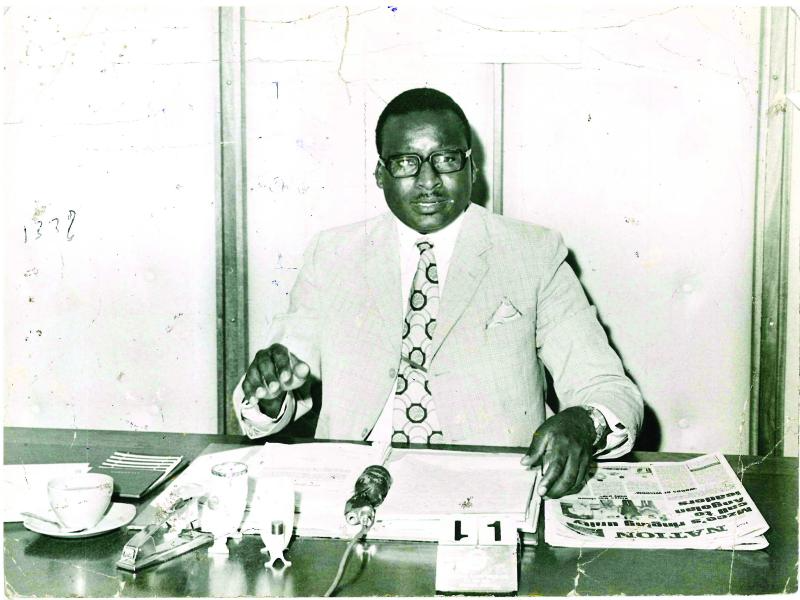
On June 28, 1939, Zachary Theodore Onyonka was born in Meru, where his father, Godrico Oeri Mairura, was employed as a police officer. Zachary was Oeri and Kerobina Kebati’s second child. After his father quit the police department to become an assistant chief in the Provincial Administration, the family moved to Kisii.
Onyonka was a bright and well-behaved student. He studied in Catholic schools, first at St. Mary’s Nyabururu in 1949 and then at St. Mary’s Yala until 1958. Among his classmates at Yala was Peter Oloo Aringo, who would go on to become a Cabinet minister.
Following graduation, Onyonka worked for the Gusii County Council until 1960, when he was awarded a scholarship by the renowned education airlifts to attend the University of Puerto Rico in San Juan, US. After graduating in 1965, he enrolled in Syracuse University in 1966 to pursue a master’s degree in economics with a focus on money and banking. Syracuse University is located in New York. After graduating, he enrolled in Syracuse University’s PhD program. At that point, Onyonka started working as a tutorial fellow at the University of Nairobi while he completed his doctoral study. It worked for him in 1969.
Prof. Terry Ryan of the Statistics Department, with whom Onyonka collaborated closely, assisted him in statistical studies related to his dissertation. After that, he was hired by the University of Nairobi to work as a lecturer in the Economics Department.
However, he was ambitious in politics. He saw that a single man was not a fit leader among the Kisii. In order to establish a family and become a legitimate candidate for parliament, he wed Beatrice Mughamba, a Tanzanian undergraduate from Moshi. Beatrice was a University of Nairobi home economics student at the time. Her classmates were Sospeter Arasa, the previous Permanent Secretary, David Kombo, a politician, and Chris Obure, who is currently a Cabinet Minister.
Beatrice recalls Onyonka as a stunning young professor who amazed everyone with his intelligence and well-spoken voice. He’s funny, fascinating, and talented, according to her. But what drew her to him was more his honesty about their impending marriage and his dignified, direct demeanor. She remembers the way his extraordinary openness manifested itself when Onyonka asked.
August 2, 1969 saw the marriage of Onyonka and Beatrice. Elisabeth Kwamboka (1970), David Wilfred (1976), Timmy Eric (1977), Kiki Christopher Robert (1975), Tolia Nakadori (1972), and Naanjela Anna (1980) were their six children. Zachary is a devoted father and husband, according to Beatrice. Onyonka phoned home to ask his family to eat dinner together in the evening, even while he was attending public events.
Before leaving for more education in the US, Onyonka was employed at the Gusii County Council. He was married to Teresia Nyakarita, with whom he had a son, Momoima Onyonka, who is currently an Assistant Minister for Foreign Affairs. Teresia remarried and went on with her life after Onyonka left. When Momoima was a Form Three student at Kisii High School, he eventually made contact with his father. Momoima was acknowledged as Beatrice’s son. Momoima joined forces with his father and supported him in his political activities before to Onyonka’s death. At that moment, Momoima honed his political acumen.
Onyonka was elected to parliament in the 1969 elections from Kitutu West Constituency when he trounced the first cabinet minister from Kisii, Lawrence Sagini Ndemo. He was the youngest MP at about 25 years. He retained his parliamentary seat until his death. He was famous for leading an anti-Nyachae crusade in Kisii after he was released from Kodiaga prison in Kisumu. He had been arrested and charged with murder following a fatal shooting incident involving his bodyguards and a voter in then Kiututu West constituency campaigns. Ouru Ndege was shot dead after he attempted to attack Dr. Onyonka with a knife during the stormy 1983 campaigns along Kisii-Migori road junction. His rival, John Bosco Mboga had just addressed his supporters in the area and when Onyonka, who was a cabinet minister in President Moi’s government arrived, Ndege attempted to stab him with a sword leading to the minister’s bodyguards shooting him to death. Onyonka and his guards did not have a car at the time of the shooting. He was rescued by a matatu driver, Joseph Moya Nyambariga, from Botori area in Bomorenda, Bonchari, who drove the sieged minister in his matatu, christened Bolingo Na Ngai Express to safety at Suneka Chief’s camp. He was arrested soon after and locked up in Kisumu awaiting trial on murder charges. The prosecution was unable to prove the case against him and in 1984, Onyonka was set free. He had won the hotly contested election in absentia and after two years in the cold, Moi appointed him Minister for Foreign Affairs. Before the 1988 elections, Onyonka led a group of politicians from Kisii dubbed the Four Os. This stands for Onyonka, Obure (Chris from Bobasi) Omanga (Andrew from Nyaribari Chache) and Onyancha (David from West Mugirango) to launch the famous “Kebirigo Declaration” in which Nyachae was denounced. The Kebirigo declaration was a strong political ideology that stood for independence of each constituency in Kisii against manipulation from Nyachae. At that time, it had become increasingly evident that Nyachae who was a powerful civil servant was planning to plunge into active politics. Onyonka alleged that Nyachae had embarked on a series of secret campaigns, recruiting candidates against incumbent MPs so that he could make it to parliament with a clean slate of leaders, if he was cleared by KANU to run for elective seat. The Kebirigo declaration was therefore meant to assert the authority and legitimacy of each member of parliament from Kisii and also sought to reject the political dominion from Nyaribari, Nyachae’s home constituency. After Onyonka’s death in 1996, he was succeeded by Jimmy Nuru Angwenyi as MP for Kitutu Chache. His son Richard Momoima Onyonka, later dethroned Angwenyi to become the area MP. After the 2013 electoral review, Kitutu Chache was hived into two constituencies, North and South (Mosocho).


