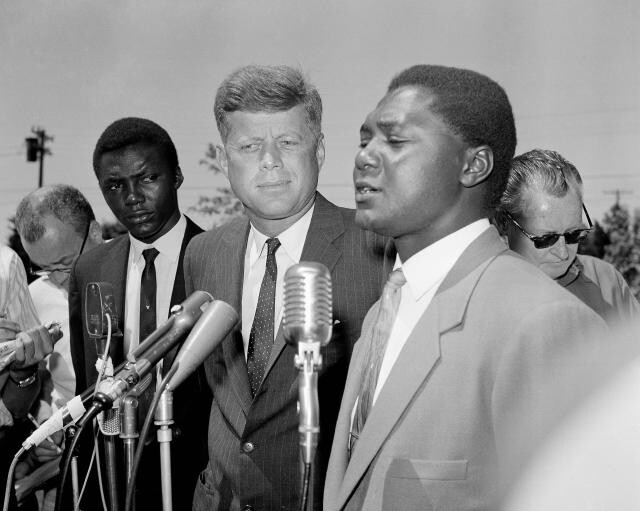
Thomas Joseph Mboya is going to be recognized as one of Kenya’s most colorful and dynamic Cabinet Ministers. He was named Minister of Justice and Constitutional Affairs at independence in 1963. He was transferred to the Ministry of Economic Planning in 1965.
The eldest son of Rusinga Island, Nyanza Province natives Leonard Ndiege and Marcela Awuor, was born on August 15, 1930, and went by the nickname TJ. Despite being laborers on a sisal farm in Kilimambogo, close to Thika, his parents made sure he received an education at Catholic mission schools because they valued education.
Mboya began her education at the age of nine. His father enrolled him in a three-year missionary elementary school in Machakos, which was overseen by an Irish priest. He relocated to Yala, Nyanza’s St. Mary’s Mission School in 1942. He started taking history and English classes at St. Mary’s. He was raised with the famous colonial American catchphrase, “No taxation without representation.” He enrolled in Holy Ghost College (Mangu), a prestigious Catholic school in Central Province, in 1946 after passing the Kenya African Primary Examination in 1945. Mboya, who played Mark Twain, was a prominent debater and performer at the school.
He enjoyed Western rhetoric and had admiration for US President Abraham Lincoln, Black civil rights activist Booker T. Washington, and the French Emperor Napoleon Bonaparte. Mboya studied and reread speeches made during the war by British Prime Minister Winston Churchill, among other things. Sadly, in his last year, his little funds ran out, and he was unable to take the national test that would have allowed him to enroll in a university. However, that didn’t deter him from trying to succeed in life.
He enrolled in the Medical Training School of the Royal Sanitary Institute in 1948 to become a sanitary inspector, and he received his inspector certification in 1950. He then spent two and a half years employed for the Nairobi City Council. After forming the Kenya Government Workers Union, he tendered his resignation to take on the role of general secretary.
Following his membership, he became vice-president of the Nairobi African Local Government Servants Association in less than a year. He joined the Kenya Federation of Labor in November 1953 and served as its general secretary until 1962, when he quit to take a position in the coalition government’s cabinet as a Minister for Labor.
Mboya made the decision to start his “activist” career with workers’ organizations in the 1950s. At a time when the colonial government had declared war on the Mau Mau and had gathered up and imprisoned nationalist leaders and sympathizers like Kenyatta and Achieng’ Oneko, his fame rose in 1952 when he created the Kenya Local Government Workers Union.
Because of his involvement in the trade union movement during Kenya’s worst period—the State of Emergency—Mboya gained notoriety both domestically and abroad in the 1950s and 1960s. Later, he was named Kenya’s delegate to the International Confederation of Free Trade Unions, a position he successfully leveraged to advance his own professional standing.