All of the following US Pacific Island territories except Midway Atoll constitute the Pacific Remote Islands National Wildlife Refuge (NWR) Complex and as such are managed by the Fish and Wildlife Service of the US Department of the Interior. Midway Atoll NWR has been included in a Refuge Complex with the Hawaiian Islands NWR and also designated as part of Papahanaumokuakea Marine National Monument. These remote refuges are the most widespread collection of marine- and terrestrial-life protected areas on the planet under a single country’s jurisdiction. They sustain many endemic species including corals, fish, shellfish, marine mammals, seabirds, water birds, land birds, insects, and vegetation not found elsewhere.
Baker Island: The US took possession of the island in 1857. US and British companies mined its guano deposits during the second half of the 19th century. In 1935, a short-lived attempt at colonization began but was disrupted by World War II, and the island was thereafter abandoned. Baker Island was declared a National Wildlife Refuge in 1974.
Howland Island: The US discovered the island early in the 19th century and officially claimed it in 1857. Both US and British companies mined guano on the island until about 1890. Earhart Light, a day beacon near the middle of the west coast, was partially destroyed during World War II but subsequently rebuilt; it is named in memory of famed aviatrix Amelia EARHART. The US Department of the Interior administers the island as a National Wildlife Refuge.
Jarvis Island: First discovered by the British in 1821, the uninhabited island was annexed by the US in 1858 but abandoned in 1879 after tons of guano deposits were removed for use in producing fertilizer. The UK annexed the island in 1889 but never carried out plans for further exploitation. The US occupied and reclaimed the island in 1935. Abandoned after World War II, the island is currently a National Wildlife Refuge administered by the US Department of the Interior.
Johnston Atoll: Both the US and the Kingdom of Hawaii annexed Johnston Atoll in 1858, but it was the US that mined the guano deposits until the late 1880s. Johnston Atoll was designated a wildlife refuge in 1926. The US Navy took over the atoll in 1934, and the US Air Force assumed control in 1948. The site was used for high-altitude nuclear tests in the 1950s and 1960s, and until 2000, the atoll was maintained as a storage and disposal site for chemical weapons. Cleanup and closure of the weapons facility ended in 2005.
Kingman Reef: The US annexed Kingman Reef in 1922. Its sheltered lagoon served as a way station for flying boats on Hawaii-to-American Samoa flights during the late 1930s. There are no terrestrial plants on the reef, which is frequently awash, but it does support abundant and diverse marine fauna and flora. In 2001, the waters surrounding the reef out to 12 nm were designated a US National Wildlife Refuge.
Midway Islands: The US took formal possession of the Midway Islands in 1867. The laying of the trans-Pacific cable, which passed through the islands, brought the first residents in 1903. Between 1935 and 1947, Midway was used as a refueling stop for trans-Pacific flights. The US naval victory over a Japanese fleet off Midway in 1942 was one of the turning points of World War II. The islands continued to serve as a naval station until 1993. Today the islands are a US National Wildlife Refuge. The refuge was open to the public from 1996 to 2002 and again from 2008 to 2012, but it is now closed.
Palmyra Atoll: The Kingdom of Hawaii claimed the atoll in 1862, and the US included it among the Hawaiian Islands when it annexed the archipelago in 1898. The Hawaii Statehood Act of 1959 did not include Palmyra Atoll, which is now partly privately owned by the Nature Conservancy and partly US Government-owned and administered as a nature preserve. The lagoons and surrounding waters within the 12-nautical-mile US territorial seas were transferred to the US Fish and Wildlife Service and were designated a National Wildlife Refuge in 2001.
Geography
Location
Oceania
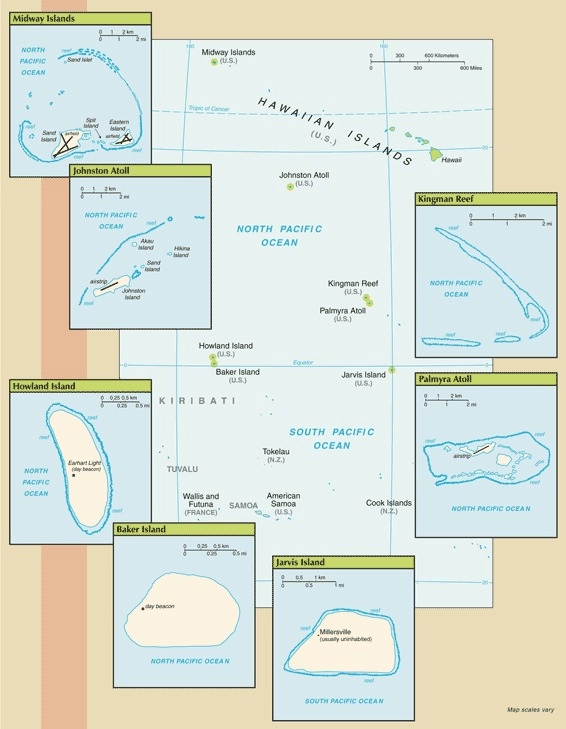
Baker Island: atoll in the North Pacific Ocean 3,390 km southwest of Honolulu, about halfway between Hawaii and Australia;
Howland Island: island in the North Pacific Ocean 3,360 km southwest of Honolulu, about halfway between Hawaii and Australia;
Jarvis Island: island in the South Pacific Ocean 2,415 km south of Honolulu, about halfway between Hawaii and Cook Islands;
Johnston Atoll: atoll in the North Pacific Ocean 1,330 km southwest of Honolulu, about one-third of the way from Hawaii to the Marshall Islands;
Kingman Reef: reef in the North Pacific Ocean 1,720 km south of Honolulu, about halfway between Hawaii and American Samoa;
Midway Islands: atoll in the North Pacific Ocean 2,335 km northwest of Honolulu near the end of the Hawaiian Archipelago, about one-third of the way from Honolulu to Tokyo;
Palmyra Atoll: atoll in the North Pacific Ocean 1,780 km south of Honolulu, about halfway between Hawaii and American Samoa
Geographic coordinates
Baker Island: 0 13 N, 176 28 W;
Howland Island: 0 48 N, 176 38 W;
Jarvis Island: 0 23 S, 160 01 W;
Johnston Atoll: 16 45 N, 169 31 W;
Kingman Reef: 6 23 N, 162 25 W;
Midway Islands: 28 12 N, 177 22 W;
Palmyra Atoll: 5 53 N, 162 05 W
Map references
Oceania
Area
land: 6,959.41 sq km (emergent land – 22.41 sq km; submerged – 6,937 sq km)
Baker Island: total – 129.1 sq km; emergent land – 2.1 sq km; submerged – 127 sq km
Howland Island: total – 138.6 sq km; emergent land – 2.6 sq km; submerged – 136 sq km
Jarvis Island: total – 152 sq km; emergent land – 5 sq km; submerged – 147 sq km
Johnston Atoll: total – 276.6 sq km; emergent land – 2.6 sq km; submerged – 274 sq km
Kingman Reef: total – 1,958.01 sq km; emergent land – 0.01 sq km; submerged – 1,958 sq km
Midway Islands: total – 2,355.2 sq km; emergent land – 6.2 sq km; submerged – 2,349 sq km
Palmyra Atoll: total – 1,949.9 sq km; emergent land – 3.9 sq km; submerged – 1,946 sq km
Area – comparative
Baker Island: about 2.5 times the size of the National Mall in Washington, D.C.;
Howland Island: about three times the size of the National Mall in Washington, D.C.;
Jarvis Island: about eight times the size of the National Mall in Washington, D.C.;
Johnston Atoll: about 4.5 times the size of the National Mall in Washington, D.C.;
Kingman Reef: a little more than 1.5 times the size of the National Mall in Washington, D.C.;
Midway Islands: about nine times the size of the National Mall in Washington, D.C.;
Palmyra Atoll: about 20 times the size of the National Mall in Washington, D.C.
Land boundaries
total: 0 km
Coastline
Baker Island: 4.8 km
Howland Island: 6.4 km
Jarvis Island: 8 km
Johnston Atoll: 34 km
Kingman Reef: 3 km
Midway Islands: 15 km
Palmyra Atoll: 14.5 km
Maritime claims
territorial sea: 12 nm
exclusive economic zone: 200 nm
Climate
Baker, Howland, and Jarvis Islands: equatorial; scant rainfall, constant wind, burning sun;
Johnston Atoll and Kingman Reef: tropical, but generally dry; consistent northeast trade winds with little seasonal temperature variation;
Midway Islands: subtropical with cool, moist winters (December to February) and warm, dry summers (May to October); moderated by prevailing easterly winds; most of the 107 cm of annual rainfall occurs during the winter;
Palmyra Atoll: equatorial, hot; located within the low pressure area of the Intertropical Convergence Zone (ITCZ) where the northeast and southeast trade winds meet, it is extremely wet with between 400-500 cm of rainfall each year
Terrain
low and nearly flat sandy coral islands with narrow fringing reefs that have developed at the top of submerged volcanic mountains, which in most cases rise steeply from the ocean floor
Elevation
highest point: Baker Island, unnamed location 8 m; Howland Island, unnamed location 3 m; Jarvis Island, unnamed location 7 m; Johnston Atoll, Sand Island 10 m; Kingman Reef, unnamed location 2 m; Midway Islands, unnamed location less than 13 m; Palmyra Atoll, unnamed location 3 m
lowest point: Pacific Ocean 0 m
Natural resources
terrestrial and aquatic wildlife
Land use
other: 100% (2018 est.)
Natural hazards
Baker, Howland, and Jarvis Islands: the narrow fringing reef surrounding the island poses a maritime hazard;
Kingman Reef: wet or awash most of the time, maximum elevation of less than 2 m makes Kingman Reef a maritime hazard;
Midway Islands, Johnston, and Palmyra Atolls: NA
Geography – note
Baker, Howland, and Jarvis Islands: scattered vegetation consisting of grasses, vines, and low-growing shrubs; primarily a nesting, roosting, and foraging habitat for seabirds, shorebirds, and marine wildlife; closed to the public
Johnston Atoll: Johnston Island and Sand Island are natural islands that have been expanded by coral dredging; North Island (Akau) and East Island (Hikina) are manmade islands formed from coral dredging; the egg-shaped reef is 34 km (21 mi) in circumference; closed to the public
Kingman Reef: barren coral atoll with deep interior lagoon; closed to the public
Midway Islands: a coral atoll managed as a National Wildlife Refuge and open to the public for wildlife observation and photography
Palmyra Atoll: high rainfall and lush vegetation make the environment of this atoll unique among the US Pacific Island territories; supports a large undisturbed stand of Pisonia beach forest
People and Society
Population
note: entry is only allowed through a Special Use Permit when the activity is deemed appropriate with purposes to the refuge establishment.
Environment
Environment – current issues
Baker Island: no natural freshwater resources
Howland Island: no natural freshwater resources
Jarvis Island: no natural freshwater resources
Johnston Atoll: no natural freshwater resources; invasion of non-native species
Midway Islands: pollution from plastic; predominantly non-native plant species
Kingman Reef: none
Palmyra Atoll: none
Climate
Baker, Howland, and Jarvis Islands: equatorial; scant rainfall, constant wind, burning sun;
Johnston Atoll and Kingman Reef: tropical, but generally dry; consistent northeast trade winds with little seasonal temperature variation;
Midway Islands: subtropical with cool, moist winters (December to February) and warm, dry summers (May to October); moderated by prevailing easterly winds; most of the 107 cm of annual rainfall occurs during the winter;
Palmyra Atoll: equatorial, hot; located within the low pressure area of the Intertropical Convergence Zone (ITCZ) where the northeast and southeast trade winds meet, it is extremely wet with between 400-500 cm of rainfall each year
Land use
other: 100% (2018 est.)
Government
Country name
conventional long form: none
conventional short form: Baker Island, Howland Island, Jarvis Island, Johnston Atoll, Kingman Reef, Midway Islands, Palmyra Atoll
etymology: self-descriptive name specifying the territories’ affiliation and location
Dependency status
with the exception of Palmyra Atoll, the constituent islands are unincorporated, unorganized territories of the US; administered by the Fish and Wildlife Service of the US Department of the Interior as part of the National Wildlife Refuge System
note: Palmyra Atoll is part privately owned and part federally owned; the Office of Insular Affairs of the US Department of the Interior continues to administer nine excluded areas comprising certain tidal and submerged lands within the 12 nm territorial sea or within the lagoon
Legal system
the laws of the US apply
Diplomatic representation from the US
none (territories of the US)
Flag description
the US flag is used
Energy
Coal
imports: 108,000 metric tons (2023 est.)
Petroleum
refined petroleum consumption: 2,000 bbl/day (2023 est.)
Carbon dioxide emissions
294,000 metric tonnes of CO2 (2023 est.)
from petroleum and other liquids: 294,000 metric tonnes of CO2 (2023 est.)
comparison ranking: total emissions 198
Transportation
Airports
2 (2025)
comparison ranking: 207