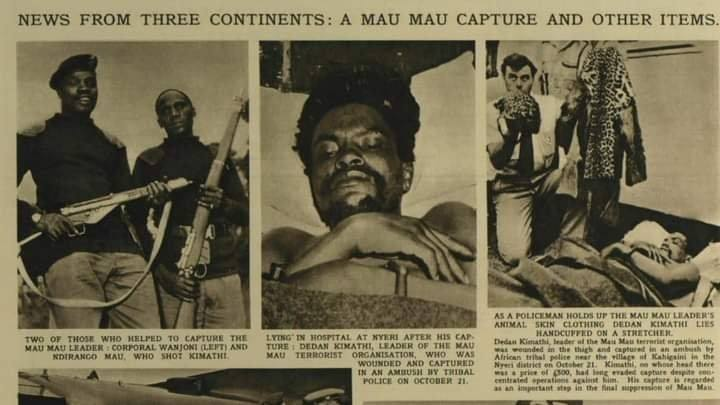
On February 18, 1957, a dark chapter in Kenya’s history was etched as Dedan Kimathi, a prominent leader of the Mau Mau uprising, faced his final moments. At midnight, Kimathi, bound in chains, was escorted by six British security officers and three white clergymen—Father M. Phillip, Reverend Canon Webster, and Father Marino—to the gallows. The execution was carried out with brutal precision, marking the end of a revolutionary figure who remained unrepentant to the last.
The Execution and Aftermath
In the early hours, at around 5:00 a.m., Kimathi’s body, still shackled, was removed from the gallows. It was secretly transported to Kamiti Maximum Security Prison, where it was buried in an unmarked grave. The desecration of his body before burial was a testament to the monstrosity of the act—his penis was cut off, his eyes were gouged out, his legs and arms were broken, and his skull was smashed with a hammer. These heinous acts were committed under the guise of British justice and civilization.
The British authorities confiscated all of Kimathi’s belongings, including the clothes he was wearing at the time of his capture, a golden watch, a .38 revolver, and his writings, which comprised about 14 volumes of books. These items were secretly sent to the British M. 1.5 and the Public Records Office in London.
The Forged Letter by Father Marino
In a bid to further undermine Kimathi’s legacy, Father Marino, one of the clergymen present at the execution, forged a letter purportedly written by Kimathi just minutes before his death. The letter falsely claimed that Kimathi had converted to Catholicism and had requested the church to take care of his family and educate his children after his death. This letter was intended to tarnish Kimathi’s image as a revolutionary leader even in death.
Copies of this forged letter were deliberately placed in the Kenya National Archives and the Public Records Office in London. The aim of Father Marino, Reverend Webster, Father Philip, and the colonial state was clear: to destroy Kimathi’s reputation and legacy.
Legacy and Remembrance
Despite these efforts to defame him, Dedan Kimathi remains a revered figure in Kenyan history. His sacrifice and unwavering commitment to the cause of Kenyan independence continue to inspire generations. The presence of the forged letter in the archives serves as a stark reminder of the lengths to which the colonial regime went to discredit those who stood against them.
The story of Dedan Kimathi’s execution and the subsequent forgery by Father Marino underscores the brutal realities of colonialism and the relentless struggle for freedom. It is a narrative that highlights the resilience of the human spirit and the enduring quest for justice.
Conclusion
The execution of Dedan Kimathi and the forgery of a letter by Father Marino represent a calculated attempt by the British colonial authorities to erase the legacy of a revolutionary leader. However, Kimathi’s spirit and his contributions to Kenya’s fight for independence remain indelibly etched in the annals of history. His story is a powerful reminder of the sacrifices made by many in the pursuit of freedom and justice.