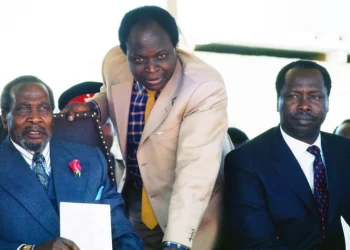
When Kenya’s founding President, Mzee Jomo Kenyatta, died in Mombasa on August 22, 1978, the news was too explosive to release immediately. His death was a state secret, guarded by a few powerful figures who understood the immense political and emotional impact it would have on the country.
One of the key men in that moment was Warrant Officer II Moses Amonde Oyugi, who found himself carrying out one of the most delicate and consequential assignments in Kenya’s history — ferrying the body of the late president to State House Nairobi without knowing who lay in the casket.
At Moi Air Base Eastleigh, the casket arrived aboard a Kenya Air Force aircraft from Mombasa. The mission was led by Kenya Air Force Commander Dedan Gichuru, who personally instructed Oyugi:
“Drive straight to State House. Don’t stop and don’t speak to anyone.”
The order was clear — absolute secrecy, no diversions, and no questions.
The Weight of a Nation in a Casket
Charles Njonjo, the powerful Attorney General at the time, had issued strict orders that the president’s death was to be kept confidential until an official announcement could be made.
The reasoning was strategic — Kenyatta’s towering influence and godlike image had led many to believe he was immortal. There was deep concern that sudden news of his death could cause mass panic and political instability.
Thus, even those directly involved in transporting the casket were kept in the dark.
According to Oyugi’s recollections, Mama Ngina Kenyatta and Vice President Daniel arap Moi also boarded the ambulance. Still, Oyugi had no idea that he was driving the remains of the nation’s founding father.
The convoy was small — just two vehicles — and moved discreetly through Nairobi’s streets, drawing no public attention.
The Moment of Realisation
Upon arriving at State House, Oyugi and his team were instructed to open the casket. It was then that the truth struck him — the body inside was that of Mzee Jomo Kenyatta himself.
In a solemn silence, the casket was opened, and the late president’s body was gently placed on a bed to begin the embalming process.
Only then did Oyugi understand the magnitude of his mission. He had unknowingly driven the body of Kenya’s first president, the man who had led the country to independence and whose passing marked the end of an era.
The Secrecy Behind a Nation’s Transition
The secrecy surrounding Kenyatta’s death allowed the government time to manage the transition of power peacefully.
When the news was finally made public, Vice President Moi was smoothly sworn in as Acting President, avoiding the chaos and confusion that could have destabilized the young nation.
Today, that silent journey from Eastleigh to State House remains one of Kenya’s most remarkable episodes of political restraint and loyalty. It symbolized the delicate balance between grief, leadership, and the need for national stability in a moment of uncertainty.