Nyongesa Sande
No Result
View All Result
  • News
    • World
    • Africa
  • Politics
  • Business
  • Tech
  • AI
  • Telecom
  • Sports
  • Opinion
  • Lifestyle
  • Live
Nyongesa Sande
No Result
View All Result
Nyongesa Sande
No Result
View All Result
  • News
  • Politics
  • Business
  • Tech
  • AI
  • Telecom
  • Sports
  • Opinion
  • Lifestyle
  • Live
ADVERTISEMENT

Home » The Man Who Stopped Kenya’s 1982 Coup

The Man Who Stopped Kenya’s 1982 Coup

Kenya’s Most Dangerous Dawn

NyongesaSande News Desk by NyongesaSande News Desk
7 months ago
in African History
Reading Time: 4 mins read
A A
The Man Who Stopped Kenya’s 1982 Coup

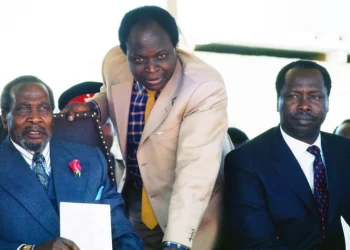
They say troops fight wars and generals take the credit, but in General Mahmoud Mohamed’s case, history gave him both the scars and the glory. The long, tense night of August 1, 1982, remains one of the darkest and most defining moments in Kenya’s political history — and the day this fearless general saved the nation from collapse.

  • How the Coup Began
  • The Rise of General Mahmoud Mohamed
  • Aftermath: Trials, Deaths, and Legacy
  • The Legacy of a Soldier’s Courage

The trouble began as faint whispers — “disturbances” in the Kenya Air Force (KAF) — that were politely downplayed but quietly alarming. James Kanyotu, Kenya’s legendary spy chief, and General Jackson Mulinge, the Chief of General Staff, had caught wind of discontent simmering within the Air Force ranks. Morale was low, tribal divisions were festering, and radical ideas had begun to spread among junior officers.

The final warning came during a ceremonial inspection in mid-1982. As President Daniel arap Moi passed along the Air Force ranks, Mulinge noticed the soldiers making mocking faces at their Commander-in-Chief — an act of open defiance that spoke louder than words. That evening, Mulinge urgently briefed Kanyotu, who in turn briefed Moi. It was clear: something was terribly wrong.

ADVERTISEMENT

How the Coup Began

Unknown to the government, young officers from Embakasi Air Base were already planning to overthrow Moi’s government. The ringleaders — Senior Private Hezekiah Ochuka, Corporal Bramwell Njeremani, Corporal Walter Ojode, Corporal Charles Oriwa, and Sergeant Joseph Ogidi — were plotting a “revolution” that would supposedly bring justice and equality to Kenya.

But their plans were fatally flawed. They lacked a coordinated command, had minimal support from the Army, and failed to secure the key bases. Even worse, as intelligence later revealed, the conspirators spent the night of July 31 drinking heavily, boasting of a coup that hadn’t yet begun.

ADVERTISEMENT

At midnight, gunfire broke out at Embakasi Air Base, where drunken airmen fired into the air, celebrating a revolution stillborn. Panic swept Nairobi. Residents flooded police lines with reports of explosions. By dawn, the mutineers had seized the Voice of Kenya (VoK) broadcasting station and declared the Moi government overthrown.

Their announcement was chaotic, their command incoherent. What began as a military coup quickly descended into looting, confusion, and indiscipline. Nairobi awoke to the sounds of gunfire, uncertainty, and fear.


The Rise of General Mahmoud Mohamed

Amid the chaos, one man remained calm — General Mahmoud Mohamed, then commanding the Kenya Army’s 20 Parachute Battalion, based in Gilgil. When word reached him of the attempted coup, he immediately mobilized loyal units of the Army and General Service Unit (GSU). Without waiting for formal orders, Mahmoud took decisive action.

ADVERTISEMENT

By mid-morning, he had secured State House, ensuring President Moi’s safety. He then led a daring counterattack, moving toward Voice of Kenya, Embakasi, and Eastleigh Air Bases — the coup’s command centers.

In fierce exchanges of gunfire, Mahmoud’s loyal forces recaptured the national broadcaster, cutting off the rebels’ propaganda. Soon after, they overran the Embakasi base, where many mutineers surrendered or fled. By evening, the coup was crushed.

The operation was swift, surgical, and precise. General Mahmoud Mohamed’s leadership was so decisive that within 12 hours, Kenya was back under government control. He became the face of calm under fire — a soldier’s soldier whose loyalty, intelligence, and courage saved an entire nation from anarchy.


Aftermath: Trials, Deaths, and Legacy

In the days that followed, hundreds of Air Force personnel were arrested, interrogated, and court-martialed. Hezekiah Ochuka, the self-declared “President” for a few hours, fled to Tanzania, but was later extradited, tried, and executed by hanging in 1987. The Kenya Air Force was disbanded and reconstituted years later under new leadership and strict oversight.

The failed coup had lasting consequences. It reshaped Kenya’s military command structure, strengthened presidential control, and marked the rise of General Mahmoud Mohamed as a national hero. His quick, disciplined action preserved Kenya’s democracy and prevented the country from spiraling into civil war.


The Legacy of a Soldier’s Courage

In the decades that followed, General Mahmoud Mohamed continued to serve Kenya with distinction — as Army Commander, Chief of General Staff, and later Ambassador. His legacy is one of patriotism, professionalism, and composure under crisis.

The 1982 coup attempt remains a chilling reminder of how fragile nations can be — and how a single man’s courage can change the course of history. Mahmoud Mohamed’s name endures not just in the annals of the military but in the collective memory of a country he refused to let fall.

Tags: 1982 Kenya CoupDaniel Arap MoiJackson MulingeJames KanyotuKenya Air ForceMahmoud Mohamed
Google Add as a Preferred Source on Google
Previous Post

The 1968 Mombasa Stroke That Nearly Shattered Kenya

Next Post

James Orengo: The Lawyer Who Turned His Life into a Legal Protest

NyongesaSande News Desk

NyongesaSande News Desk

Nyongesa Sande offers diverse content across news, technology, entertainment, and more, aiming to provide readers with a wide range of informative and engaging articles. NYONGESA SANDE's dedicated team provides our audience not only with the highly relevant news but also with outstanding interactive experience.

Related Posts

Memorial marker in Ngong Forest marking the spot where J.M. Kariuki’s body was found in 1975.
African History

The Ngong Forest Site Where J.M. Kariuki’s Body Was Found

by NyongesaSande News Desk
4 weeks ago
0

Deep inside Ngong Forest stands a modest memorial marker marking one of the most painful...

Read moreDetails
Historic image associated with Kenya’s notorious Three Musketeers criminal gang of the 1990s.
African History

The Story of Kenya’s Infamous “Three Musketeers” Gang

by NyongesaSande News Desk
4 weeks ago
0

This is The Story of Kenya’s Infamous “Three Musketeers” Gang. During the 1990s, few names...

Read moreDetails
Historic image of Jomo Kenyatta lying in state after his death in August 1978.
African History

Kenya Remembers Jomo Kenyatta 48 Years After His Death

by NyongesaSande News Desk
4 weeks ago
0

It has been 48 years since Kenya entered one of the most emotional moments in...

Read moreDetails
Young Julius Malema during his early years in student politics in South Africa.
African History

How Julius Malema Rose Through Student Politics

by NyongesaSande News Desk
4 weeks ago
0

Long before becoming one of South Africa’s most recognizable and controversial political figures, Julius Malema...

Read moreDetails
Historic image showing Jomo Kenyatta, Daniel arap Moi and Mwai Kibaki together during a public event in Kenya.
African History

Rare Photo Captures Kenya’s First Three Presidents Together

by NyongesaSande News Desk
4 weeks ago
0

A rare and iconic photograph bringing together Kenya’s first three presidents — Jomo Kenyatta, Daniel...

Read moreDetails
Jomo Kenyatta sitting in a garden reading in Highover Storrington, England in 1939.
African History

Rare 1939 Photo Shows Jomo Kenyatta in England Garden

by NyongesaSande News Desk
4 weeks ago
0

A rare 1939 photograph of Jomo Kenyatta sitting quietly in a garden at Highover, Storrington...

Read moreDetails
Load More
Next Post
James Aggrey Bob Orengo Governor Siaya County 2022 – 2027

James Orengo: The Lawyer Who Turned His Life into a Legal Protest

The 1994 IGAD Summit in Nairobi: A Turning Point for Sudan Peace Talks

The 1994 IGAD Summit in Nairobi: A Turning Point for Sudan Peace Talks

ADVERTISEMENT

Who We Are

Nyongesa Sande

NyongesaSande.com is a digital news and media platform covering breaking news, business, technology, AI, politics, sports, world affairs and African innovation.

News Sections

  • News
    • World
    • Africa
  • Politics
  • Business
  • Tech
  • AI
  • Telecom
  • Sports
  • Opinion
  • Lifestyle
  • Live

Editorial Standards

  • Editorial Policy
  • Fact Checking Policy
  • Corrections Policy
  • Ethics Policy
  • AI Usage Policy
  • News Tips
  • Submit Press Release

Legal

  • Privacy Policy
  • Terms of Use
  • Cookie Policy
  • Disclaimer
  • Risk Disclaimer
  • DMCA
  • Ad Choices

Our Company

  • About Us
    • Nyosake Designers
      • Nyosake Webmasters
      • Nyosake Investment
  • Contact Us
    • Newsroom Contact
  • Ownership Disclosure
  • Advertise
  • Privacy Policy
  • Terms of Use
  • Cookie Policy
  • Disclaimer
  • Risk Disclaimer
  • DMCA
  • Ad Choices

NyongesaSande.com is an independent digital news and media platform covering Africa, business, technology, AI, politics and global developments.

© 2026 NyongesaSande.com. All rights reserved.

No Result
View All Result
  • News
    • World
    • Africa
  • Politics
  • Business
  • Tech
  • AI
  • Telecom
  • Sports
  • Opinion
  • Lifestyle
  • Live

NyongesaSande.com is an independent digital news and media platform covering Africa, business, technology, AI, politics and global developments.

© 2026 NyongesaSande.com. All rights reserved.