On September 23, 1957, the world watched as nine African American students attempted to enter Central High School in Little Rock, Arkansas. It was a pivotal moment in the American civil rights movement. But while the students became the face of school integration, another story unfolded—a brutal one involving a courageous Black journalist named Lucious Alexander Wilson. As a white mob unleashed its fury against integration, Wilson was violently attacked for simply doing his job.
The Little Rock Nine and a Nation on Edge
The desegregation of public schools had become a battleground in the fight for civil rights. The U.S. Supreme Court’s 1954 ruling in Brown v. Board of Education declared segregation unconstitutional, but enforcement faced fierce resistance in the South. In Little Rock, nine Black students—later known as the Little Rock Nine—were selected to integrate Central High School.
On the morning of September 23, 1957, as the students approached the school, a mob of white parents and segregationists gathered in protest. Due to escalating tensions and threats of violence, authorities turned the students away.
Lucious Alexander Wilson: A Journalist Under Attack
Among the journalists sent to cover the event was Lucious Alexander Wilson, a respected editor at the Black newspaper Tri-State Defender. While doing his job and documenting this historic day, Wilson became the target of a white mob’s rage. Singled out purely because of his race, he was beaten, choked, and struck with a brick as onlookers either cheered or did nothing.
One man’s kick knocked Wilson to the ground. His hat flew off. In an act of quiet dignity, Wilson picked it up, straightened his suit, and placed the hat back on his head. He did this repeatedly, calmly, as he tried to leave the scene without escalating the situation further. His self-control seemed only to provoke the attackers more.
Despite the brutality, Wilson refused to retaliate. He later said, “I decided not to run. If I were to be beaten, I’d take it walking if I could, not running.”
Images That Shook the Nation

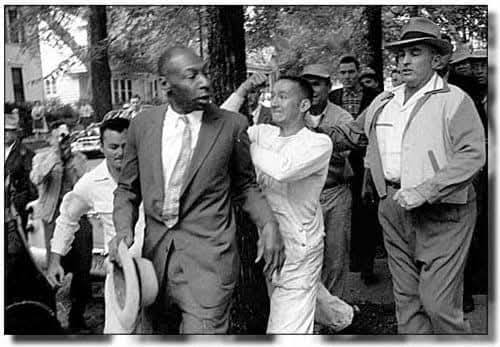
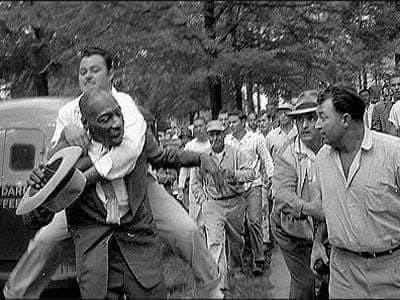
Photographs of the attack appeared in newspapers across the country. The haunting image of Wilson being surrounded and attacked became a turning point in public perception. The violence he endured moved President Dwight D. Eisenhower to take federal action.
On September 24, the day after the attack, President Eisenhower deployed 1,000 troops from the 101st Airborne Division to Little Rock. That same day, under military protection, the Little Rock Nine entered Central High School for the first time.
Wilson’s Courage and Legacy
Despite his injuries, Wilson never sought medical help. Instead, he returned to work and published a powerful editorial the very next day:
“Any newsman worth his salt is dedicated to the proposition that it is his responsibility to report the news factually under favorable and unfavorable conditions… I am not bitter. If my effort helps bring human dignity to the oppressed minority, then the welfare of all will be enhanced.”
Wilson’s words reflected not only courage but a deep belief in justice and journalistic integrity.
In a later interview, he revealed that his U.S. Marine Corps training and time as a war correspondent in Korea gave him the composure to withstand the mob’s assault. He never wavered, even in the face of potential death.
A Life Cut Short
Tragically, Wilson died just three years later at the age of 50. His wife, Emogene Wilson, would later reveal that the blow to his head during the mob attack triggered symptoms consistent with Parkinson’s disease. The assault had lasting consequences—not only for civil rights history but for a man who gave everything to report the truth.
Conclusion
The story of Lucious Alexander Wilson is often overshadowed by the broader narrative of the Little Rock Nine. Yet, his experience is a chilling reminder of the dangers faced by Black journalists in the Jim Crow South—and of the quiet strength it took to confront hate without retaliation.
His unwavering courage helped awaken a nation to the brutal reality of racism and the urgent need for federal intervention. In honoring his legacy, we remember not just a journalist, but a hero of the civil rights movement.