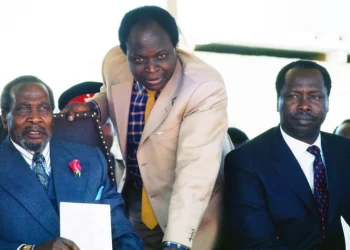
On September 1, 1978, just weeks after the death of Mzee Jomo Kenyatta, Kenya stood at a crossroads. The country’s Founding Father had passed away on August 22, 1978, in Mombasa, leaving behind both a mourning nation and an uncertain political future. At that moment of anxiety, all eyes turned to one man — Vice President Daniel Toroitich arap Moi.
Kenya’s leadership faced a test that could have easily fractured the young nation. The question on every Kenyan’s mind was simple but profound: Would the country hold together after Kenyatta?
The Cabinet’s Historic Declaration
At State House, Nairobi, Kenya’s Cabinet convened in solemn unity under the letterhead now preserved by the Presidential Library and Museum. On that day, the ministers signed a historic document titled “Resolution by the Cabinet”, dated 1st September 1978.
The declaration read in part:
“We, the Cabinet Ministers who had the privilege to serve under the leadership of the Founding Father of the Nation, H.E. Mzee Jomo Kenyatta, and being dedicated disciples of Mzee’s teachings of love and unity, do now pledge and proclaim our total confidence and loyalty to our President H.E. Daniel arap Moi, and call upon all Kenyans to do the same.”
The resolution was more than words — it was a collective vow to preserve national stability and continuity. By invoking Mzee Kenyatta’s “teachings of love and unity”, the ministers framed loyalty to Moi as loyalty to the ideals of the republic’s founding.
Signatures of the Era’s Political Giants
The document bears the signatures of nearly every major political figure of the time — men who had shaped Kenya’s independence and early governance. Among those who signed were:
- Mwai Kibaki, Minister for Finance
- Charles Njonjo, Attorney General
- Mbiu Koinange, Minister of State
- Isaac Omolo Okero, Minister for Labour
- Zachary Onyonka, Minister for Planning
- Dr. Njoroge Mungai, Minister for Defence
- Dr. Munyua Waiyaki, Minister for Foreign Affairs
- Taaitta Towett, Minister for Education
- J.G. Kiano, Minister for Commerce
- J.C. Osogo, Minister for Information
- R.S. Matano, S. Ole Tipis, E.T. Mwamunga, and others
Each signature represented not just a name, but a political commitment — a rare moment of unanimity in a country often defined by ethnic and ideological divisions.
The Beginning of the Moi Era
This Cabinet Resolution effectively smoothed Kenya’s first presidential succession. It assured the public that the government remained united and that there would be no power vacuum. In a continent where military coups were frequent, Kenya’s peaceful handover of power stood out as a model of constitutional order.
When Moi was sworn in on October 14, 1978, the groundwork had already been laid by this symbolic act of loyalty. For 24 years that followed, Moi would rule Kenya — his era shaped by the same Cabinet that had once vowed loyalty to him.
The September 1, 1978 Resolution remains a cornerstone document of Kenya’s political stability, a testament to how unity among leaders preserved the peace at a moment when history could have taken a darker turn.