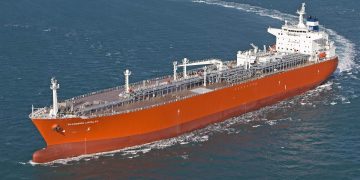
SS Juvenal was an Argentine oil tanker built in Italy in 1928 for the Compañia General de Combustibles. At the time of her completion, she was the largest merchant ship on the Argentine registry and one of the largest oil tankers in the world. She remained in service for more than four decades before being scrapped in 1972.
Construction and Design
SS Juvenal was built by Cantiere Navale Triestino at Monfalcone, near Trieste, Italy. She was launched on 3 June 1928 and completed in August 1928.
- Length: 556.0 ft (169.5 m)
- Beam: 74.1 ft (22.6 m)
- Draught: 29 ft 2 in (8.89 m)
- Depth: 40.3 ft (12.3 m)
- Tonnage: 13,247 GRT (later revised to 13,896 GRT in 1934)
- Deadweight: 18,425 DWT
- Propulsion: Two triple-expansion steam engines, supplied by five boilers heated by 15 corrugated furnaces
- Installed Power: 1,167 NHP, twin screw propulsion
- Speed: Moderate service speed (typical of oil tankers of the era)
The boilers had a combined heating surface of 17,735 square feet (1,648 m²), generating steam at 200 lbf/in² for the twin triple-expansion engines, which were built by the North East Marine Engineering Co. Ltd of Sunderland, England.
When built, she was only slightly smaller than the C.O. Stillman, then the world’s largest tanker, completed in Bremen earlier in 1928.
Service History
Early Career
SS Juvenal entered service in 1928 with the Compañia General de Combustibles of Buenos Aires. She remained under their ownership until 1968.
- In 1932, Juvenal was assigned the code letters NSOP.
- In 1934, she was given the call sign LOFU and fitted with wireless direction-finding equipment and an echo sounding device. Her tonnages were slightly revised to 13,896 GRT and 7,920 NRT. The echo sounder was reportedly removed in 1935.
- By 1936, she remained the largest merchant ship in Argentina’s fleet.
Second World War
During World War II, SS Juvenal was active in the South Atlantic. On 27 December 1942, the British cargo ship SS Oakbank (5,154 GRT, operated by Bank Line) was sunk by German submarine U-507 off the northern coast of Brazil. Juvenal rescued one survivor and transported him to Curaçao, where he was put ashore on 8 January 1943.
Later Career and Ownership Change
In 1968, the vessel was sold to Transmaritima del Plata Compañia de Naviera SAC, who operated her until her retirement.
After over 44 years of service, SS Juvenal was scrapped in December 1972.
Legacy
At the time of her launch, SS Juvenal was a symbol of Argentina’s growing role in international oil transport. Her size and modern design made her a significant addition to the Argentine merchant fleet, and she served during an era when oil tankers became crucial to both commercial trade and wartime logistics.