


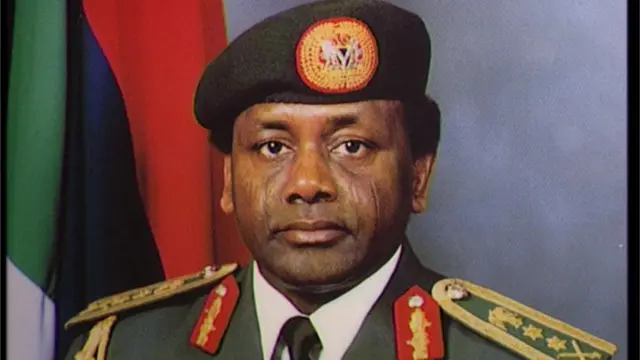
Sani Abacha was born on September 20, 1943, in Kano, Nigeria, into a Kanuri family. Growing up in the bustling northern city, Abacha attended Kano Provincial School and later the Nigerian Military Training College in Kaduna. His ambition to pursue a career in the armed forces led him to further studies at the Mons Officer Cadet School in Aldershot, United Kingdom, where he received British-style training that prepared him for a rapid rise in the Nigerian Army.
Abacha’s early career reflected discipline and loyalty to military hierarchy. He was commissioned as a second lieutenant in 1963, at a time when Nigeria faced political instability following independence in 1960.
Military Career and Rise to Power
Abacha’s career gained momentum during the Nigerian Civil War (1967–1970), where he served with distinction. By 1975, he had risen to the rank of brigadier, becoming one of the youngest officers to attain such status. His loyalty to successive military governments under Murtala Mohammed and later Olusegun Obasanjo earned him a reputation as a dependable officer.
In 1983, Abacha played a decisive role in the coup that removed President Shehu Shagari, ushering in the government of Major General Muhammadu Buhari. Two years later, in 1985, Abacha supported General Ibrahim Babangida in another coup, which installed Babangida as head of state. Abacha’s skill in managing coups reinforced his role as the military’s strongman.
By the early 1990s, Nigeria faced mounting domestic unrest and international criticism over the annulled June 12, 1993 elections, widely believed to have been won by Moshood Abiola. Babangida resigned, handing power to an interim civilian government. In November 1993, Abacha seized power, dissolving democratic institutions and declaring himself head of state.
Rule as Head of State (1993–1998)
As Nigeria’s military ruler, Sani Abacha consolidated power swiftly. He suspended the constitution, banned political activity, and dismissed civilian leaders. His administration created a powerful security network, including a personal presidential guard of thousands of soldiers.
Despite promises of a transition to democracy, Abacha ruled with authoritarian methods. The press was tightly censored, opposition parties were banned, and dissent was harshly suppressed. Prominent political figures, including Moshood Abiola and Olusegun Obasanjo, were imprisoned on charges of treason. Intellectuals and activists such as Wole Soyinka faced persecution, with many forced into exile.
The most controversial act of his regime came in 1995, when Ken Saro-Wiwa, writer and environmental activist, and eight other Ogoni leaders were executed after a military tribunal convicted them of treason. The executions, linked to protests against multinational oil exploitation in the Niger Delta, sparked global outrage and led to Nigeria’s suspension from the Commonwealth of Nations.
Economic Policies and Regional Influence
Abacha’s rule was marked by paradox. On one hand, Nigeria’s economy experienced growth due to rising oil revenues. He introduced economic reforms that stabilized the national currency and curbed inflation. Foreign reserves increased, and Nigeria reduced its external debt.
On the other hand, corruption flourished. Investigations after his death revealed that Abacha and his associates diverted billions of dollars into foreign accounts. The term “Abacha loot” became synonymous with large-scale embezzlement.
Regionally, Abacha supported ECOWAS (Economic Community of West African States) and its peacekeeping force, ECOMOG, deploying Nigerian troops to Liberia and Sierra Leone to stabilize governments in civil conflict. This gave Nigeria considerable influence in West African politics.
Death and Succession
On June 8, 1998, Abacha died suddenly at the presidential villa in Abuja, reportedly from a heart attack at the age of 54. His death ended five years of military authoritarianism. He was succeeded by General Abdulsalami Abubakar, who initiated a transition that restored civilian rule by 1999, leading to the election of Olusegun Obasanjo as president.
Legacy and Controversy
The legacy of Sani Abacha remains one of the most debated in Nigeria’s history. For some, he is remembered as a nationalist who defended Nigeria’s sovereignty, strengthened the military, and maintained regional stability. For others, he is seen as a dictator whose regime represented the height of repression, censorship, and corruption.
After his death, international investigations revealed that the Abacha family and close allies had illicitly amassed an estimated $3 billion in offshore accounts. Efforts to recover this wealth, termed the Abacha loot, have continued for decades, with Nigeria repatriating significant sums from European banks and other jurisdictions.
Despite the controversies, Abacha remains a central figure in Nigeria’s post-independence history. Streets, buildings, and even stadiums once bore his name, although many were later renamed as public sentiment shifted. His rule continues to serve as a cautionary tale of unchecked power, authoritarianism, and the long struggle for democracy in Africa’s most populous country.


