Samsung AI smart glasses have made their official debut, expanding the Galaxy ecosystem into lightweight eyewear designed to deliver hands-free, context-aware assistance throughout the day.
Samsung introduced the intelligent eyewear at its Galaxy Unpacked event in London on July 22, following an earlier preview at Google I/O 2026. The glasses were developed with Google, Qualcomm and eyewear brands Gentle Monster and Warby Parker.
Unlike conventional augmented-reality glasses, the first models do not contain visual displays. They rely on audio, voice commands, touch controls and a built-in camera to help users access Gemini without repeatedly looking at a phone.
Samsung has not announced final prices. The first collections are scheduled to reach selected markets in the fall, with broader availability and additional product details expected later.
Google and Samsung have a shared vision to bring helpful and context-aware intelligence into everyday life. Built on the Android XR platform, the intelligent eyewear blends world-class designs with Gemini’s advanced assistance that naturally responds to what you see, delivering all-day, hands-free help. We’re excited to continue this momentum and bring this experience to people soon,” said Sameer Samat, President of Android Ecosystem at Google.
Samsung AI smart glasses run Android XR
The glasses use Google’s Android XR platform, which was developed for headsets, smart glasses and other extended-reality devices.
Android XR supports two main categories of intelligent eyewear. Audio glasses deliver information through speakers, while display glasses can place visual information within the wearer’s field of view. Samsung’s first designs belong to the audio-focused category.
The lack of a display allows the frames to remain thinner and lighter while reducing battery and thermal demands. Samsung says the design is intended to bring AI assistance into everyday activities without requiring every interaction to begin with a screen.
The glasses are designed as companion devices for smartphones. Google previously said the first models would be compatible with both Android and iOS devices, although specific phone requirements and feature limitations may vary.
Snapdragon chip powers wearable AI
Samsung’s glasses are powered by Qualcomm’s Snapdragon AR1 Gen 1 platform.
The processor was developed specifically for compact smart-glasses designs, with an emphasis on camera processing, artificial intelligence, connectivity, power efficiency and thermal management. Those priorities differ from the requirements of larger mixed-reality headsets such as Samsung’s Galaxy XR.
Samsung says the glasses can operate for up to nine hours on one charge. Their charging case can provide as many as seven additional full charges, although actual endurance will vary according to network conditions, applications, settings and feature use.
The company has not published complete details covering memory, storage, camera resolution, weight or individual battery capacities.
Gemini uses the camera for visual context
Google Gemini serves as the central AI assistant.
The built-in camera allows Gemini to interpret what the wearer is viewing when permission is provided. This gives the assistant contextual information that would not be available from a voice command alone.
For example, users can ask the glasses to photograph a whiteboard or capture information from a meeting. Samsung says the system can organize important details in Samsung Notes, making them easier to review, share and use for follow-up tasks.
The camera can also capture photos and first-person video. During supported video calls, wearers can share their point of view with another participant while keeping their hands free.
Because camera-equipped eyewear can raise privacy concerns for both the wearer and people nearby, Samsung says the product includes controls and safeguards intended to support responsible use. More detailed privacy policies are likely to become important when the glasses reach consumers.
Navigation and translation operate hands-free
The Samsung AI smart glasses are designed to help users move through unfamiliar locations without constantly checking a phone.
Wearers can ask Gemini for a route, select a destination or request information about nearby places. Earlier demonstrations also showed the assistant recommending businesses along a walking route and helping users perform related actions.
Live translation is another central feature. The glasses can provide spoken translation during conversations and help interpret text found on signs or menus.
Language support, accuracy and feature availability will vary by market, application, service provider and network connection. The audio-focused models will read information aloud rather than displaying translated text on a lens.
The glasses can also summarize long messages, read important information and assist with everyday communication. Some functions will require a compatible Galaxy device, supported application or active internet connection.
Voice and touch provide multiple controls
Users can operate the eyewear through spoken requests, touch-sensitive areas on the frame and compatible connected devices.
Voice control is intended to provide the main hands-free experience. Touch input offers an alternative when speaking aloud would be inconvenient.
Samsung also says gesture interaction will be available through the Galaxy Watch9, enabling wearers to control selected functions using the connected smartwatch. That particular interaction method will not be available independently through the glasses.
The company has not provided a complete list of supported gestures or explained whether all controls will work across Android and iOS phones.
Gentle Monster and Warby Parker shape the designs
Samsung partnered with two established eyewear companies rather than treating the glasses solely as a technology product.
The Gentle Monster edition uses a slim black frame with a straight upper rim and softly rounded lower edges. Samsung describes it as the more fashion-forward of the two designs.
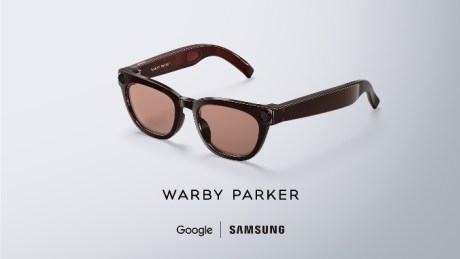
Warby Parker created a brown frame featuring a slightly raised brow line and a more conventional everyday appearance.
Samsung says the companies worked together to improve comfort around important contact points, including the ears and forehead. Different frame styles, colors and lens options are expected, although the final retail range has not been detailed.
Display-equipped AR glasses remain in development
Samsung’s first consumer models concentrate on audio and AI assistance, but the company is also working within the broader Android XR ecosystem on glasses that include displays.
Display-equipped models could show navigation instructions, notifications, translations and other digital information directly within the wearer’s view.
Those products will present greater technical challenges involving battery life, heat, weight and visual clarity. Samsung has not announced when its display-based AR glasses will launch.
For now, the first intelligent eyewear collection represents a more restrained approach: familiar-looking glasses that use cameras, speakers and Gemini to provide assistance without placing another visible screen in front of the user.
Their success will depend on comfort, battery reliability, privacy protections and how consistently Gemini can understand real-world situations. Pricing will also determine whether Samsung’s glasses become a mainstream Galaxy accessory or remain a premium experiment when sales begin in selected markets this fall.
Read Also: AWS Billing Bug Displayed Fake Charges Worth Billions