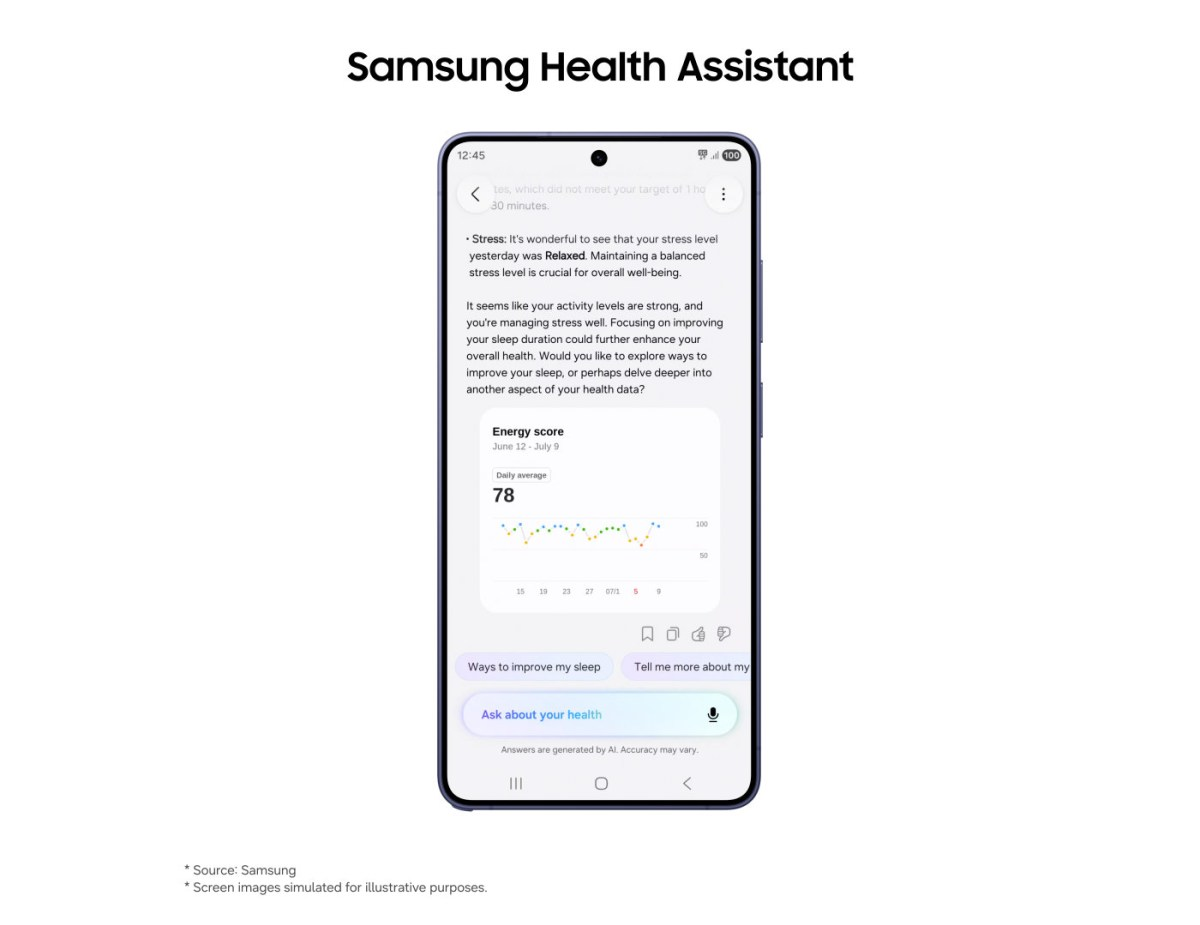
Samsung Health Assistant is now available in beta for eligible users in the United States, bringing conversational artificial intelligence and personalized wellness guidance into the company’s health platform.
Samsung describes the service as its first fully integrated AI-powered personal health assistant. It allows users to ask questions about their health information and receive recommendations based on data collected across Samsung Health.
The system organizes information around five areas: sleep, physical activity, nutrition, mindfulness and vital measurements. It then examines how changes in one category may affect the others, helping users interpret information that would otherwise appear as separate charts and scores.
The assistant is intended to support everyday wellness decisions rather than replace professional medical care, diagnosis or treatment.
Samsung Health Assistant connects wellness data
Samsung Health already collects a wide range of information through Galaxy phones, smartwatches and connected services.
Depending on the devices and features available, that information can include sleep duration, daily movement, exercise records, heart-rate trends, stress measurements, blood-oxygen readings and nutrition logs.
The new assistant combines relevant data instead of requiring users to interpret each measurement separately.
A user experiencing lower energy, for example, could ask why their Energy Score has declined. The assistant may examine recent sleep, activity and other available records before explaining patterns that could have contributed to the change.
Samsung says the system can identify relationships and signals that users might otherwise overlook. It is designed to translate complex health information into more understandable and actionable guidance.
Its usefulness will depend on the quality and consistency of the information recorded in Samsung Health. Missing sleep data, incomplete food logs or an incorrectly worn device could limit the accuracy of its conclusions.
Users can ask questions about their health
The conversational interface is one of the most important additions.
Rather than opening several sections of Samsung Health and comparing measurements manually, users can ask natural-language questions about their wellness data.
Possible questions could address sleep consistency, activity levels, recovery patterns or changes in measured stress. Samsung has not published a complete list of supported questions, and capabilities may evolve during the beta.
The company says recommendations are based on Samsung Health’s knowledge system and have been reviewed by a team of physicians and certified health coaches.
That review may help improve the general quality of the guidance, but it does not turn the assistant into a doctor. Automated recommendations may not account for a user’s complete medical history, medication, symptoms or circumstances outside the information available to the platform.
People with health concerns should therefore treat the feature as an informational wellness tool and seek qualified medical advice when necessary.
Five pillars provide a broader picture
Samsung has reorganized its health platform around five core wellness pillars:
Sleep covers rest duration, consistency and related recovery information.
Activity includes exercise, movement and broader physical-fitness records.
Nutrition incorporates food and dietary information entered into Samsung Health or supported connected services.
Mindfulness focuses on stress management and mental-wellness routines.
Vitals includes measurements recorded through compatible devices and health features.
Bringing these areas together reflects Samsung’s effort to provide a more holistic interpretation of daily health.
A poor night’s sleep may affect exercise readiness. Increased physical activity may influence stress and recovery. Nutrition patterns may also contribute to changes in energy or weight.
The assistant is designed to explain those relationships rather than presenting each metric in isolation.
However, the five categories will not be equally complete for every user. Sleep and activity information can often be captured automatically by a wearable, while nutrition and mindfulness data may require more manual input.
Personalization could expand over time
Samsung plans to broaden the Health Assistant beyond its initial question-and-answer functions.
Future development may include coaching tools intended to help users change habits and work toward specific goals. Samsung has identified weight management as one possible area for expansion.
The company also plans to incorporate context from its Personal Data Engine. That could allow the assistant to consider information such as a user’s schedule and preferences when generating responses.
A recommendation could therefore become more practical by accounting for when the user is usually available to exercise or sleep, rather than supplying generic guidance.
Samsung says its Personal Data Engine processes information from supported native applications when the relevant personalization setting is enabled. The company has previously stated that analyzed information is removed when the Personal Data Intelligence feature is turned off.
Samsung has not yet detailed every privacy control specific to the Health Assistant beta. Users should review permissions, data-sharing options and supported-device requirements before enabling the service.
Health data raises privacy questions
Health information is among the most sensitive data collected by consumer technology platforms.
Combining sleep records, activity patterns, vital measurements and behavioral information can produce highly personal insights. Adding an AI interface also raises questions about where information is processed, how long it is retained and which systems can access it.
Samsung’s deeper integration may offer convenience because the assistant works within the company’s existing health ecosystem. It may also reduce the need for users to transfer data manually into an unrelated chatbot.
Even so, users will need clear explanations of how their questions and health records are handled during the beta.
Important considerations include whether data is processed locally or in the cloud, whether conversations are retained and whether information may be used to improve the underlying AI system.
The quality of Samsung’s privacy disclosures will be as important as the usefulness of the recommendations, particularly if the assistant expands into more sensitive areas.
Samsung builds a more proactive health platform
Samsung has gradually been moving its health products from passive measurement toward proactive guidance.
Recent Samsung Health updates have emphasized personalized daily insights, readiness information and recommendations based on connected data. The Health Assistant adds a conversational layer that lets users explore those insights directly.
The approach reflects a wider shift in wearable technology. Smartwatches and fitness trackers increasingly do more than count steps or display heart-rate readings. Companies are using AI to interpret patterns, explain changes and suggest actions.
That creates opportunities to make health information easier to understand. It also increases the risk that users may give too much weight to automated advice.
Samsung will need to communicate uncertainty clearly and distinguish general wellness suggestions from information that requires professional medical assessment.
US beta will test real-world usefulness
The Samsung Health Assistant beta is initially limited to eligible users in the United States. Samsung has not announced a timetable for a wider international rollout.
The beta period will allow the company to evaluate how people use the service, which questions are most common and where responses require improvement.
Key issues will include the accuracy of personalized explanations, compatibility across Galaxy devices and the reliability of advice when user data is incomplete.
Samsung will also face pressure to demonstrate that the assistant can offer useful guidance without overstepping into diagnosis or creating false confidence.
The service could become an important part of the Galaxy health ecosystem if it consistently turns complex data into understandable insights. Its broader success, however, will depend on privacy protections, transparent limitations and whether users find its recommendations meaningfully better than the dashboards already available in Samsung Health.