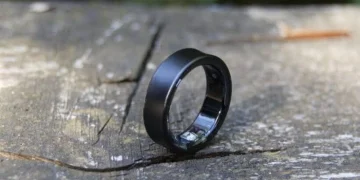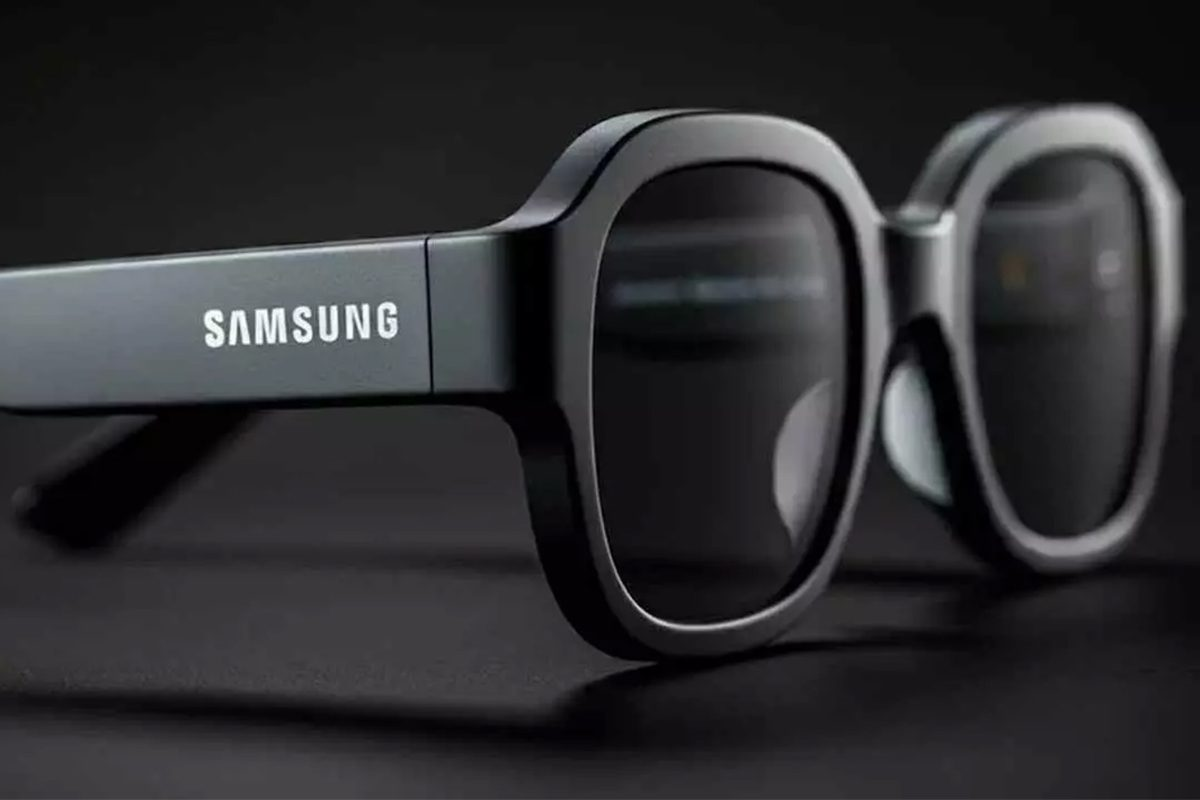
Samsung’s upcoming Galaxy Glasses are starting to look more real.
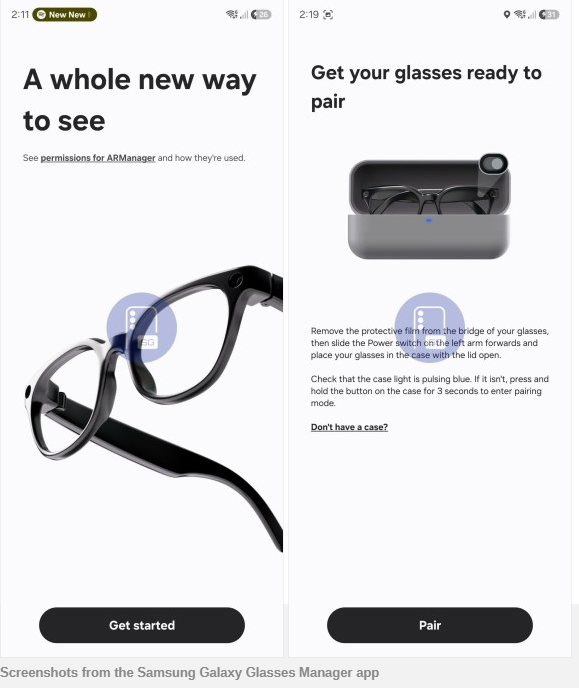
Fresh screenshots from the Samsung Galaxy Glasses Manager app have surfaced online, offering a closer look at how the company’s intelligent eyewear may work once it reaches consumers. The app appears to act as the main control centre for pairing the glasses, managing settings, installing updates, importing media and connecting the glasses with other Galaxy devices.
The leak focuses on the Warby Parker version of the glasses, one of the two eyewear styles Samsung and Google have already previewed publicly alongside Gentle Monster. The screenshots suggest that Samsung is preparing a tightly integrated Galaxy ecosystem experience, with phone, watch and ring controls all playing a role.
The most important detail is the software branding. The app references One UI XR, the same Samsung XR software identity used for its wider extended-reality ambitions. That suggests the glasses will not be treated as a simple Bluetooth accessory. Instead, they appear to be part of Samsung’s larger Android XR strategy, built with Google and Qualcomm.
Samsung has not yet announced a full launch date, price or final retail details for the Galaxy Glasses. But with Google already saying intelligent eyewear is coming later this fall, the leaked app screenshots make the product feel much closer to release.
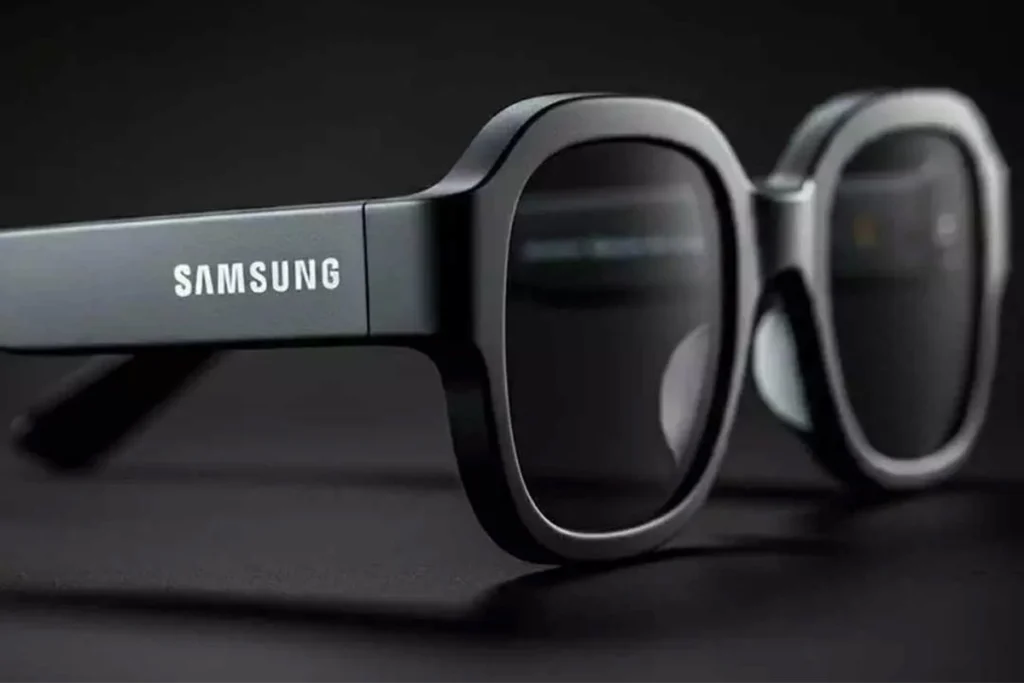
What the Galaxy Glasses Manager App Shows
The Galaxy Glasses Manager app appears to be the companion app users will rely on to set up and control Samsung’s smart glasses.
According to the leaked screenshots, the app can guide users through pairing, manage device settings, install software updates and enable or disable features. That is similar to how Galaxy Buds, Galaxy Watch and Galaxy Ring devices are managed through Samsung’s wearable ecosystem.
The app’s main screen reportedly shows the paired glasses at the top, likely with battery information. This would give users a quick way to check device status before leaving home.
The app also includes options connected to camera features, AI assistants, notification reading, advanced features, accessibility and finding the glasses. This suggests Samsung wants the glasses to operate as an everyday wearable, not just a camera accessory.
One of the most useful features appears to be automatic photo and video import. If enabled, media captured on the glasses could be moved directly to a connected Galaxy phone after the right permissions are granted. That would make the glasses feel more like part of the phone camera system.
For users, this could be important. Smart glasses are most useful when they reduce friction. If taking a photo requires complicated transfers, people may stop using the feature. Automatic import would make first-person capture easier and more natural.
The Warby Parker Model Takes Shape
The glasses shown in the leaked app are reportedly the Warby Parker model. That matters because Samsung and Google are not building these glasses as ordinary tech hardware first. They are working with eyewear brands to make them look wearable in daily life.
Warby Parker is known for accessible, stylish prescription eyewear. Gentle Monster, the other partner, brings a more fashion-forward and experimental design identity. By working with both brands, Samsung and Google appear to be targeting different style preferences.
This is a major lesson from the smart glasses market. People may accept a smartwatch even if it looks slightly technical, but glasses sit directly on the face. They are deeply personal. If they look awkward, heavy or obviously gadget-like, many users will not wear them.
The Warby Parker model appears to be aimed at a more refined everyday look. The goal is likely to make the device feel close to normal eyeglasses while still including microphones, speakers, cameras and AI capabilities.
If Samsung can make the glasses stylish enough for daily wear, it will have a much stronger chance of competing with Meta’s Ray-Ban smart glasses.
One UI XR: Samsung’s Software Identity for Smart Glasses
The app leak points to One UI XR branding, which is one of the most important details.
One UI is Samsung’s familiar software layer across Galaxy phones, tablets, watches and foldables. One UI XR extends that identity into extended reality devices. If Galaxy Glasses run One UI XR on top of Android XR, users may get a Samsung-style interface designed specifically for wearable AI experiences.
Android XR is the platform Google, Samsung and Qualcomm have been developing for headsets and glasses. It is designed to bring Android apps, Gemini AI and spatial computing experiences to new form factors.
For glasses, One UI XR may not look like a full headset interface. The first models are expected to be audio-first smart glasses rather than full augmented-reality displays. That means the experience may focus more on voice, audio, camera capture, notifications and phone-connected AI than on floating visual screens.
Still, One UI XR branding suggests Samsung wants a consistent software foundation across its XR devices. This could help the company build a broader ecosystem that includes Galaxy XR headsets, Galaxy Glasses, phones, watches and rings.
Galaxy Ring Gesture Controls Could Be a Big Deal
One of the most interesting findings in the app leak is possible Galaxy Ring integration.
The screenshots and app strings reportedly suggest that the Galaxy Ring may support gesture controls for the glasses. This could allow users to control certain glasses functions through small finger gestures rather than touching the glasses or speaking out loud.
That idea makes sense.
Voice control is useful, but it is not always appropriate. People may not want to speak commands in a meeting, on public transport, in a quiet room or during a private moment. Touch controls on glasses can also be awkward because tapping the frame is visible and may move the glasses.
A ring gesture could be more discreet. A small pinch or finger movement could start or stop a function, control media, trigger capture, silence alerts or interact with the glasses in a more natural way.
Samsung already uses the Galaxy Ring as a health and wellness device, but smart glasses could give it a new role as an input device. If the integration works well, the Galaxy Ring may become more than a passive tracker. It could become a controller for the broader Galaxy ecosystem.
That would make Samsung’s wearable strategy more interesting than simply copying existing smart glasses.
Galaxy Watch Controller App Also Appears
The leak also points to a Galaxy Glasses Controller app for Galaxy Watch.
This would give users another way to control the glasses from the wrist. A watch controller could be useful for managing settings, adjusting volume, starting capture, checking battery status or controlling smart features without opening the phone.
Samsung already uses the Galaxy Watch as a control point for phones, earbuds, cameras and smart home devices. Adding smart glasses would fit naturally into that pattern.
A watch-based controller could also solve one of the biggest smart glasses challenges: input. Glasses have limited space for buttons and touch sensors. Voice commands are powerful but not always ideal. A watch gives users a screen, buttons, gestures and touch input in a familiar form.
If Samsung combines phone, watch and ring controls, the Galaxy Glasses could become one of the most ecosystem-dependent smart glasses products on the market.
That could be good for existing Galaxy users. It may also make the glasses less attractive to people outside the Samsung ecosystem unless Android-wide support is strong.
Automatic Photo and Video Import
The app’s media import feature may be one of the most practical additions.
Smart glasses with cameras are useful for capturing quick first-person photos and videos. They allow users to record what they are seeing without pulling out a phone. This can be useful for travel, family moments, events, tutorials, commuting, shopping, cooking or hands-free documentation.
But capture is only half the experience. Users also need easy access to those files.
If the Galaxy Glasses Manager app automatically imports photos and videos to a paired phone, Samsung can make the workflow feel familiar. Captured media could appear in the phone’s gallery, be edited, shared or backed up like normal phone content.
This could help Samsung position the glasses as a companion camera rather than a standalone device. Instead of replacing the phone camera, the glasses would add a new first-person perspective.
However, camera-equipped smart glasses also raise privacy questions. Samsung will need clear recording indicators, permission controls and responsible design choices so people nearby know when recording is happening.
AI Assistants and Gemini Integration
Samsung and Google have already shown that Gemini will be central to the intelligent eyewear experience.
The glasses are expected to help users through voice interaction. That may include asking for directions, sending messages, receiving summaries, adding calendar events, translating text or audio and getting contextual help based on what the glasses can see or hear.
This is where the product becomes more than a camera.
With AI, smart glasses can act as an assistant that understands the user’s surroundings. For example, a user could ask for help reading a sign, translating a menu, identifying a location, remembering where they parked or summarising an incoming message while walking.
The key advantage is hands-free use. A phone requires the user to look down, unlock the screen and open an app. Glasses can respond while the user keeps moving.
The challenge is accuracy. AI glasses must understand context correctly, respond quickly and avoid being intrusive. If Gemini is too slow, too talkative or too often wrong, users may lose confidence.
Samsung and Google will need to make the AI feel useful in small daily moments rather than overwhelming users with features.
Read Notifications Aloud
The leaked app includes a “Read notifications aloud” option.
This feature could be one of the most commonly used parts of Galaxy Glasses. Instead of checking a phone every time a message arrives, users could hear important notifications through the glasses.
That sounds simple, but it could change daily behaviour.
When walking, cycling, cooking, shopping or carrying bags, users may prefer hearing a short notification summary rather than stopping to check their phone. For accessibility, spoken notifications could also be helpful for users who need audio-first interaction.
The risk is notification overload. If every app reads alerts aloud, the experience could become annoying very quickly. Samsung will need strong controls that let users choose which apps can speak through the glasses.
The best version of this feature would prioritise important messages and allow quick replies through voice.
Find My Glasses
The app also appears to include a “Find my glasses” feature.
This is a small but important practical tool. Glasses are easy to misplace because people remove them frequently at home, in cars, in offices, at restaurants and while travelling. A find feature could help locate them through a connected phone or possibly make the case or glasses emit a sound.
For an expensive wearable, this matters. Users may be more comfortable buying smart glasses if they know there are tools to help locate them.
Samsung already offers device-finding features through its Galaxy ecosystem, so adding glasses would be expected. The key will be whether the feature works when the glasses are inside their case, powered down or out of Bluetooth range.
The Charging Case Could Be Important
Reports on the app leak also mention a case that appears to work like a charging and carrying case.
That would make sense. Smart glasses need a convenient way to charge because they are too small to hold large batteries. A case can protect the glasses, top up battery life and help with pairing status.
Meta’s Ray-Ban smart glasses already use a charging case model, and Samsung is likely to follow a similar approach. A good case can make or break the daily experience. If users must plug the glasses in manually every time, the product becomes less convenient. If the case charges them automatically, the routine feels closer to earbuds.
The case design will also matter because glasses are larger and more fragile than earbuds. It must be protective without becoming too bulky.
A well-designed case could make the Galaxy Glasses easier to carry, charge and use every day.
Why Samsung Is Entering Smart Glasses Now
Samsung is entering smart glasses at a moment when the category is becoming more serious.
Meta has shown that camera-and-audio smart glasses can appeal to consumers when the design is fashionable enough. Google is returning to eyewear with Android XR and Gemini after the early Google Glass era failed to become mainstream. Apple is still focused on spatial computing through Vision Pro, while other companies are exploring lighter XR devices.
For Samsung, glasses are a natural extension of the Galaxy ecosystem. The company already sells phones, tablets, watches, earbuds, rings and XR headsets. Smart glasses could become another screen-free or lightweight AI companion device.
The timing also reflects the rise of generative AI. Smart glasses were once mainly about cameras and notifications. Now they can be framed as AI companions that understand context and help in real time.
That gives Samsung and Google a stronger reason to try again.
How Galaxy Glasses Could Compete With Meta Ray-Ban Glasses
Meta’s Ray-Ban smart glasses are the obvious competitor. They combine stylish frames, cameras, speakers, microphones and AI features inside a familiar eyewear brand.
Samsung’s advantage could be ecosystem integration. If Galaxy Glasses connect deeply with Galaxy phones, watches and rings, Samsung can offer a broader wearable experience than a standalone pair of glasses.
Google’s Gemini and Android XR may also be major advantages. Integration with Android apps, Google Maps, Google Messages, Calendar, Translate and other services could make the glasses more useful for Android users.
Meta’s advantage is maturity. Its Ray-Ban line is already on the market and has benefited from a strong fashion partnership with EssilorLuxottica. Samsung and Google must prove that their glasses are not only smart but also comfortable, stylish and reliable.
The battle may come down to everyday usefulness. Consumers will not wear smart glasses just because the technology is clever. They will wear them if they look good, feel light and solve daily problems.
Launch Timing Remains Unclear
Samsung has not announced a final retail launch date for Galaxy Glasses.
Google has said the first audio glasses are coming later this fall, and Samsung has already previewed intelligent eyewear with Warby Parker and Gentle Monster. However, the exact country rollout, pricing, model names and availability remain unknown.
There is speculation that Samsung could tease the glasses again at an upcoming Galaxy Unpacked event. That would make sense because the company may use its foldable-phone launch stage to remind users that Galaxy is becoming more than phones.
Still, a teaser is not the same as a full launch. Buyers should wait for official details before assuming release timing, pricing or market availability.
Why This Leak Matters
The Galaxy Glasses Manager app leak matters because companion apps often reveal how a product will actually work.
Marketing previews show what companies want people to imagine. App screenshots show the practical reality: settings, pairing, updates, permissions, controls and ecosystem links.
In this case, the leak suggests Samsung is preparing a serious wearable platform. The glasses are not just being treated as a camera accessory. They appear to connect with One UI XR, Galaxy Watch, Galaxy Ring, AI assistants, media import and accessibility features.
That points to a broader strategy. Samsung wants smart glasses to become part of the Galaxy ecosystem, much like earbuds, watches and rings.
If the final product delivers on that promise, Galaxy Glasses could become one of Samsung’s most important new categories.
Final Thoughts
The leaked Samsung Galaxy Glasses Manager app gives the clearest look yet at how Samsung’s intelligent eyewear may work in real life.
The app suggests users will be able to pair the glasses, manage settings, install updates, import photos and videos, control features, find the glasses and connect them with other Galaxy wearables. The presence of One UI XR branding also confirms that Samsung sees the glasses as part of its broader Android XR future.
The most exciting detail may be Galaxy Ring and Galaxy Watch integration. If users can control the glasses through discreet ring gestures or a watch-based controller, Samsung could offer a more natural input system than voice commands alone.
At the same time, many questions remain. Samsung has not confirmed the final launch date, price, battery life, full specifications or market availability. Privacy safeguards around camera use will also be important.
For now, the Galaxy Glasses look like more than a concept. They are moving toward a real product, and the leaked app shows Samsung is building them as a connected AI wearable rather than a simple pair of camera glasses.
If Samsung, Google and Warby Parker get the design, comfort, AI and privacy balance right, Galaxy Glasses could become one of the most important wearable launches of the year.
FAQs About Samsung Galaxy Glasses
What are Samsung Galaxy Glasses?
Samsung Galaxy Glasses are expected to be intelligent eyewear developed by Samsung and Google with eyewear partners Warby Parker and Gentle Monster. They are designed as phone companion devices that can provide AI help, notifications, navigation, translation and hands-free photo capture.
What did the Galaxy Glasses Manager app leak reveal?
The leaked app screenshots show a companion app for pairing and managing the glasses. The app appears to include settings, software updates, media import, AI assistant controls, notification reading, accessibility options and a “Find my glasses” feature. It also shows One UI XR branding.
Will Galaxy Glasses run Android XR?
The glasses are expected to use Android XR technology, with Samsung’s One UI XR branding appearing in the leaked companion app. Android XR is the platform developed by Google with Samsung and Qualcomm for headsets, smart glasses and other extended-reality devices.
What is One UI XR?
One UI XR is Samsung’s extended-reality software identity built around Android XR. It is expected to bring Samsung’s familiar One UI approach to XR devices such as headsets and smart glasses. For Galaxy Glasses, it may power settings, updates, AI features and ecosystem integration.
Which eyewear brands are involved?
Samsung and Google are working with Warby Parker and Gentle Monster. Warby Parker is expected to provide refined, everyday eyewear designs, while Gentle Monster is known for more fashion-forward and expressive frames.
Will the Galaxy Glasses have a camera?
Samsung and Google have described hands-free photo capture as part of the intelligent eyewear experience. The leaked manager app also includes media import for photos and videos captured with the glasses. Final camera specifications have not yet been officially confirmed.
Can Galaxy Glasses import photos and videos to a phone?
The leaked app suggests users will be able to automatically import photos and videos from the glasses to a connected phone after granting the required permissions. This would make captured media easier to access, edit and share.
Will Galaxy Ring control the glasses?
The app leak includes references suggesting Galaxy Ring gesture controls may work with the glasses. This could allow users to trigger or control certain features through discreet finger gestures. Samsung has not yet officially detailed how this will work.
Will Galaxy Watch control the glasses?
The leak points to a Galaxy Glasses Controller app for Galaxy Watch. This could let users manage certain glasses functions from the wrist, such as controls, settings or status information. Final functionality has not been officially confirmed.
What features will the glasses support?
Expected features include Gemini voice assistance, navigation help, message and notification summaries, calendar support, real-time translation, text translation, hands-free capture and phone-connected AI experiences. Exact features may vary by model and market.
When will Samsung Galaxy Glasses launch?
A full launch date has not been officially confirmed. Google has said the first intelligent audio glasses are coming later this fall, and Samsung may provide more details at a future Galaxy event. Market availability and pricing remain unknown.
Are Galaxy Glasses the same as AR glasses?
The first models appear to be intelligent audio glasses rather than full augmented-reality glasses with rich in-lens displays. Google has described two categories: audio glasses launching first and display glasses that can show information visually. Samsung’s first consumer model may focus on audio, camera and AI features.
How will Galaxy Glasses compare with Meta Ray-Ban glasses?
Meta Ray-Ban glasses are already established in the smart glasses market. Samsung’s advantage may come from deeper Android, Gemini and Galaxy ecosystem integration, including phones, watches and rings. The final comparison will depend on design, battery life, camera quality, AI usefulness and price.
Will Galaxy Glasses work only with Samsung phones?
Samsung has not fully confirmed compatibility details. The glasses are expected to work closely with Galaxy phones, especially because of Galaxy Watch and Galaxy Ring integration. Wider Android compatibility may be possible through Android XR, but final details are not yet official.
Should you wait for Galaxy Glasses?
Galaxy Glasses are worth watching if you use Samsung devices and want AI-powered smart eyewear. However, buyers should wait for official pricing, battery life, market availability and privacy details before deciding.
Read Also: Europe-Made Punkt. MC03 “Sovereign Smartphone” Is Now Available