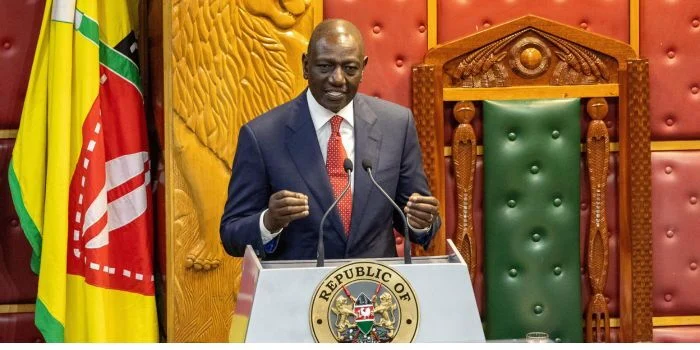
University funding in Kenya could undergo another major overhaul after President William Ruto pledged government support for every qualified student placed in a university or college.
Ruto announced the proposed shift at State House in Nairobi on Tuesday, July 21, saying financial support would no longer depend on a student’s household income. Any additional contribution from parents would be voluntary rather than compulsory, according to reports of his remarks.
The pledge could significantly change Kenya’s student-centered financing system, which currently divides education costs among government scholarships, Higher Education Loans Board loans and household contributions.

However, the government has not yet published detailed rules showing how the new approach will work, how much it will cost or when it will take effect.
University funding pledge marks a major policy shift
Under the proposal outlined by Ruto, a student who passes the required examinations and secures placement at an eligible university or college would receive full government support.
That would represent a shift away from the principle that families should pay different portions of tuition based on their assessed financial capacity.
The current student-centered funding model distributes scholarships and loans according to financial need. The Universities Fund says scholarships range from 30% to 70%, while loans and household contributions cover the remaining cost.
Students must apply through the Higher Education Financing portal, where a means-testing process assesses their level of need.
Ruto’s latest statement suggests that government support would become universal for qualified students, rather than being determined primarily by household circumstances.
Still, it remains unclear whether “full funding” refers entirely to nonrepayable scholarships or to a combination of grants and government-backed loans.
That distinction is important. A scholarship covers costs without requiring repayment, while a HELB loan creates an obligation that follows the student after graduation.
Current model requires household contributions
Kenya introduced the student-centered funding model in 2023 to address financial strain at public universities and technical and vocational education institutions.
Under the framework, each student receives a funding package based on assessed need. The package can include a government scholarship, a tuition loan, an upkeep loan and a contribution paid by the household.
The Universities Fund states that the scholarship component covers between 30% and 70% of tuition. Families and HELB-supported borrowing must cover the balance.
As a result, even students classified among the most financially vulnerable may still face some education expenses. Students from households judged more capable of paying receive smaller scholarship shares and carry a larger family contribution.
Ruto’s proposal would potentially eliminate the compulsory household portion. Parents who could afford to offer additional support might still do so, but their payments would no longer determine whether tuition had been fully covered.
The government has not clarified whether the existing financial-need categories would remain in use for upkeep allowances, accommodation support or other non-tuition expenses.
Budget pressures could complicate the plan
The biggest challenge facing the proposed model is financing.
Kenya’s existing higher education system already faces a substantial funding shortfall. HELB was allocated KES 56.3 billion for the 2026-27 financial year against an estimated requirement of KES 112.1 billion to support about 1.38 million university and TVET students, according to budget reports.
That leaves HELB with an estimated deficit of KES 55.8 billion.
When scholarship needs under the Universities Fund are included, the combined higher education financing gap exceeds KES 72 billion, according to the same reports.
The shortfall raises questions about how the government would finance universal support while also meeting existing obligations.
Removing mandatory family contributions would increase the amount the state must provide. Replacing repayable loans with grants, should the government choose that route, would create an even larger long-term cost because future loan repayments would no longer help replenish the system.
The education sector received KES 784.5 billion in the 2026-27 budget, making it one of the government’s largest spending areas. However, that allocation covers the entire sector, including teachers’ salaries, school capitation, infrastructure and student financing.
The administration has not identified a dedicated revenue source for the universal university funding proposal.
| Band | Govt scholarship | HELB tuition loan | Family gap | Annual upkeep loan |
| 1. Most needy | 70% | 25% | 5% | KES 60,000 |
| 2. Needy | 60% | 30% | 10% | KES 55,000 |
| 3. Moderately needy | 50% | 30% | 20% | KES 50,000 |
| 4. Less needy | 40% | 30% | 30% | KES 45,000 |
| 5. Least needy | 30% | 30% | 40% | KES 40,000 |
Universities remain under financial strain
The new pledge also comes as Kenya’s public universities face large unpaid obligations.
Public universities had accumulated pending bills of about KES 100.3 billion by January 2026, according to information presented to lawmakers by the State Department for Higher Education.
Those debts reflect years of financial pressure, including delayed government disbursements, growing enrollment and a mismatch between the cost of degree programs and the money available to institutions.
Before the current student-based system, Kenya relied heavily on the Differentiated Unit Cost model. That framework was intended to fund universities according to the estimated cost of delivering specific academic programs.
In practice, the government frequently provided less than the calculated amount. The resulting shortfalls contributed to growing university debts and weakened institutions’ ability to pay employees, suppliers and statutory obligations.
The student-centered model was introduced as a way to direct money more precisely toward individual learners. However, it has faced criticism over its means-testing process, household payment requirements and overall funding adequacy.
TVET treatment remains unclear
Ruto’s remarks referred to students placed in both universities and colleges, indicating that technical and vocational learners may also be covered.
However, the government has not explained whether TVET students would receive tuition grants, upkeep support or a mixture of grants and loans.
TVET financing currently operates through a separate support structure, with students able to seek government assistance based on assessed need.
A universal approach could expand access to technical training, which the administration has promoted as central to employment, manufacturing and industrial development.
Yet extending full support across universities and TVET institutions would also increase the number of beneficiaries and the total annual cost.
Eligibility rules will therefore matter. The government must define which institutions, programs and students qualify, particularly where private colleges, repeat years or second qualifications are involved.

Legislation and implementation details still needed
The president’s announcement sets out a policy direction, but it does not by itself change the existing funding framework.
Implementing the plan may require amendments to higher education and HELB laws, along with new regulations governing scholarships, loans, eligibility and repayment.
Parliament would also need to approve adequate funding through the national budget.
The government must explain whether current students will move into the new system or whether it will apply only to future university and college entrants. It must also clarify whether students who already hold HELB loans will continue repaying them under existing terms.
Other unresolved issues include support for living expenses, the treatment of students in private institutions and the mechanism for paying universities on time.
The next development to watch will be the publication of a formal policy and financing plan. Without clear legislation, eligibility rules and a sustainable budget, the pledge will remain an ambitious

Read Also: PesaLink Fees Fall as Banks Challenge M-Pesa