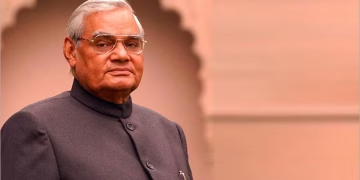
Net Worth: $100 Million
💰 Wealth source: Government control, state-run enterprises, secret accounts
💰 Estimated Castro family fortune: $500–$900 million
💰 Hidden assets: Swiss bank accounts, offshore investments
Raúl Castro, the brother of Fidel Castro, played a key role in Cuba’s Communist Revolution and later ruled as President of Cuba from 2008 to 2018. Despite stepping down, he remained the most powerful figure in Cuba until 2021, overseeing political and economic reforms.
Early Life & Path to Revolution
📍 Born: June 3, 1931, in Birán, Cuba
🏡 Family: Spanish immigrant father, rebellious childhood
📚 Education:
✔️ Studied social sciences but was not an academic standout
✔️ Joined Socialist Youth and participated in violent protests
🔹 Revolutionary Beginnings:
- Followed his older brother Fidel Castro into revolutionary politics.
- 1953: Helped Fidel lead an attack on Moncada Barracks, but they were captured and imprisoned.
- 1955: Released under public pressure, went into exile in Mexico, where they met Che Guevara and trained in guerrilla warfare.
Cuban Revolution (1956–1959)
🔹 Granma Landing & Guerrilla Warfare:
✔️ 1956: Raúl, Fidel, Che Guevara, and 75 rebels landed in Cuba.
✔️ Most were killed; only 12 survived, including Raúl.
✔️ Regrouped in the Sierra Maestra mountains and launched guerrilla attacks.
🔹 Military Role:
✔️ Raúl played a key role in coordinating kidnappings of U.S. and Canadian citizens to gain leverage.
✔️ Captured Maffo, but historians debate his true military abilities.
✔️ Fidel made him second-in-command, trusting him over others.
🔹 Victory Over Batista (1959):
✔️ Revolution succeeded, Batista fled, and Fidel took power.
✔️ Raúl became head of the Cuban Armed Forces, establishing a strong military-state structure.
Consolidation of Power & Cold War Era
🔹 Cuban Missile Crisis (1962):
✔️ Raúl played a role in shooting down a U.S. spy plane (U2) during the crisis.
✔️ The world came close to nuclear war, but Fidel & Soviet leader Khrushchev negotiated a deal.
🔹 Brutal Suppression of Dissent:
✔️ Oversaw executions of political prisoners and opposition figures.
✔️ Helped Fidel create a state-run economy with no private businesses.
✔️ All industries, media, and land were nationalized.
🔹 Strong Soviet Alliance:
✔️ Raúl forged deep ties with the USSR, securing economic aid and weapons.
✔️ Became a hardline Communist, stricter than Fidel in many ways.
Presidency (2008–2018): A More Pragmatic Leader
🔹 Taking Over from Fidel (2006–2008)
✔️ Fidel’s health declined, Raúl took over leadership.
✔️ 2008: Officially elected as President of Cuba.
🔹 Key Reforms Under Raúl:
✔️ Allowed Cubans to buy DVD players, cell phones, and travel abroad.
✔️ Legalized some private businesses, shifting from strict Communism to a hybrid economy.
✔️ Higher wages in state-run jobs and limited foreign investment allowed.
🔹 Historic U.S.-Cuba Relations (2014–2016):
✔️ Restored diplomatic relations with the U.S., ending over 50 years of hostility.
✔️ Cuban & U.S. embassies reopened for the first time since 1961.
✔️ Met with U.S. President Barack Obama in 2016, shaking hands in a landmark moment.
🔹 Retirement & Continued Influence:
✔️ 2018: Stepped down as President, handing power to Miguel Díaz-Canel.
✔️ 2021: Stepped down as First Secretary of the Communist Party, ending the Castro family’s 62-year rule.
✔️ Continues to have influence behind the scenes.
Controversies & Hidden Wealth
💰 Castro Family Fortune:
✔️ Fidel Castro’s net worth estimated at $500–900 million from state-run enterprises.
✔️ Raúl Castro and top Communist elites control hidden bank accounts in Switzerland.
✔️ Cuba’s economy remains under tight military control, ensuring the ruling elite stays wealthy.
👮 Human Rights Violations:
✔️ Political repression, censorship, and mass arrests of dissidents.
✔️ Cuban exile communities blame Raúl for executions and forced labor camps.
✔️ His military controlled most of the economy, making reforms slow and limited.
🚫 Banned from Entering the U.S. (2019):
✔️ Sanctioned by the Trump administration for supporting Venezuela’s Maduro government.
Legacy: Pragmatic Reformer or Communist Hardliner?
✅ Supporters Say:
✔️ Helped modernize Cuba with limited reforms.
✔️ Restored relations with the U.S. and reduced tensions.
✔️ Maintained stability after Fidel’s death and avoided collapse.
❌ Critics Say:
❌ Kept political oppression and a one-party system.
❌ Did not fully open Cuba’s economy, keeping tight military control.
❌ Failed to improve living standards for most Cubans while elites stayed wealthy.
Final Thoughts: Raúl Castro’s Impact on Cuba & The Future
✅ One of the most influential figures in Cuban history.
✅ Oversaw Cuba’s transition after Fidel and prevented collapse.
✅ Made cautious reforms but kept strict control over power.
❌ Left Cuba’s economy struggling and people demanding more freedom.
🔹 Will Cuba fully reform post-Castro? Only time will tell. Raúl Castro’s legacy remains deeply controversial.