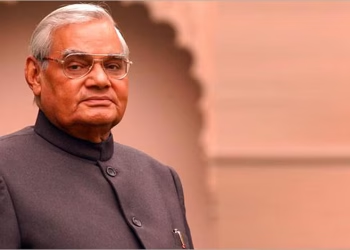
Girma Wolde-Giorgis net worth is estimated at $1.5 million, a reflection of his long-standing service in Ethiopian civil aviation, government leadership, and public diplomacy. As President of Ethiopia from 2001 to 2013, Girma held a largely ceremonial role, but his career before and during his presidency showcased his deep involvement in national development and civil service.
Early Life and Military Education
Girma Wolde-Giorgis was born on December 8, 1924, in Addis Ababa, Ethiopia. He graduated from the Oletta Military Academy in 1944 as a Sub-Lieutenant, a position that launched his early involvement in aviation and military service. Girma went on to receive certificates in:
- Air Traffic Management
- Air Traffic Control
- Public Administration and Management
These qualifications marked him as one of the first Ethiopians to enter the Ethiopian Air Force and become involved in civil aviation administration at a national level.
Pioneering Work in Aviation
In the 1950s and 1960s, Girma rose through the ranks of Ethiopia’s emerging civil aviation sector. He held several key leadership roles:
- Director General of the Ministry of Trade, Industry, and Planning (1951)
- Head of Civil Aviation in Eritrea (1955)
- Director General of the Ethiopian Civil Aviation Authority (1957)
His contributions included technical oversight of aviation infrastructure and policy formation. He also authored a book on the fundamentals of the airline industry, helping to build local expertise in a field previously dominated by foreign advisors.
Entry into Politics
Girma’s political career formally began in 1961 when he was elected to the Imperial Ethiopian Parliament’s lower house. He served as Speaker of the House for three consecutive years, a rare distinction in Ethiopian parliamentary history.
Following the 1974 revolution and the fall of Emperor Haile Selassie, Ethiopia went through political upheaval. Girma remained active in civic life and re-entered formal politics in 2000 as a member of the House of People’s Representatives in the post-Derg federal system.
Presidency of Ethiopia (2001–2013)
Girma was elected as President of Ethiopia in 2001 by unanimous parliamentary vote. Though the Ethiopian presidency is largely symbolic—with real executive power held by the Prime Minister—Girma’s election was seen as a unifying choice. He was re-elected in 2007, serving a total of 12 years in office.
During his tenure, he focused on:
- Advocating for environmental sustainability
- Condemning racial injustice, including apartheid in South Africa
- Representing Ethiopia at international forums
He was widely regarded as non-partisan, respected across Ethiopia’s ethnically and politically diverse population.
Personal Life and Character
Girma was married and had five children. Known for his humility, patriotism, and dedication to public service, he stayed out of direct party politics, a rarity in Ethiopia’s often polarized environment.
Even in retirement, Girma was involved in social activism and interfaith dialogue, promoting peace and civic engagement.
Girma Wolde-Giorgis Net Worth in Context
While Girma Wolde-Giorgis’ net worth of $1.5 million is modest compared to many global heads of state, it reflects a life grounded in public service rather than commercial ventures. His income sources likely included:
- Government salaries and pensions
- Consulting or advisory roles post-retirement
- Book royalties and speaking engagements
- Long-held investments or land ownership
There is no record of major business holdings or luxury assets, which aligns with his image as a statesman of integrity.
Legacy and Historical Significance
Girma Wolde-Giorgis left behind a legacy of institution-building, civic responsibility, and inclusive leadership. His presidency helped navigate Ethiopia through politically sensitive transitions, and his earlier work in aviation helped lay the groundwork for Ethiopia’s development in transport and infrastructure.
In a region often defined by political instability, Girma’s career remains a model of consensus-building, national service, and ethical leadership.