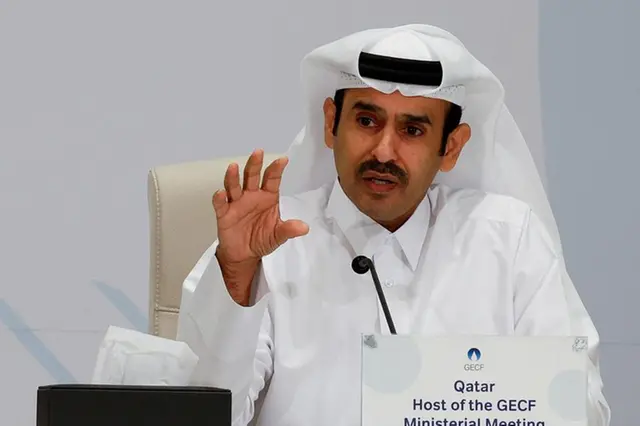
Qatar LNG halt has escalated fears of a full-scale Gulf energy shutdown, after the country’s energy minister warned that all regional exporters could suspend shipments within weeks if the conflict persists. The statement signals a dramatic shift from supply disruption risk to outright export paralysis.
Qatar, which accounts for roughly 20 percent of global liquefied natural gas supply, has already paused LNG production. According to Energy Minister Saad al-Kaabi, if hostilities continue, Gulf producers may have no option but to declare force majeure across the board.
Qatar LNG Halt and the Strait of Hormuz Threat
The Strait of Hormuz remains the linchpin of global energy flows. A significant share of the world’s oil and LNG exports passes through the narrow corridor linking the Gulf to global markets.
Kaabi warned that if tankers cannot safely transit the Strait, oil prices could surge to $150 per barrel within weeks. Gas prices, he added, could climb to $40 per million British thermal units.
Such projections underscore the fragility of maritime energy routes. While oil traders monitor crude flows, LNG markets face equal vulnerability. Qatar’s LNG cargoes supply both Europe and Asia, balancing seasonal demand fluctuations.
Force Majeure Across the Gulf?
The Qatar LNG halt may only be the beginning. Kaabi indicated that other Gulf exporters could soon invoke force majeure if the war persists. In energy markets, force majeure clauses allow producers to suspend contractual obligations due to extraordinary events.
If multiple producers halt exports simultaneously, global supply chains would tighten sharply. Even countries with strategic reserves would struggle to cushion prolonged outages.
Historically, Gulf conflicts disrupted specific facilities or transit routes. However, a region-wide export suspension would represent a different magnitude of shock.
Delays to Expansion Plans
Beyond immediate exports, Qatar’s North Field expansion faces delays. The project aimed to boost LNG output significantly, reinforcing Qatar’s long-term dominance in the gas market.
If construction setbacks extend beyond weeks, the impact on future supply growth could alter global energy forecasts. Europe, which increasingly depends on LNG imports after reducing Russian gas reliance, would feel pressure first.
Global Economic Consequences
Kaabi warned that prolonged conflict would hit global GDP growth. Energy remains a foundational input for manufacturing, transport and electricity generation.
If oil reaches $150 and gas spikes toward $40 per MMBtu, inflation could accelerate worldwide. Industrial production may slow, especially in energy-intensive sectors.
For African economies, the ripple effects could prove severe. Many countries import refined fuel or LNG-linked products. Higher energy bills would strain fiscal balances and weaken currencies.
Moreover, remittances and investment flows from Gulf economies into Africa could slow if regional growth stalls.
Energy Security Revisited
The Qatar LNG halt forces policymakers to reconsider energy diversification strategies. European and Asian importers have worked to diversify supply sources, yet Gulf energy remains central.
Countries with renewable energy capacity may accelerate investment. However, renewables cannot immediately replace baseload LNG in many systems.
Why This Matters
The Qatar LNG halt marks one of the most serious energy supply threats in recent decades. If Gulf exporters suspend shipments, the shock would rival historic oil embargoes.
Energy markets serve as the backbone of global trade. Therefore, sustained disruption could reshape inflation trends, monetary policy decisions and industrial planning worldwide.
What Happens Next
Much hinges on maritime security in the Strait of Hormuz. Diplomatic efforts or naval escorts could restore confidence and allow cargoes to resume.
However, even if hostilities end quickly, Qatar estimates it would take weeks to months to return to normal delivery cycles. Energy buyers will monitor shipping data and force majeure declarations closely.
Until clarity emerges, volatility will dominate oil and gas markets. The Qatar LNG halt signals how swiftly geopolitical conflict can transform into a global economic risk.