Messi Ronaldo 2030 speculation is rising again as football fans look beyond the current World Cup and ask whether the sport’s two defining modern stars could extend their careers into another tournament cycle.
The idea remains highly unlikely. Lionel Messi would be 43 by the 2030 World Cup, while Cristiano Ronaldo would be 45. For outfield players, competing at that age at the highest international level would be extraordinary.
Still, the question refuses to disappear because both players have repeatedly stretched the limits of football longevity. Messi continues to shape Argentina’s attack with intelligence, timing and technique. Ronaldo remains one of the most disciplined athletes the game has produced, with a career built around conditioning, scoring instincts and relentless ambition.
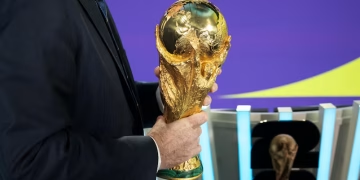
The 2030 World Cup also carries emotional weight. FIFA has awarded hosting rights to Morocco, Portugal and Spain, with centenary celebration matches in Argentina, Paraguay and Uruguay. That means Ronaldo’s Portugal will be one of the main hosts, while Messi’s Argentina will be part of the wider centenary story.
Messi Ronaldo 2030 Debate Is Mostly About Longevity
The biggest barrier is physical reality.
World Cup football demands more than reputation. Players must handle travel, training, tactical intensity, recovery cycles and matches against younger opponents at peak athletic level. Even substitutes need the speed, stamina and sharpness to affect games in short windows.
That makes the Messi Ronaldo 2030 question different from a normal career-projection debate. It is not only about whether either player could still be registered professionally. It is about whether they could still justify a national-team place in a tournament environment.
Ronaldo would be 45, an age that almost no elite outfield player reaches while still competing internationally. Messi would be 43, also far beyond the typical career arc for a forward or attacking midfielder.
Goalkeepers have sometimes lasted into their 40s at major tournaments, but outfield players face heavier running demands and greater exposure to physical duels. That makes a 2030 appearance by either icon an extreme long shot.
Ronaldo Has the Stronger Public 2030 Link
Ronaldo has the clearer public connection to the 2030 conversation.
Portugal coach Roberto Martinez has left open the possibility of Ronaldo being involved when the tournament reaches Portugal, saying the forward’s professionalism and influence remain exceptional. Ronaldo has also often spoken about playing as long as his body and motivation allow.
That does not mean he will definitely play in 2030. It only means the door has not been fully closed.
Ronaldo’s case depends on several factors. He would need to remain active at club level, avoid serious decline or injury, and still offer Portugal a role that makes tactical sense. That role might not be as a 90-minute starter. It could be as a specialist finisher, dressing-room leader or late-game option.
Even then, Portugal will have to balance sentiment with performance. A home World Cup would create emotional pressure, but national teams must make decisions based on squad balance and competitive value.
If Ronaldo reached the 2030 tournament, it would be one of the most remarkable endurance stories in football history.
Messi’s Path Looks More Difficult
Messi’s 2030 case looks even harder.
He would be 43 and would have already carried Argentina through multiple tournament cycles. His game has aged better than most because it relies heavily on vision, first touch, passing angles and decision-making rather than pure speed.
That gives him a theoretical path to lasting longer than a typical forward. However, World Cup football still requires physical resilience, especially for a player expected to influence matches in possession and survive defensive pressure.
It is more realistic to imagine Messi connected to Argentina in an off-field or ambassadorial role by 2030 than leading the team on the pitch. He could be involved as a mentor, federation figure, global ambassador or eventually in a coaching-related capacity, though no such role should be assumed unless announced.
The Argentina question also depends on succession. If the national team has fully moved to a new generation by 2030, there may be little sporting reason to bring Messi back as a player, even for symbolic value.
Still, Messi has already defied several career timelines. That is why fans continue to ask the question.
2030 World Cup Setting Adds Emotion
The host structure gives the debate extra meaning.
Portugal will be one of the three main hosts, making Ronaldo’s potential presence especially symbolic. If he were still involved, he would be playing a World Cup on home soil at 45.
Argentina will host one centenary celebration match, recognizing the 100-year anniversary of the first World Cup in 1930. That gives Messi’s country a special role in the tournament, even though Argentina is not one of the main hosts.
Those details create a romantic football storyline. Ronaldo in Portugal and Messi connected to Argentina during a centenary tournament would feel like a final bridge between football’s past and present.
But romance does not select squads. Coaches must choose players who can help win matches.
What Would Need to Happen
For either player to appear in 2030, several unlikely things would need to align.
First, they would need to remain professionally active. Second, their bodies would need to hold up against injuries and recovery demands. Third, their national-team coaches would need to believe they still offer competitive value. Fourth, they would need to accept roles that might be smaller than the ones they held during their prime years.
That final point may be important. A 2030 version of Ronaldo or Messi would almost certainly not be the same player fans watched in their peak years. Their value would have to come from moments, leadership and experience rather than constant match control.
Football has seen older stars extend careers through adaptation. But the World Cup is a different test because every squad place is precious.
The Likely Answer
The most realistic view is simple: both playing in 2030 is highly unlikely.
Ronaldo has the more visible pathway because Portugal is a host and his coach has not ruled out the possibility. Messi’s pathway appears more difficult because of age, physical demands and Argentina’s likely generational transition.
One of them appearing would be historic. Both appearing would be almost unbelievable.
For now, the Messi Ronaldo 2030 debate is best treated as a dream scenario rather than an expectation. Their careers have already changed football history. If either player somehow reaches the 2030 World Cup as an active player, it would become one of the greatest longevity stories the sport has ever seen.

Read Also: Messi Ronaldo 2030 Question Grows Before World Cup