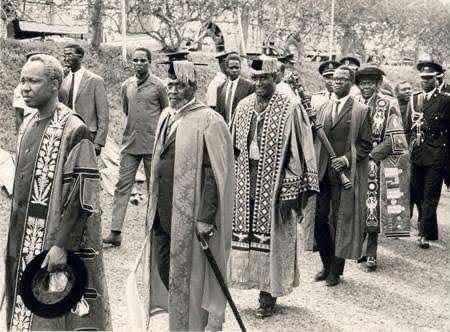
The Makerere University graduation ceremony of July 1970 remains one of the most iconic gatherings in East Africa’s post-independence history. The event brought together four towering statesmen — Julius Nyerere of Tanzania, Jomo Kenyatta of Kenya, Kenneth Kaunda of Zambia, and Milton Obote of Uganda — each a symbol of African liberation and nation-building.
The historic image captures the leaders walking in full academic regalia, shoulder to shoulder, embodying the unity, optimism, and intellectual promise that defined the early years of independent Africa. At the forefront of the ceremonial procession, bearing the Makerere University mace, was a young scholar — Prof. Peter Anyang’ Nyong’o, now the Governor of Kisumu County in Kenya. His presence in the photo underscores the enduring bridge between academia and public service that Makerere fostered across generations.
A Meeting of Minds and Ideals
In 1970, Makerere University was more than a center of learning; it was the intellectual heartbeat of East Africa, drawing students and thinkers from across the continent. The graduation was attended by dignitaries from multiple nations, reflecting Makerere’s reputation as the “Harvard of Africa.”
The presence of Nyerere, Kenyatta, Kaunda, and Obote symbolized the shared dream of Pan-African solidarity and self-reliance through education. Each of these leaders had risen from the struggles of colonial resistance to lead their nations toward independence, and their gathering at Makerere represented the unity of purpose among East Africa’s founding fathers.
Makerere’s Role in Shaping African Leadership
By 1970, Makerere had already produced a generation of African leaders, scholars, and policymakers who went on to shape post-colonial governance and development. The university’s emphasis on critical thinking, public service, and Pan-African ideals resonated with the philosophies of Nyerere’s Ujamaa, Kenyatta’s Harambee, Obote’s Common Man’s Charter, and Kaunda’s Humanism.
Their attendance at the graduation was both symbolic and aspirational — a declaration that education would be the cornerstone of Africa’s progress. It was also a moment of reflection, showing how far the region had come since the colonial era when Makerere served as a college under the University of London system.
A Legacy Captured in One Photograph
The photograph of that July morning — showing the leaders walking in academic gowns, surrounded by scholars and guards — remains a powerful visual narrative of East Africa’s golden era. It captures a time when intellectualism, unity, and nationhood intertwined seamlessly.
For Prof. Anyang’ Nyong’o, leading the procession with the university mace marked the beginning of a lifelong journey dedicated to scholarship, political thought, and public leadership. Today, the image is not merely a historical artifact but a timeless reminder of Africa’s educational pride and political heritage.