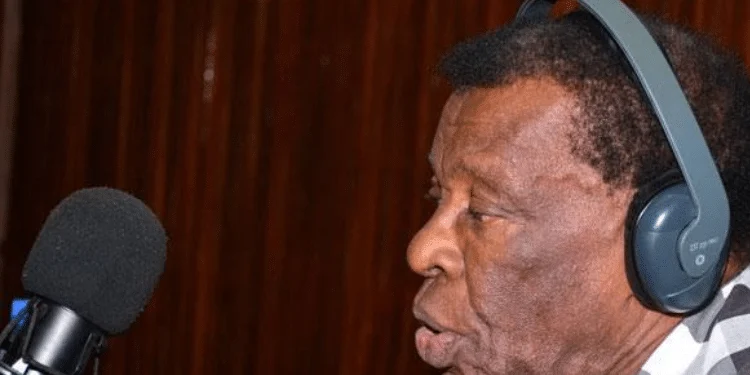
Leonard Mambo Mbotela remains one of Kenya’s most celebrated broadcasting figures, remembered for a voice that defined generations. For decades, Leonard Mambo Mbotela shaped public discourse through radio and television, earning recognition as a pioneer in the country’s media landscape. His calm delivery during moments of national tension and his commitment to social education made him a household name.
Born in 1940 in Freetown, Mombasa, Leonard Mambo Mbotela grew up during a period when Kenya was transitioning through colonial rule toward independence. His upbringing in a culturally rich and disciplined household influenced both his personality and professional values. Over time, he became synonymous with public service broadcasting through his long association with the Kenya Broadcasting Corporation.
From live football commentary to the iconic program “Je, Huu ni Ungwana?”, Leonard Mambo Mbotela’s career reflected versatility, discipline and resilience. His passing on February 7, 2025, marked the end of an era in Kenyan media.
Education Background
Leonard Mambo Mbotela attended Kitui High School for his secondary education. The institution, known for academic and leadership excellence, provided him with a strong educational foundation.
Unlike many contemporary broadcasters, Leonard Mambo Mbotela did not pursue a formal university degree in journalism or media studies. Instead, he honed his skills through practical experience. His passion for broadcasting was inspired by listening to notable radio figures such as Simon D’Souza and Steven Kumu Joho.
In 1964, he joined Voice of Kenya, now known as KBC. At the time, broadcasting relied heavily on discipline, voice control and storytelling. Through mentorship and on the job learning, he refined his craft and quickly distinguished himself.
Family Life and Background
Leonard Mambo Mbotela was the first of eight children born to James and Aida Mbotela. His father worked as a teacher in several institutions including Shimo La Tewa High School and Kabianga High School before retiring as an education officer.
Beyond teaching, his father was a respected musician and choirmaster at Emmanuel’s Church Choir and the Mbotela Church Choir. This musical environment influenced Leonard’s early exposure to performance and rhythm. His mother was active in Maendeleo ya Wanawake, reflecting a family deeply engaged in community service.
Leonard Mambo Mbotela also had Malawian roots, adding a cross regional cultural dimension to his identity. He was married but kept details about his spouse and children largely private. Throughout his public life, he maintained a clear boundary between professional visibility and personal discretion.
Broadcasting Career
Leonard Mambo Mbotela began his professional journey with brief roles at Kenya Weekly News and the East African Standard. These early experiences sharpened his journalism skills before he transitioned fully into broadcasting.
In 1964, he joined Voice of Kenya as a program assistant. Two years later, in 1966, he launched “Je, Huu ni Ungwana?”, a radio program designed to promote good manners and social responsibility through storytelling and commentary. The show became one of the longest running programs in Kenyan broadcasting history and later transitioned to television.
His career reached a dramatic moment during the attempted coup of 1982. Leonard Mambo Mbotela provided live commentary amid the unfolding events, demonstrating composure under extreme pressure. His calm reporting during national uncertainty reinforced his reputation as a trusted voice.
Between 1984 and 1991, he served in the Presidential Press Unit. During this period, he interacted closely with President Daniel arap Moi and other senior government officials. This role expanded his influence within national media circles.
After leaving the Presidential Press Unit, Leonard Mambo Mbotela returned to KBC, where he continued as a producer and announcer. His football commentaries became particularly memorable, bringing energy and clarity to sports broadcasts across the country.
Passion for Music and Public Engagement
Outside broadcasting, Leonard Mambo Mbotela nurtured a passion for music. Influenced by his father’s musical background, he occasionally performed as a vocalist at social events and clubs in Nairobi.
His ability to connect with audiences extended beyond radio microphones. Whether addressing etiquette through “Je, Huu ni Ungwana?” or narrating live sports events, he embodied the essence of public broadcasting in Kenya.
Age and Legacy
Born in 1940, Leonard Mambo Mbotela lived into his mid eighties before passing away in February 2025. His longevity in media meant that multiple generations grew up listening to his voice.
Leonard Mambo Mbotela’s legacy lies in his consistency and professionalism. At a time when media landscapes evolved rapidly, he remained anchored in public service values. His career demonstrated how broadcasting can educate, entertain and unite a nation.
Through decades at KBC and landmark moments in Kenya’s history, Leonard Mambo Mbotela secured his place as one of the country’s true broadcasting legends.