How UK Pressure Helped Free Kenneth Matiba in 1991: Inside a Declassified Memo
In June 1991, Kenyan democracy advocate Kenneth Matiba was released from detention under President Daniel arap Moi’s authoritarian regime. His release came amid mounting domestic unrest and intensifying international pressure, particularly from Britain, Kenya’s former colonial ruler and long-time diplomatic partner.
A declassified British Foreign and Commonwealth Office (FCO) document dated 10 June 1991, signed by R.J.S. Edis from the East African Department, provides rare insight into the behind-the-scenes diplomacy that contributed to Matiba’s release—and the wider political reforms unfolding in Kenya.
The Memo: UK Pressure and Quiet Negotiations
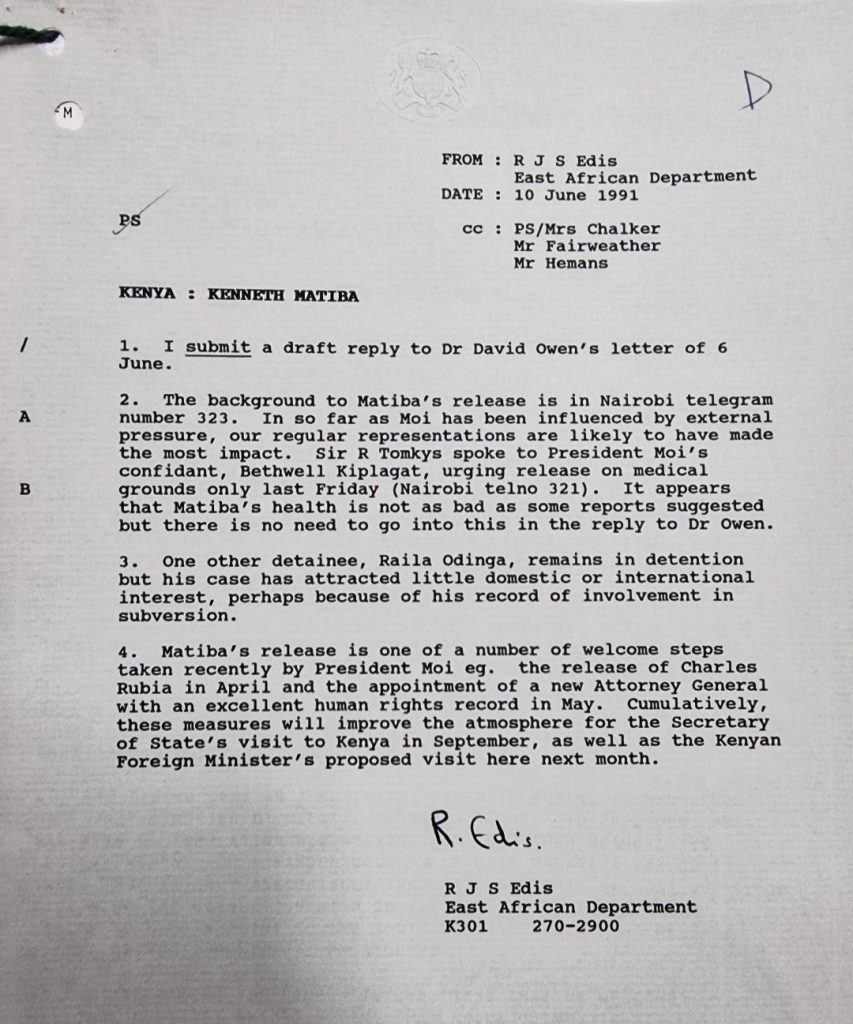
The letter, marked “KENYA: KENNETH MATIBA”, details British diplomatic efforts to secure Matiba’s freedom. According to the memo:
- Sir Richard Tomkins, a British diplomat, personally engaged Bethwell Kiplagat, a close confidant of President Moi, urging Matiba’s release on medical grounds.
- Kiplagat’s influence within Moi’s circle played a pivotal role in persuading the president to act.
- Matiba had been held without trial and was suffering deteriorating health. Although the memo states that “Matiba’s health is not as bad as some reports suggested,” it acknowledges that medical grounds were used as the official justification for his release.
While the UK chose not to publicize these details, it’s clear that British diplomatic pressure was instrumental.
“In so far as Moi has been influenced by external pressure, our regular representations are likely to have made the most impact.” — R.J.S. Edis, FCO Memo, 10 June 1991
Raila Odinga’s Detention Downplayed
The memo also mentions Raila Odinga, another prominent detainee at the time, who remained in custody. However, the tone used to describe Raila’s detention is notably dismissive:
“His case has attracted little domestic or international interest, perhaps because of his record of involvement in subversion.”
This statement reflects the Western skepticism and caution surrounding Raila Odinga in the early 1990s, prior to his transformation into a global democracy icon.
Broader Reform Context: Moi’s Calculated Moves
Matiba’s release was one of several strategic reforms by Moi in 1991, designed to appease both local dissent and foreign scrutiny amid increasing calls for multi-party democracy.
Other key reforms noted in the memo include:
- The release of Charles Rubia, another key democracy campaigner, earlier in April 1991.
- The appointment of a new Attorney General in May 1991, described as someone with an “excellent human rights record.”
The British Foreign Office viewed these moves as signals of reform ahead of critical diplomatic engagements, including:
- A proposed visit by the UK Foreign Secretary in September 1991.
- A reciprocal Kenyan Foreign Minister visit to the UK the following month.
“Cumulatively, these measures will improve the atmosphere,” the memo concludes, indicating that Moi’s administration was keen on managing international perception, even as it suppressed internal dissent.
Legacy of the 1991 Detentions
The detentions of Matiba, Rubia, and Raila Odinga became pivotal moments in Kenya’s journey toward multi-party democracy, which was formally reinstated later that year.
- Kenneth Matiba would go on to become a presidential contender and remains a revered symbol of sacrifice for democratic space.
- Raila Odinga, then still considered a controversial figure by some Western diplomats, would eventually become Kenya’s longest-serving opposition leader and a five-time presidential candidate.
- The UK’s discreet pressure campaign, documented in this memo, illustrates the complex but crucial role foreign diplomacy played during one of Kenya’s most politically volatile periods.
Conclusion
The release of Kenneth Matiba was not just an act of mercy, but part of a broader geo-political chessboard, where Britain sought to balance diplomacy with democratic values. The June 1991 memo shows how persistent but quiet diplomatic engagement—targeting key insiders like Bethwell Kiplagat—could nudge autocratic regimes toward critical decisions.
Today, these declassified files remind us that the road to democracy in Kenya was shaped not just by local heroes but also by global actors maneuvering in the shadows.