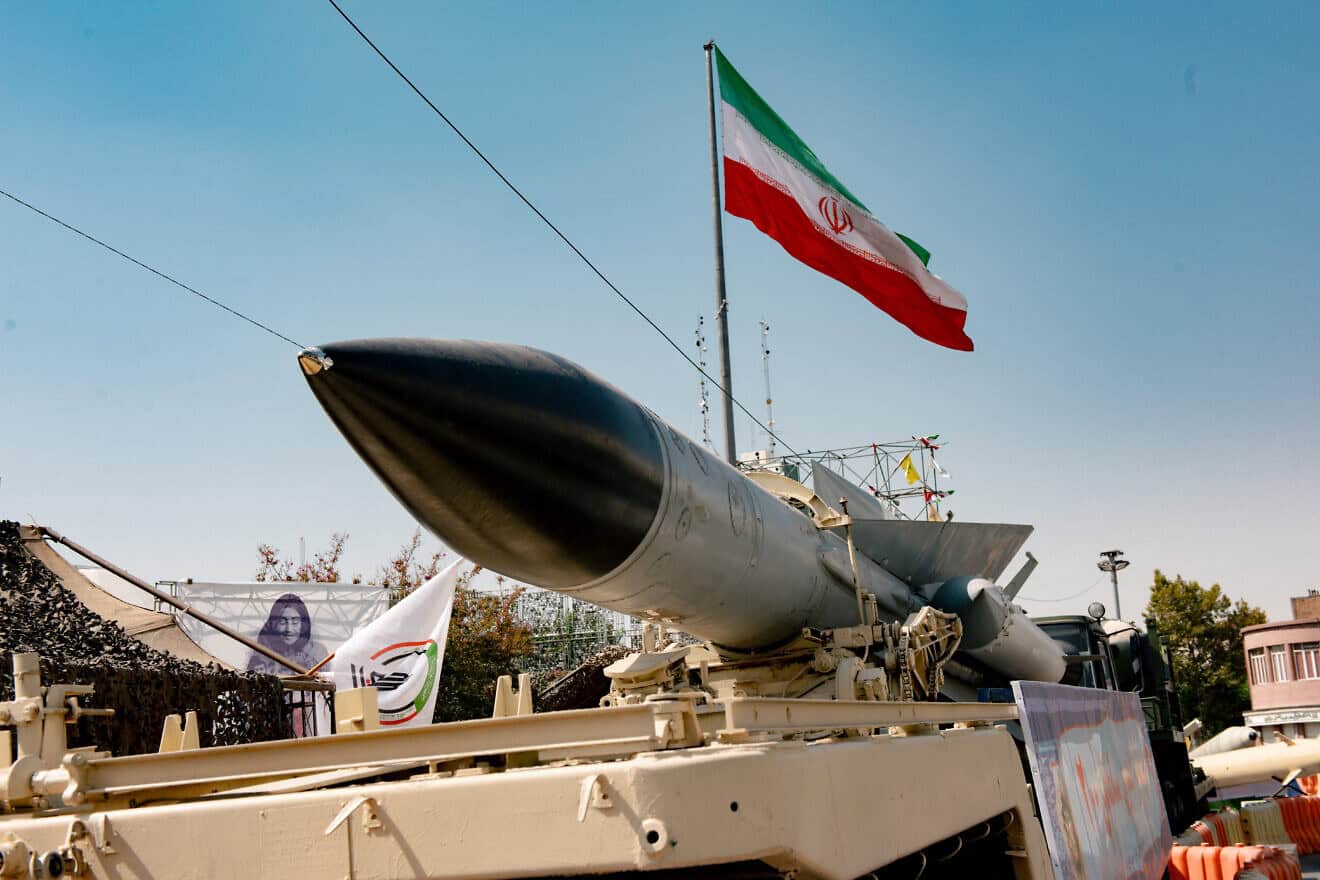


Iran’s ballistic missile program is the most extensive and diverse in the Middle East. It plays a central role in the country’s defense and deterrence doctrine, compensating for its outdated air force and offsetting adversaries like the United States, Israel, and Saudi Arabia.
Administered by the Islamic Revolutionary Guard Corps (IRGC) and Aerospace Industries Organization (AIO), the program is supported by a network of domestic manufacturers and foreign procurement channels. Iran’s missile strategy emphasizes “deterrence by punishment” and the ability to respond asymmetrically to threats across the region.
Historical Background: From Scud Imports to Indigenous Mastery

Iran–Iraq War Origins
The foundation of Iran’s missile program was laid during the Iran–Iraq War (1980–1988), where Iraq’s use of Scud missiles exposed Iran’s vulnerability. In 1984, Iran acquired its first ballistic missiles—20 Soviet Scud-B SRBMs—via Libya, followed by imports from North Korea and China.
From Reverse Engineering to Indigenous Design
By the 1990s, Iran had reverse-engineered these platforms to develop the Shahab-1 and Shahab-2, and later the Shahab-3, which marked Iran’s entry into the medium-range missile club with a range of over 1,200 km. In the 2000s, Iran began testing solid-fueled systems like the Sejjil-2, showcasing significant domestic technological progress.
Iran Ballistic and Cruise Missile Inventory
| Name | Type | Max Range | Payload | Propulsion | CEP | Status |
|---|---|---|---|---|---|---|
| Shahab-1 (Scud B) | SRBM | up to 300 km | 770–1,000 kg | liquid fuel, single stage | ~500 m | deployed |
| Shahab-2 (Scud C) | SRBM | ~500 km | ~700 kg | liquid fuel, single stage | 700 m | deployed |
| Qiam-1, Qiam-1 (mod.) | SRBM | 700–800 km | 650 kg | liquid fuel, single stage | <500 m | deployed |
| Fateh-110 (incl. Khalij Fars and Hormuz) | SRBM | 300 km | ~450 kg | solid fuel, single stage | 100 m | deployed |
| Fateh-313 | SRBM | 500 km | 350 kg | solid fuel, single stage | 10–30 m | deployed |
| Raad-500 | SRBM | 500 km | unknown | solid fuel, single stage | 30 m | tested |
| Zolfaghar (incl. Zolfaghar Basir) | SRBM | 700 km | 450–600 kg | solid fuel, single stage | 10–30 m | deployed |
| Dezful | SRBM | 1,000 km | 450–600 kg | solid fuel, single stage | 10–30 m | deployed |
| Shahab-3 | MRBM | 1,300 km | 750–1,000 kg | liquid fuel, single stage | ~3 km | deployed |
| Ghadr | MRBM | 1,600 km | ~750 kg | liquid fuel, single stage | 300 m | deployed |
| Emad | MRBM | 1,800 km | ~750 kg | liquid fuel, single stage | <500 m | deployed |
| Khorramshahr-1, -2, -4 (BM-25/Musudan) | MRBM | 2,000–3,000 km | 750–1,500 kg | liquid fuel, single stage | 30 m | deployed |
| Fattah-1 | MRBM | 1,400 km | unknown | solid fuel, single stage | unknown | tested |
| Haj Qassem | MRBM | 1,400 km | 500 kg | solid fuel, single stage | unknown | deployed |
| Kheibar Shekan | MRBM | 1,450 km | 450–600 kg | solid fuel, single stage | unknown | deployed |
| Sejjil | MRBM | 2,000 km | ~750 kg | solid fuel, two stage | unknown | deployed |
| Soumar (Kh-55) | LACM | unknown | unknown | turbofan engine | N/A | possibly deployed |
| Hoveizeh | LACM | 1,350 km | unknown | turbojet engine | N/A | possibly deployed |
| Ya Ali | LACM | 700 km | unknown | turbojet engine | N/A | tested |
| Paveh | LACM | 1,650 km | unknown | turbojet engine | N/A | deployed |
| Safir | SLV | 2,100 km | 500–750 kg | liquid fuel, two stage | N/A | retired |
| Simorgh | SLV | 4,000–6,000 km | 500–750 kg | liquid fuel, two stage | N/A | operational |
| Qased | SLV | 2,200 km | 1,000 kg | liquid 1st stage; solid 2nd and 3rd stages | N/A | operational |
| Zuljanah | SLV | 4,000–5,000 km | 1,000 kg | solid 1st and 2nd stages, liquid 3rd stage | N/A | tested |
| Ghaem-100 | SLV | 3,000–4,000 km | 1,000 kg | solid fuel, three stage | N/A | operational |
Missile Arsenal: Types and Capabilities


Iran’s ballistic missile stockpile is estimated to exceed 3,000 missiles, encompassing short-range (SRBM) and medium-range (MRBM) capabilities. Below is a categorized breakdown:
Short-Range Ballistic Missiles (300–1,000 km)
| Missile | Range | Propellant | Key Notes |
|---|---|---|---|
| Shahab-1 | 350 km | Liquid | Early reverse-engineered Scud |
| Shahab-2 | 750 km | Liquid | Improved version of Shahab-1 |
| Qiam-1 | 750 km | Liquid | Precision targeting system |
| Fateh-110 | 300 km | Solid | Fast deployment; widely used |
| Zolfaghar | 750 km | Solid | Exported to regional proxies |
| Hormuz | 300 km | Solid | Anti-ship capability |
Medium-Range Ballistic Missiles (1,000–3,000 km)
| Missile | Range | Propellant | Key Features |
|---|---|---|---|
| Shahab-3 | 1,200–2,100 km | Liquid | Based on North Korean Nodong |
| Haj Qasem | 1,400 km | Solid | Named after Qassem Soleimani |
| Kheibar Shekan | 1,450 km | Solid | High accuracy and mobility |
| Fattah-1 / Fattah-2 | 1,400–1,500 km | Hypersonic | Reported speeds up to Mach 13 |
| Ghadr-110 | 2,000–3,000 km | Liquid | Advanced Shahab-3 variant |
| Sejjil-2 | 2,000 km | Solid | Two-stage missile |
| Emad | 2,000 km | Liquid | Precision-strike capability |
| Khorramshahr | 2,000 km | Liquid | Heavy payload; MRV-capable |
Iran’s Ballistic Missile Program Cost and Maintenance
Missile development and deployment are not cheap. Here’s an overview of unit and upkeep costs:
| Missile | Unit Cost (USD) | Annual Upkeep (USD) |
|---|---|---|
| Fateh-110 | $110,000–$2.1 million | $20,000–$100,000 |
| Qiam-1 | ~$3.5 million | ~$120,000 |
| Shahab-3 | ~$3 million | $150,000–$250,000 |
| Ghadr-110 | ~$5 million | ~$250,000 |
| Sejjil-2 | ~$6 million | $200,000–$300,000 |
| Khorramshahr | ~$8 million | $300,000–$400,000 |
Storage, Transport, and Missile Cities
Iran uses mobile transporter-erector-launchers (TELs) for rapid deployment and survivability. These vehicles carry missiles like Zelzal, Qiam, and Sejjil on 6×6 to 10×10 chassis, allowing flexible launch options.
Underground Missile Facilities
Iran maintains a network of deep underground missile bases, sometimes referred to as “missile cities”:
- Khorramabad Base (Lorestan Province) – Houses multiple silos.
- Kenesht Canyon & Panj Pelleh Bases (Kermanshah) – Mountain bases.
- Bakhtaran Missile Base – Strategically positioned for strikes against Israel and Gulf states.
- Haji Abad Base – Hardened new site.
- Southern Gulf Region Bases (2025) – New underground naval missile sites revealed by the IRGC.
Many of these facilities are located 500 meters underground, reinforced and protected from aerial attacks.
Nuclear Potential: A Dual-Use Concern
Several of Iran’s MRBMs are considered nuclear-capable:
- Shahab-3 and Ghadr-1: Designed for potential nuclear payloads.
- Khorramshahr: Its large cone suggests space for nuclear warheads.
- Sejjil and Emad: Range and payload capacity exceed minimum nuclear delivery thresholds.
Though Iran denies pursuing nuclear weapons, the dual-use nature of its missile platforms continues to raise alarms. The expiration of UN Resolution 2231 restrictions in October 2023 has intensified concerns about unchecked missile development.
Strategic Use: Regional Influence and Proxy Warfare
Iran’s missile program supports asymmetrical warfare and arms its regional allies:
- Hezbollah: Supplied with hundreds of Fateh-110-based M-600 missiles.
- Houthis (Yemen): Use Iranian missiles to strike Saudi and Israeli targets.
- Iraqi Militias: Reported to possess short-range Iranian ballistic missiles.
These proxies extend Iran’s strike capability beyond its borders, allowing plausible deniability while maintaining pressure on adversaries.
Recent Developments (2025): Resurgence and Rearmament
In February 2025, a major shipment of sodium perchlorate—critical for solid-propellant missiles—arrived in Bandar Abbas, sufficient to produce:
- 260 Kheibar Shekan missiles, or
- 200 Haj Qasem MRBMs
This reflects Iran’s continued procurement from international sources, despite sanctions, and signals ongoing expansion of its missile stockpile.
Conclusion: Iran’s Missile Power and Global Implications
Iran’s ballistic missile program is more than a military asset—it’s a pillar of national defense, a tool of foreign policy, and a symbol of self-reliance. With over 3,000 missiles, expanding hypersonic capability, and extensive underground infrastructure, Iran is building a credible deterrent force.
However, the nuclear-capable potential and proxy proliferation have kept the program under international scrutiny. As regional tensions escalate, especially involving Israel and U.S. interests, Iran’s missile arsenal remains both a shield and a sword—capable of deterring aggression or igniting conflict.
Frequently Asked Questions (FAQs)
Q: How many ballistic missiles does Iran have?
A: Estimates suggest over 3,000, covering both short and medium ranges.
Q: Can Iran’s missiles carry nuclear warheads?
A: Yes, several of Iran’s MRBMs are considered nuclear-capable.
Q: Why is Iran investing so heavily in missiles?
A: To compensate for its outdated air force, project power regionally, and deter adversaries.
Q: Which countries are within range of Iran’s missiles?
A: All of the Middle East, parts of Europe, and U.S. bases in the Gulf.
Footnotes:
[1] Independently estimating the size of Iran’s missile arsenal is difficult, given the paucity of reliable information relating to its missile quantities. The U.S. Air Force and some non-governmental organizations have released estimates in the past, but these lack specificity and usually only estimate the number of launchers, not the missiles themselves, since launchers are, in principle, easier to track and count. See “2020 Ballistic and Cruise Missile Threat,” U.S. National Air and Space Intelligence Center, pp. 21, 25, January 2020, available at https://irp.fas.org/threat/missile/bm-2020.pdf.
[2] Precision is the ability of a weapon to impact where it is aimed; accuracy is the ability of the user to aim the weapon at the true location of the desired target and of the weapon to be precise enough to hit it. Accuracy thus takes into account target acquisition and tracking capabilities. For example, Iran’s development of capable surveillance drones has served to improve the accuracy of its missile forces.
[3] Missiles can be classified according to whether they are liquid-fueled or solid-fueled. A liquid-fueled missile engine generally can produce more thrust per pound of fuel than a solid-rocket motor but is more complex and can require many precision-machined and moving parts. Some types of liquid-fueled missiles must also be fueled at their launch site, which makes them easier for an opponent to detect and destroy. Solid rocket motors are relatively economical and easier to maintain and store. Solid fuel also allows for a more rapid launch. Solid-fueled missiles are therefore generally less vulnerable in combat. Iranian engineers do not appear to have the wherewithal to design and build a liquid-fueled engine from scratch, but they do possess that ability for solid-fueled motors. The ability to build new systems tailored to Iran’s military needs, in addition to the operational advantages, helps explain Iran’s increasing preference for solid-fuel missiles.
[4] The table does not include missiles or artillery rockets with a maximum range below 300 km, missiles that have only been displayed as mock-ups, surface-to-air missiles, or anti-ship cruise missiles. Nor does it include derivatives, variants, or renamed copies of Iranian missiles that have been used by Iran’s regional proxies, such as the Houthis. The capabilities of those missiles can be best assessed by referencing the Iranian missiles they are modeled after. For example, the Houthis’ Burkan-2H ballistic missile closely resembles the Iranian Qiam-1. Similarly, Iran’s Rezvan appears to be a copy of the Houthi Zulfiqar, itself a modified Qiam.
[5] Ballistic missiles can be divided into five classes based on range: close-range (less than 300 km), short-range (300 to 1,000 km), medium-range (1,000 to 3,000 km), intermediate-range (3,000 to 5,500 km), and intercontinental (more than 5,500 km). Iran’s ballistic missile arsenal is composed mainly of short-range ballistic missiles (SRBMs) and medium-range ballistic missiles (MRBMs), although some work on longer-range missiles is suspected. Space launch vehicles (SLVs) are designed to launch satellites into orbit but could potentially be reconfigured as ballistic missiles due to their similar characteristics. Land-attack cruise missiles (LACMs) function essentially as pilotless aircraft and do not fly on a ballistic trajectory, thus posing a challenge to missile defense systems.
[6] Missile precision is commonly measured by circular error probable (CEP): the radius within which, on average, half of all missiles fired will land. For example, given a missile with a CEP of ten meters, if one hundred were launched at a target, on average fifty would land within ten meters of the target.
[7] Although the original Qiam probably had a CEP of several hundred meters, a modified version with a steerable re-entry vehicle has likely improved upon that. Evidence suggests that it was this newer version that was among the missiles used in the January 2020 strike on U.S. forces in Iraq.
[8] The modified Qiam-1 has been called Qiam-2 by some independent analysts, but not by official Iranian sources.
[9] The Khalij Fars is the anti-ship variant of the Fateh-110, while the Hormuz is the anti-radar variant.
[10] Iran has reportedly developed a guidance kit for the Fateh-110 that, when attached, can reduce its CEP to 30 meters or less.
[11] Based on its likely use in the January 2020 ballistic missile attack against U.S. forces and damage assessments of that attack.
[12] The Zolfaghar Basir is the anti-ship variant of the Zolfaghar.
[13] Based on its likely use in the January 2020 ballistic missile attack against U.S. forces and damage assessments of that attack. Also based on similar assessments following the Great Prophet 17 military exercise in December 2021.
[14] Based on its use in the Great Prophet 17 military exercise suggesting it has precision similar to that of the Zolfaghar.
[15] Iran has displayed at least four different variants of the Khorramshahr missile, each potentially with its own specifications in terms of range, warhead size, and accuracy. Iran has consistently claimed that the missile has a 2,000 km maximum range and a warhead with a mass of 1,500 kg or greater. France, Germany, and the United Kingdom claimed in 2019, however, that one variant of the missile has a nose cone whose size would limit the warhead mass to about 750 kg. They further claimed that the modelling of such a missile puts its range at approximately 3,000 km, which would classify it as an intermediate-range ballistic missile (IRBM). See, “Letter dated 25 March 2019 from the Permanent Representatives of France, Germany and the United Kingdom of Great Britain and Northern Ireland to the United Nations addressed to the Secretary-General,” United Nations Security Council, S/2019/270, March 27, 2019, available at https://www.undocs.org/S/2019/270.
[16] Iran has billed the Fattah-1 as a “hypersonic” missile. Hypersonic missiles are typically defined not only by their ability to reach speeds in excess of Mach 5, but also by their ability to maintain such speeds while making significant maneuvers within the atmosphere during flight. Although the Fattah missile may fit this description, it is largely in a class of its own in terms of how it achieves this: the two main types of hypersonic missiles under development across the world are hypersonic gliders and hypersonic cruise missiles, and the Fattah, a ballistic missile with an extra solid rocket motor in its re-entry vehicle, is neither.
[17] The Fattah-1 missile consists of a large solid rocket booster (derived from the Kheibar Shekan design) plus a small solid rocket motor situated inside the re-entry vehicle for terminal maneuvering. The latter is a post-boost propulsion system, and these are not traditionally counted as “stages.” The Minuteman III, for example, is considered a three-stage missile even though it consists of three solid rocket motors plus a liquid-fueled post-boost vehicle. So, Fattah can be considered a single-stage missile.
[18] In 2001, Iran illicitly acquired six Soviet-made Kh-55 air-launched cruise missiles, which have a range of up to 2,500 km. In 2012, an Iranian official claimed that Iran’s forthcoming copy of the Kh-55, modified to have a solid-rocket booster for ground launch, would have a range exceeding 2,000 km. In 2019, however, an official claimed the missile’s range was only 700 km. There is not sufficient open-source evidence to verify either of the claims, but it is unlikely that Iran has successfully reverse-engineered a turbofan engine with the capabilities to match those of the original Soviet type.
[19] Paveh is the Iranian name for the missile that Yemen’s Houthi rebels have displayed as the Quds. By all appearances, the two missile types are identical. The Quds, also referred to as the “351” missile in various sources, was used in the September 2019 attack on Saudi Aramco facilities, long before Iran acknowledged having the missile in its own arsenal. Although the Houthis claimed responsibility for that attack, the UN Panel of Experts on Yemen presented evidence in a 2020 report that the missile’s components were made in Iran and that the attack could not have been launched from Houthi-controlled territory. The Houthis have displayed several variants of the Quds.
[20] Based on visual similarities with the Quds-1.
[21] Estimate if reconfigured as a ballistic missile.