


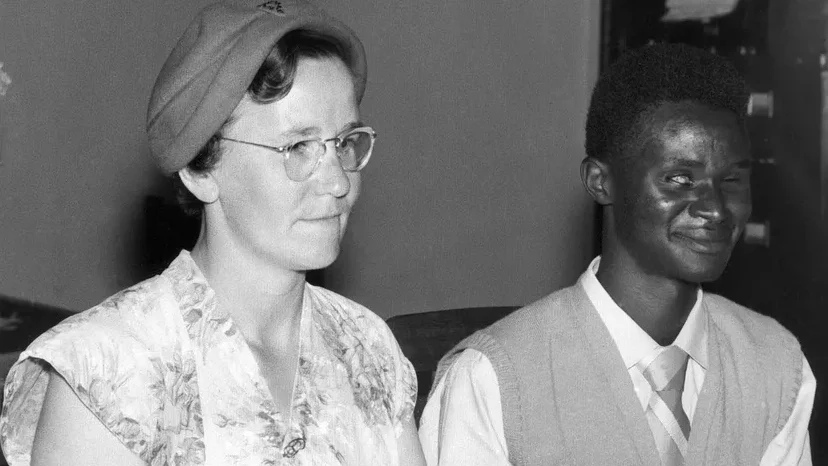
John Kimuyu Kalendo and Ruth Holloway formalized what is widely regarded as Kenya’s first registered interracial marriage on January 23, 1959, during the colonial period, marking a significant moment in the country’s social history. Their union, known today in discussions of interracial marriage Kenya, challenged strict racial divisions enforced at the time.
The marriage took place amid widespread resistance from both colonial authorities and sections of the local population. Despite these pressures, the couple proceeded with a small ceremony attended by only two of Kimuyu’s female relatives, highlighting the extent of social opposition they faced.
Background to Interracial Marriage Kenya
John Kimuyu was born in Mwala, Machakos County, and lost his sight at the age of two due to illness. Nevertheless, he pursued education despite limited opportunities for Africans under colonial rule. In 1949, he enrolled at the Thika School for the Blind, although health challenges interrupted his studies in 1951 before he resumed in 1953.
Ruth Holloway, originally from Nottingham, England, trained as a missionary at the Salvation Army’s William Booth College in London. She later moved to Kenya, where she taught braille at the same institution where Kimuyu studied. It was there that their relationship began, grounded in shared educational work and mutual respect.
Opposition to Interracial Marriage Kenya
Interracial relationships during colonial Kenya were rare and often discouraged. According to historical accounts, Holloway faced professional consequences, including losing her job, after her relationship became known. She later returned to the United Kingdom to inform her family and superiors of her plans, where she encountered additional resistance.
However, she proceeded with her decision. After securing a wedding ring, she traveled back to Kenya by ship. Reports indicate she concealed the ring during the journey, reflecting the challenges surrounding the planned union.
Marriage and Historical Significance
The couple married on January 23, 1959, in a ceremony marked by minimal attendance and ongoing threats. Their union stands as an early example of interracial marriage Kenya during a period defined by rigid racial segregation.
Although not widely documented at the time, the marriage has since been referenced in discussions of Kenya’s social evolution and the gradual dismantling of colonial-era restrictions.
Legacy and Later Life
John Kimuyu Kalendo lived for several decades after the marriage and remained a figure associated with resilience in Kenya’s social history. He died in November 2023 and was buried in Makueni County.
His life story continues to be cited as an example of personal determination and social change. Moreover, the marriage is often referenced in broader reflections on how Kenya transitioned from colonial divisions to a more inclusive society.
Broader Implications
The story of Kimuyu and Holloway highlights the intersection of personal relationships and political realities in colonial Africa. While their marriage did not immediately change policy, it contributed to shifting perceptions over time.
Today, interracial marriage Kenya is no longer subject to the same institutional barriers. However, the couple’s experience remains a reminder of the social constraints that existed and the individuals who challenged them.
Their union remains part of Kenya’s historical narrative, illustrating how personal decisions can reflect and influence broader societal change.


