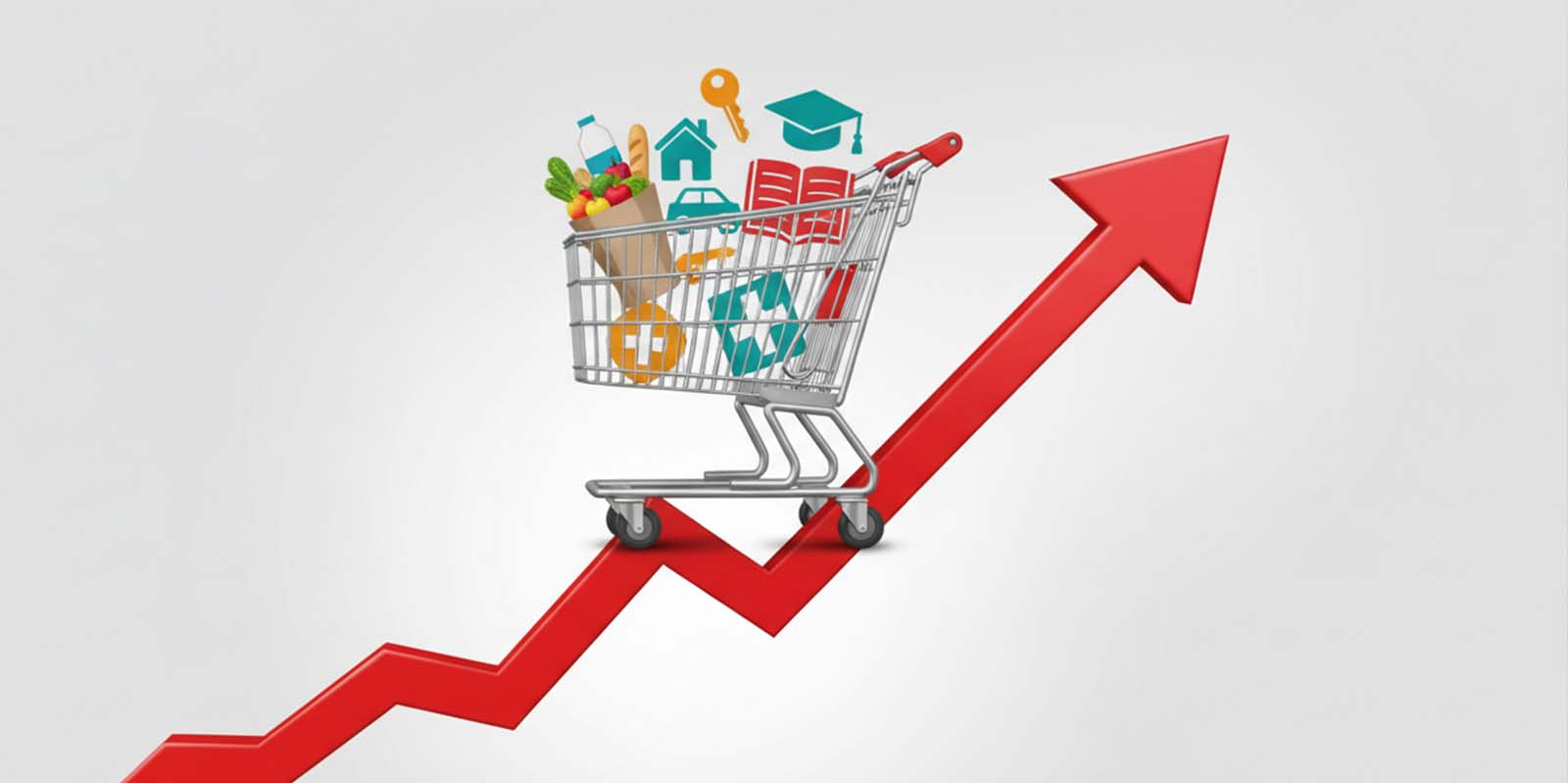
A savings account can show a higher balance every year while its real value quietly declines.
The number displayed by the bank may be growing because interest has been added. However, if the prices of food, housing, transport, insurance and other necessities rise faster than the account, the money will purchase less than it did before.
That loss of purchasing power is one of the most important effects of inflation.
Inflation does not usually remove money directly from a bank account. Instead, it changes what each unit of currency can buy. A household may still have $10,000, £10,000 or €10,000, but the same balance may cover fewer months of living expenses several years later.
This is why inflation and savings must be considered together.
Cash remains essential for emergencies, short-term goals and regular expenses. The solution is not to invest every available dollar or take unnecessary risks. It is to understand which money needs immediate safety and which money may need long-term growth.
Protecting savings from inflation requires a balanced strategy that considers interest rates, taxes, fees, investment risk and the expected date when the money will be needed.
What inflation means
Inflation is a broad increase in the prices of goods and services over time.
It is not simply the price of one product rising. A shortage can make coffee, petrol or rent more expensive without proving that the overall economy is experiencing the same rate of inflation.
In the United States, the Bureau of Labor Statistics describes the Consumer Price Index as a measure of the average change over time in prices paid by urban consumers for a representative basket of goods and services. The Federal Reserve similarly defines inflation as an increase in the general level of prices over time.
The measured inflation rate is normally expressed as an annual percentage.
If a representative collection of products costs $100 one year and $103 the following year, that represents approximately 3% inflation for that basket.
The International Monetary Fund explains that inflation can be measured broadly through changes in the overall cost of living or more narrowly for particular goods and services.
Inflation figures are averages. A particular household may experience a higher or lower personal rate depending on where it lives and how it spends money.
Someone who spends a large share of income on rent and food may feel greater pressure when those categories rise rapidly. A household that owns its home outright and uses little energy may experience a different effect.
How inflation destroys purchasing power
Purchasing power describes how many goods and services a fixed amount of money can buy.
When prices rise, each unit of currency buys less.
The European Central Bank explains that high inflation limits purchasing power, meaning consumers can buy fewer goods and services with the same amount of money. The Bank of England makes the same point: when prices rise quickly, the cost of living increases and money purchases less.
Consider a household that needs $3,000 per month for essential expenses.
A $18,000 emergency fund covers six months of those costs.
If the cost of the same essentials rises by 20% over several years, monthly expenses become $3,600. The unchanged emergency fund now covers only five months.
No money disappeared from the account. Its practical protection became weaker.
The same effect applies to education funds, home deposits, retirement savings and money reserved for major purchases.
Inflation gradually moves the target.
A simple inflation example
Suppose $10,000 is held in an account earning no interest.
If inflation averages 3% annually, the future balance remains $10,000, but its purchasing power declines.
After approximately:
- Five years, it would have purchasing power similar to about $8,626 today.
- Ten years, it would be equivalent to about $7,441.
- Twenty years, it would be equivalent to about $5,537.
- Thirty years, it would be equivalent to about $4,120.
These calculations are simplified illustrations. Actual inflation changes from year to year, and different households experience different price increases.
The lesson is not that cash becomes worthless. It is that an unchanged balance does not preserve an unchanged standard of living.
Even relatively moderate inflation can create a significant cumulative effect when it continues for decades.
Inflation compounds over time
Inflation has a compounding effect.
A 3% price increase does not simply add the same dollar amount every year. Each increase is applied to the new, higher price level.
A product costing $100 would cost:
- $103 after one year at 3% inflation.
- Approximately $115.93 after five years.
- Approximately $134.39 after ten years.
- Approximately $180.61 after twenty years.
- Approximately $242.73 after thirty years.
The total increase after 30 years is not 90%. It is approximately 143% because each year’s inflation builds on previous price increases.
This is similar to compound interest, but it works against the purchasing power of money.
The effect can be easy to ignore during a single year. Over a working lifetime or retirement, it can become one of the greatest risks facing long-term savings.
Falling inflation does not usually mean falling prices
One of the most common misconceptions is that lower inflation means prices are returning to their previous levels.
Usually, it does not.
If inflation falls from 8% to 3%, prices are still rising. They are simply rising more slowly.
For example, an item costs $100 before an 8% annual increase. Its new price is $108.
If inflation then falls to 3%, the price may increase again to $111.24. The inflation rate declined, but the product did not return to $100.
A broad decline in the overall price level is known as deflation. Deflation is different from disinflation, which means inflation is slowing.
This distinction helps explain why households may continue feeling pressure even after headline inflation rates improve. The earlier price increases remain built into the price level.
Inflation and savings account interest
Interest can partly or fully offset the effect of inflation, but the comparison must be made correctly.
Suppose a savings account pays 2% annually while inflation is 4%.
The account balance rises, but purchasing power declines by roughly 2% before considering taxes.
The Bank of England has used a similar illustration: savings growing by 2% while inflation reduces purchasing power by 3% would still leave the saver worse off in real terms.
Two types of return are therefore important:
Nominal return
The nominal return is the percentage shown before adjusting for inflation.
If an account earns 4%, the nominal return is 4%.
Real return
The real return measures growth after inflation.
A simplified estimate is:
Real return ≈ nominal return − inflation rate
If savings earn 4% while inflation is 3%, the approximate real return is 1%.
The exact calculation is:
Real return = (1 + nominal return) ÷ (1 + inflation) − 1
Using the same example, the exact real return would be approximately 0.97%.
The difference is small at moderate rates but becomes more important when rates are high.
Taxes can make the loss worse
Interest may be taxable, depending on the country, account type and saver’s circumstances.
Suppose a savings account pays 4%, inflation is 3% and tax reduces the interest received to 3.2%.
The nominal account balance still grows. However, the after-tax return is only slightly above inflation.
If inflation rises to 4%, the saver experiences a negative real return after tax.
This is why the advertised savings rate does not always reveal the final outcome.
A proper comparison should consider:
- The stated interest rate.
- Whether the rate is fixed or variable.
- How often interest is compounded.
- Account fees.
- Tax on interest.
- Inflation.
- Withdrawal restrictions.
- Whether the introductory rate will expire.
Tax treatment varies significantly. Some countries provide tax-advantaged savings, pension or investment accounts, but contribution and withdrawal rules must be understood.
Personal inflation can be higher than official inflation
Official inflation measures represent average spending patterns across a large population.
They do not describe every household perfectly.
The Bureau of Labor Statistics explains that the CPI represents a broad basket of consumer purchases and measures inflation experienced in day-to-day living expenses. It does not mean every consumer’s costs rise at exactly the published rate.
A household may experience higher personal inflation when it spends heavily on categories rising faster than the average.
Examples may include:
- Rent.
- Medical care.
- Childcare.
- Education.
- Energy.
- Insurance.
- Food.
- Transport.
Another household may spend less in those areas and experience a lower personal rate.
This is why financial planning should use actual household expenses rather than relying entirely on one national inflation figure.
Reviewing several years of bank statements can reveal which essential costs are rising fastest.
Why low-income households can be hit harder
Inflation does not affect every household equally.
Lower-income households often spend a greater percentage of their income on necessities. When food, energy, housing and transport become more expensive, they have fewer discretionary expenses available to reduce.
They may also hold more of their limited savings in cash or non-interest-bearing accounts.
Federal Reserve officials have noted that lower-income households typically have smaller savings buffers and may hold a greater share of those savings in cash, allowing inflation to erode purchasing power directly.
The European Central Bank has similarly reported that cash and bank deposits are easily accessible but vulnerable to purchasing-power erosion. Wealthier households are often better able to hold a broader mixture of financial assets.
Inflation can therefore widen financial inequality.
Households with assets that increase in value may receive some protection, while households dependent entirely on wages and cash savings can face more immediate pressure.
Inflation also affects wages
Savings are not the only part of household finances affected by inflation.
If salaries rise more slowly than prices, workers experience a decline in real wages.
For example:
- Salary increase: 3%
- Inflation: 5%
- Approximate real wage change: negative 2%
The worker receives more money in nominal terms but can purchase less.
The reverse is also possible. If wages increase faster than inflation, purchasing power improves.
Aggregate wage data do not describe every worker. The Federal Reserve notes that real wage changes depend on individual occupations, industries and the particular goods and services each household buys.
This is why a household can feel financially worse even when employment income is rising.
Emergency savings still belong in cash
The fact that inflation weakens cash does not mean all savings should be invested.
Emergency funds must prioritise safety and accessibility.
A person who loses a job or faces an urgent repair cannot wait several years for an investment portfolio to recover from a market decline.
Cash is appropriate for:
- Emergency reserves.
- Rent and regular bills.
- Taxes due soon.
- Planned purchases within a short period.
- Insurance deductibles.
- Money that cannot tolerate a market loss.
The role of emergency money is not to maximise returns. It is to remain available when needed.
A savings account with a competitive interest rate may reduce inflation’s impact while preserving access. Eligible deposits should be held with appropriately regulated institutions and within the relevant deposit-protection limits.
The inflation risk of cash must be balanced against the market and liquidity risks of investing.
Long-term savings face greater inflation risk
Money intended for use decades from now has different needs.
Retirement savings may need to support living expenses for 20, 30 or more years. Holding the entire balance in low-interest cash could expose the owner to substantial purchasing-power loss.
For example, a retirement income of $40,000 today would need to rise to approximately $72,244 after 20 years of 3% annual inflation to maintain similar purchasing power.
After 30 years, it would need to be roughly $97,090.
These are mathematical illustrations rather than inflation forecasts.
Long-term financial plans should therefore estimate future costs rather than assuming today’s prices will remain unchanged.
This is particularly important for:
- Healthcare.
- Housing.
- Insurance.
- Energy.
- Care services.
- Education.
The appropriate long-term strategy depends on age, income, time horizon and risk tolerance.
Can investing protect savings from inflation?
Investing may help long-term money outpace inflation, but protection is not guaranteed.
Potential investments include:
- Diversified stock funds.
- Bonds.
- Inflation-linked government securities.
- Property.
- Real estate investment trusts.
- Other regulated assets.
Each carries different risks.
Stocks
Shares represent ownership in companies. Businesses may raise prices, increase revenue and grow profits over time, giving stocks the potential to outperform inflation over long periods.
However, stock prices can decline substantially. Individual companies can fail, and even diversified markets may remain weak for years.
Stocks are therefore unsuitable for money needed soon.
Bonds
Bonds may provide scheduled interest, but fixed payments can lose purchasing power during inflation.
Rising market interest rates can also cause existing bond prices to fall.
Shorter-term bonds, variable-rate products and diversified bond funds respond differently, but none should be assumed to provide perfect protection.
Inflation-linked bonds
Some governments issue securities whose principal or payments are linked to an inflation measure.
Examples include Treasury Inflation-Protected Securities in the United States and index-linked gilts in the United Kingdom.
These products are designed to provide some inflation protection, but investors can still face:
- Changing market prices.
- Interest-rate risk.
- Tax complications.
- Liquidity risk.
- Differences between official and personal inflation.
- Losses when selling before maturity.
They should be studied carefully rather than treated as guaranteed profits.
Property
Property may increase in value or generate rent that rises over time.
However, it also creates costs:
- Mortgage interest.
- Repairs.
- Insurance.
- Taxes.
- Vacancies.
- Legal compliance.
- Transaction fees.
Property prices can fall, and an individual building creates concentration and liquidity risk.
Gold and commodities
Gold and commodities are often promoted as inflation protection.
Their prices can rise during some inflationary periods and fall during others. They do not produce predictable income and can be highly volatile.
They should not be presented as guaranteed inflation hedges.
Diversification matters
No single asset performs best under every economic condition.
Stocks may benefit from economic growth but decline during recessions. Long-term bonds may perform poorly when interest rates rise. Cash provides stability but may lose purchasing power. Property can generate rent but is costly and illiquid.
Diversification spreads money across different assets rather than relying on one outcome.
The goal is not to eliminate risk. It is to reduce the damage caused when one investment or asset class performs badly.
A diversified portfolio may include a mixture of:
- Cash for immediate needs.
- Bonds for income and stability.
- Stocks for long-term growth.
- Property exposure where appropriate.
- Inflation-linked securities.
The correct allocation depends on the investor’s goals and capacity for loss.
Someone saving for a home purchase next year should not use the same allocation as someone investing for retirement in 30 years.
Interest rates and inflation
Central banks may raise interest rates when inflation is too high.
Higher rates can reduce demand by making borrowing more expensive and saving more attractive. Over time, weaker demand may reduce pressure on prices.
The Federal Reserve targets inflation of 2% over the longer run using the personal consumption expenditures price index. The Bank of England and European Central Bank also operate around 2% inflation objectives under their respective frameworks.
Higher central-bank rates may lead banks to offer better savings rates, but the relationship is not automatic or immediate.
A bank may raise mortgage and loan rates faster than deposit rates. Some savings products may remain uncompetitive unless the customer switches accounts.
When inflation falls, central banks may eventually reduce rates, which can also lower the interest earned on savings.
This means savers should review accounts periodically rather than assuming a once-competitive rate will remain attractive.
Fixed-rate savings: advantages and limitations
Fixed-rate deposits may offer a guaranteed nominal return for a set period.
Their advantages can include:
- Predictable interest.
- Protection from falling savings rates during the term.
- Simplicity.
- Deposit protection where eligible.
Their limitations may include:
- Restricted access.
- Early-withdrawal penalties.
- Inability to benefit if market rates rise.
- Inflation exceeding the fixed rate.
- Tax on interest.
A saver should not lock away all emergency money.
One approach is to separate cash according to when it will be needed. Immediate emergency money remains accessible, while funds not expected to be used soon may qualify for better rates under fixed terms.
This is sometimes organised through a deposit ladder, where several accounts mature at different times.
The method can improve flexibility but does not eliminate inflation risk.
How inflation affects retirement
Inflation is especially dangerous in retirement because income may be less flexible.
A worker can seek a raise, change jobs or work additional hours. A retiree may depend on pensions, investments and savings that are difficult to increase.
A retirement plan should consider whether income sources are:
- Fixed.
- Linked to inflation.
- Partially adjusted.
- Dependent on market returns.
- Exposed to currency changes.
A private pension paying a fixed amount may become less valuable every year.
Government benefits and workplace pensions may receive inflation adjustments, but the formula, cap and timing can vary.
Healthcare and long-term care costs may also rise differently from general inflation.
Retirement planning should therefore focus on real spending power rather than only the size of the account on retirement day.
How inflation affects a home deposit
Someone saving for a property can experience two different types of inflation.
First, general living costs may increase, reducing the amount available to save each month.
Second, house prices may rise faster than the saver’s account.
For example, a buyer targeting a 10% deposit on a $300,000 home needs $30,000.
If the property price rises to $360,000, the same percentage deposit becomes $36,000.
Even if the saver accumulated $30,000, the target moved another $6,000 away.
This illustrates why goal-based saving should consider the changing price of the intended purchase—not only general consumer inflation.
However, taking excessive investment risk with a near-term home deposit can create a larger problem if markets fall before the purchase.
Practical ways to protect savings
Calculate the real return
Compare the savings rate with inflation and consider fees and taxes.
A positive nominal return does not guarantee a positive real return.
Keep emergency money accessible
Do not expose essential short-term reserves to major market fluctuations.
Look for regulated, competitive savings products without inappropriate withdrawal restrictions.
Separate savings by purpose
Create different categories for:
- Emergency money.
- Annual bills.
- Short-term purchases.
- Medium-term goals.
- Retirement and other long-term objectives.
Each category can then use an appropriate level of risk.
Compare savings accounts regularly
Banks may leave existing customers on lower rates while offering better terms elsewhere.
Review:
- Annual percentage yield or equivalent.
- Fees.
- Introductory periods.
- Minimum balances.
- Withdrawal limits.
- Deposit protection.
- Transfer times.
Increase saving when expenses rise
If an emergency fund was calculated several years ago, update it using current costs.
A six-month reserve should reflect today’s rent, food, insurance and transport—not historical spending.
Consider long-term investments
Money not required for many years may need exposure to assets with greater growth potential.
Investments must be diversified, regulated and appropriate for the investor’s risk tolerance.
Control taxes and fees
Tax-efficient accounts and low-cost investments may leave more of the return available to compound.
Local rules should be checked through official sources.
Strengthen earning power
Inflation protection is not limited to financial assets.
Professional skills, qualifications and salary negotiation can help income keep pace with rising costs.
Avoid panic decisions
High inflation can encourage people to buy speculative assets, property or commodities without understanding the risks.
A temporary fear of inflation should not lead to permanent losses from fraud, leverage or unsuitable products.
Common inflation misconceptions
“Inflation means everything rises by the same amount”
Different categories change at different rates. Some prices may even fall while overall inflation remains positive.
“Lower inflation means prices are falling”
It usually means prices are rising more slowly.
“Cash is always a bad asset”
Cash is essential for emergencies and short-term obligations. Its weakness is long-term purchasing-power erosion.
“A savings account protects money automatically”
The nominal balance may be protected while its real value declines.
“Stocks always beat inflation”
Stocks have long-term growth potential, but markets can fall and individual companies can fail.
“Property always rises with inflation”
Property performance depends on location, financing, maintenance, demand and broader economic conditions.
“Gold guarantees inflation protection”
Gold prices are volatile and do not track inflation perfectly.
“Official inflation is fake because personal costs differ”
A national price index measures an average basket. Personal inflation can differ without making the official measure meaningless.
The BLS publishes detailed explanations of CPI construction and common misconceptions surrounding the index.
Risks of chasing inflation protection
Trying to avoid one risk can create another.
A saver concerned about inflation may move all cash into stocks immediately before a market decline.
Another may purchase a rental property without budgeting for repairs, vacancies or rising mortgage costs.
Some may buy unregulated investments advertised as inflation-proof.
Common dangers include:
- Concentrating money in one asset.
- Borrowing to invest.
- Purchasing products that cannot be sold easily.
- Ignoring fees.
- Assuming past performance will continue.
- Using emergency funds for speculation.
- Falling for guaranteed-return claims.
No legitimate investment removes risk completely.
The objective is to manage inflation risk alongside market risk, liquidity risk, credit risk and personal financial needs.
Future outlook
Inflation will continue changing as economies respond to energy prices, labour costs, housing, technology, trade, government policy and consumer demand.
Forecasts can be useful, but they are uncertain.
Central banks aim for relatively low and stable inflation because stable prices make it easier for households and businesses to plan saving, spending and investment.
Even at a 2% inflation rate, purchasing power declines gradually.
At 2% annual inflation, prices would increase by approximately:
- 10% after five years.
- 22% after ten years.
- 49% after twenty years.
- 81% after thirty years.
This means long-term planning must account for inflation even when policymakers are meeting their targets.
Digital banks and financial apps may make it easier to compare savings rates and estimate real returns. Artificial intelligence may also help households calculate personal inflation based on spending patterns.
These tools could be useful, but they may rely on incomplete data or assumptions that do not reflect future needs.
The basic financial principles are unlikely to change: hold accessible cash for short-term needs, seek competitive rates, diversify long-term assets and review plans as expenses change.
Conclusion
Inflation destroys savings quietly by reducing what money can buy.
A bank balance does not need to fall for the saver to become poorer in real terms. When prices grow faster than interest after taxes and fees, purchasing power declines.
This does not mean cash should be abandoned.
Emergency funds, regular bills and near-term goals still require safe and accessible money. The mistake is using one low-return cash account for every financial objective, including goals that are decades away.
A practical response to inflation and savings is to divide money by purpose.
Short-term funds should emphasise safety and access. Medium-term funds may use competitive deposits or lower-risk products. Long-term savings may require diversified investments capable of producing growth, although returns are never guaranteed.
The most important steps are straightforward:
- Monitor actual household expenses.
- Calculate returns after inflation.
- Review savings rates.
- Keep emergency money available.
- Avoid excessive fees and taxes where legally possible.
- Diversify long-term investments.
- Increase savings targets as prices rise.
- Avoid supposedly guaranteed inflation-proof schemes.
Inflation cannot be controlled by an individual saver. The response to it can be.
The goal is not to eliminate cash or predict every future price movement. It is to ensure that today’s money still supports tomorrow’s needs.
Disclaimer: This article provides general financial education and does not constitute personalised financial, investment, tax, pension or legal advice. Inflation, interest rates and investment returns can change. Investments may fall in value, and investors may receive less than they contribute. Financial products, deposit protections and tax rules vary by country. Consult official local sources or a suitably qualified professional before making significant decisions.
Sources consulted
- U.S. Bureau of Labor Statistics — Consumer Price Index
https://www.bls.gov/cpi/ - U.S. Bureau of Labor Statistics — Consumer Price Index Frequently Asked Questions
https://www.bls.gov/cpi/questions-and-answers.htm - U.S. Bureau of Labor Statistics — Common Misconceptions About the CPI
https://www.bls.gov/cpi/factsheets/common-misconceptions-about-cpi.htm - Federal Reserve — What Is Inflation, and How Does the Federal Reserve Evaluate Changes in the Rate of Inflation?
https://www.federalreserve.gov/faqs/economy_14419.htm - Federal Reserve — Why Does the Federal Reserve Aim for Inflation of 2 Percent Over the Longer Run?
https://www.federalreserve.gov/faqs/economy_14400.htm - Federal Reserve — Navigating Inflation Waves: A Phillips Curve Perspective
https://www.federalreserve.gov/newsevents/speech/kugler20250220a.htm - Federal Reserve — Opportunity and Inclusive Economic Growth
https://www.federalreserve.gov/newsevents/speech/jefferson20221117a.htm - International Monetary Fund — Inflation: Prices on the Rise
https://www.imf.org/en/publications/fandd/issues/series/back-to-basics/inflation - European Central Bank — Why Are Stable Prices Important?
https://www.ecb.europa.eu/ecb-and-you/explainers/tell-me-more/html/stableprices.en.html - European Central Bank — Benefits of Price Stability
https://www.ecb.europa.eu/mopo/intro/benefits/html/index.en.html - European Central Bank — The Impact of the Recent Inflation Surge Across Households
https://www.ecb.europa.eu/press/economic-bulletin/articles/2023/html/ecb.ebart202303_02~037515ed7d.en.html - Bank of England — What Is Inflation?
https://www.bankofengland.co.uk/explainers/what-is-inflation - Bank of England — Inflation and the 2% Target
https://www.bankofengland.co.uk/monetary-policy/inflation - OECD — Inflation: Consumer Price Index
https://www.oecd.org/en/data/indicators/inflation-cpi.html
Read Also:Best Passive Income Ideas That Actually Work Without Get-Rich-Quick Promises