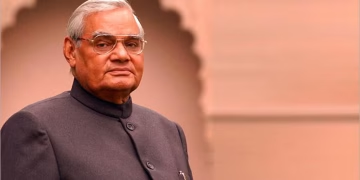
Net Worth and Financial Overview
- Net Worth: $70 Billion
- Category: Richest Politicians › Presidents
- Birthdate: May 4, 1928 – February 25, 2020 (91 years old)
- Birthplace: Monufia Governorate, Egypt
- Gender: Male
- Profession: Politician, Military Officer
- Nationality: Egyptian
What Was Hosni Mubarak’s Net Worth?
At the peak of his power, Hosni Mubarak was one of the richest men in the world, with a reported net worth estimated to be between $40 billion and $70 billion. If these figures are accurate, Mubarak would have secretly been the wealthiest person in Egypt and potentially the richest in the world during his presidency.
His vast fortune was reportedly accumulated over three decades of political rule, with bribes, government contracts, and control over key industries contributing to his immense wealth. Investigations have suggested that his wealth was stashed in Swiss and UK bank accounts, invested in foreign real estate, and hidden through complex financial networks.
Following his forced resignation in 2011, international efforts were made to freeze Mubarak’s assets, with the Swiss government taking action against multiple bank accounts linked to his family.
Political Career and Presidency
Early Life and Military Service
Born on May 4, 1928, in Kafr El-Meselha, Monufia Governorate, Egypt, Muhammad Hosni El Sayed Mubarak came from a humble background. His early ambitions led him to enroll in Egypt’s Military Academy, later joining the Air Force Academy, where he graduated in 1950 with a degree in aviation sciences.
Mubarak’s military career was marked by rapid promotions and strategic leadership, eventually rising to:
- Commander of the Air Force Academy in 1967
- Chief of Staff of the Egyptian Air Force in 1969
- Commander of the Air Force and Deputy Minister of Defense in 1972
His leadership during the Yom Kippur War of 1973 gained him national recognition, particularly for Egypt’s successful airstrike campaign against Israeli forces. This victory led to his promotion to Air Chief Marshal.
Vice Presidency and the Assassination of Anwar Sadat
In 1975, Egyptian President Anwar Sadat appointed Mubarak as Vice President, entrusting him with diplomatic missions and internal security matters. He played a crucial role in shaping Egypt’s foreign policy, particularly in its relations with the United States and Israel.
However, on October 6, 1981, during a military parade, President Sadat was assassinated by a radical jihadist faction within the Egyptian army. Mubarak, standing nearby, narrowly escaped death. In the power vacuum that followed, he was quickly sworn in as Egypt’s fourth president, marking the beginning of his 30-year rule.
The Mubarak Era: Power, Stability, and Repression
Reinstating Egypt’s Arab League Membership
One of Mubarak’s early successes was restoring Egypt’s membership in the Arab League, which had been suspended due to the 1979 Egypt-Israel Peace Treaty under Sadat. This move strengthened Egypt’s role in Middle Eastern diplomacy.
Domestic Policies and the Emergency Law
Throughout his presidency, Mubarak maintained a tight grip on power, using martial law and heavy security enforcement to silence opposition. Under Egypt’s Emergency Law (in effect since 1967), his government had:
- The power to arrest individuals without charges
- The authority to detain political opponents indefinitely
- The ability to ban public demonstrations and media criticism
While his regime boasted economic modernization and infrastructure projects, it was largely characterized by political oppression, corruption, and human rights violations.
Elections and the Illusion of Democracy
Mubarak was re-elected four times (1987, 1993, 1999, and 2005) through referendums or highly controlled elections. His final victory in 2005 came after the U.S. pressured Egypt to hold a multi-party election, yet the opposition was suppressed, and Mubarak secured another six-year term.
Despite international criticism, Mubarak ruled as Egypt’s longest-serving leader since Muhammad Ali Pasha in the 19th century.
Wealth and Corruption Allegations
How Did Mubarak Amass $70 Billion?
Mubarak and his family were deeply involved in corrupt business practices, amassing billions through bribes, government contracts, and financial kickbacks. Key sources of his wealth included:
- Control over Egypt’s major industries, particularly oil, construction, and telecommunications
- Bribery and financial embezzlement from foreign aid and government contracts
- Investments in Swiss and British banks, real estate, and offshore accounts
In 2011, both ABC News and The Guardian reported that his wealth was conservatively estimated at $40 to $70 billion—making him one of the richest political figures of all time.
Swiss Banks and Asset Freezes
After the Egyptian Revolution in 2011, the Swiss government froze several Mubarak-linked bank accounts, estimating hundreds of millions of dollars in assets. Other European nations followed suit, launching investigations into his financial holdings.
The 2011 Egyptian Revolution and Mubarak’s Downfall
In January 2011, mass protests erupted across Egypt, inspired by the Arab Spring movement. Demonstrators accused Mubarak of:
- Widespread corruption and theft of national wealth
- Repressive authoritarian rule
- Economic mismanagement and worsening poverty
Despite initial attempts to quell the protests, public pressure and military intervention forced Mubarak to step down on February 11, 2011, ending his three-decade reign.
Trials and Convictions
Shortly after his resignation, Mubarak and his two sons, Alaa and Gamal, were arrested and charged with corruption and premeditated murder of protesters.
In June 2012, he was sentenced to life in prison, but Egypt’s high court later overturned the ruling, leading to years of retrials. In March 2017, he was finally acquitted and released from prison.
Personal Life and Death
Family and Sons’ Involvement in Corruption
Mubarak was married to Suzanne Mubarak, and they had two sons, Alaa and Gamal, both of whom were deeply involved in corruption scandals and jailed for embezzlement before being released in 2015.
Death and State Funeral
Hosni Mubarak died on February 25, 2020, at the age of 91, after undergoing surgery at a military hospital in Cairo.
Despite his controversial legacy, he was granted a full state funeral, attended by Egyptian President Abdel Fattah el-Sisi and other dignitaries. The Egyptian government declared three days of national mourning, and Mubarak was buried in Heliopolis, Cairo.
Legacy: Hero or Dictator?
Mubarak’s three-decade rule remains one of the most debated eras in Egyptian history. While some credit him for:
- Economic modernization
- Maintaining regional stability
- Diplomatic achievements in Middle Eastern affairs
His corrupt regime, suppression of freedoms, and mass protests ultimately cemented his reputation as an authoritarian ruler. His downfall became a defining moment of the Arab Spring, symbolizing the power of popular uprisings against dictatorships.
Though his wealth, corruption, and authoritarian rule remain a cautionary tale, his long-lasting influence on Egypt’s political landscape cannot be ignored.