Net Worth and Financial Overview
- Net Worth: $60 Million (Inflation-adjusted)
- Category: Richest Politicians › Presidents
- Birthdate: January 30, 1882 – April 12, 1945 (63 years old)
- Birthplace: Hyde Park, New York, USA
- Gender: Male
- Height: 6 ft 2 in (1.88 m)
- Profession: Politician, Lawyer, Writer, Corporate Lawyer, Soldier
- Nationality: United States of America
What Was Franklin D. Roosevelt’s Net Worth?
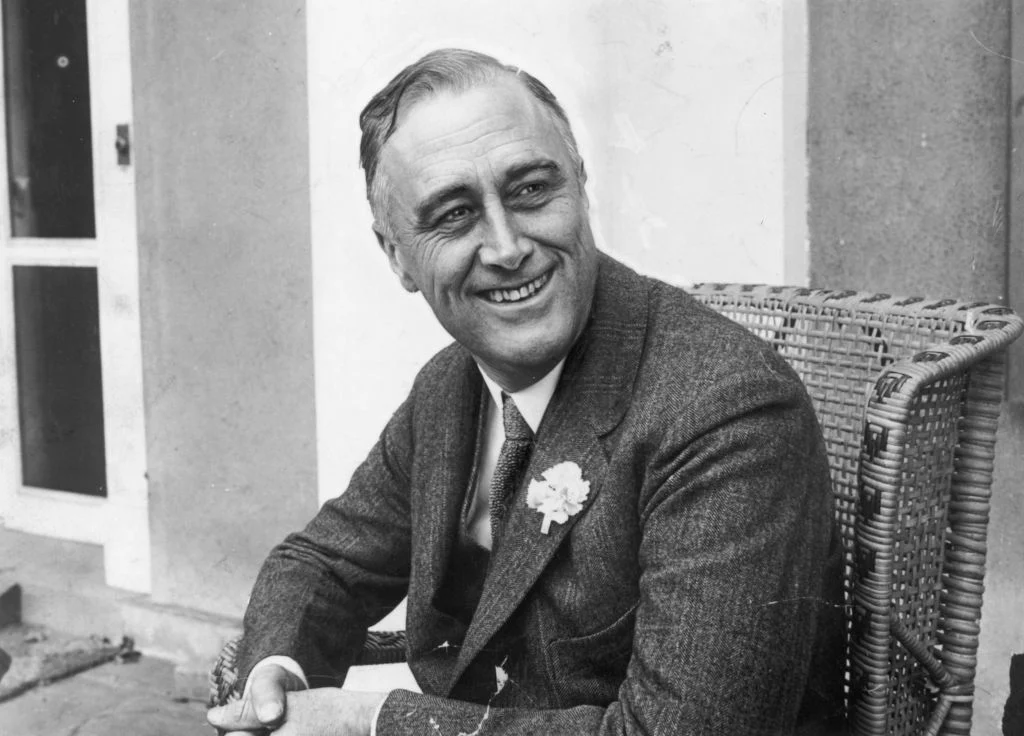
Franklin D. Roosevelt, the 32nd President of the United States, had an inflation-adjusted net worth of approximately $60 million. He was born into immense wealth, as both the Roosevelt and Delano families were among the elite of New York society. His financial resources came from real estate, business investments, inheritances, and family wealth, allowing him to maintain a comfortable and privileged lifestyle throughout his life.
While Roosevelt’s personal fortune was substantial, his political career and policy decisions were centered on uplifting the economically disadvantaged, especially through his New Deal programs during the Great Depression.
Early Life and Education
Franklin Delano Roosevelt was born on January 30, 1882, in Hyde Park, New York to James Roosevelt I and Sara Delano, both of whom were from wealthy and politically connected families. His half-brother, James Roosevelt Jr., came from his father’s previous marriage.
Raised in privilege, Roosevelt traveled extensively as a child, spending time in Europe and becoming fluent in French and German. Unlike most children, he was homeschooled until age 14, after which he attended Groton School, an elite preparatory school in Massachusetts.
He later enrolled at Harvard College, where he was editor-in-chief of The Harvard Crimson. It was during his time at Harvard that his distant cousin, Theodore Roosevelt, became the 26th President of the United States, influencing Franklin’s future political ambitions.
After graduating from Harvard in 1903 with a degree in history, he briefly attended Columbia Law School, but left after passing the New York Bar Exam in 1907. He then worked at the law firm Carter Ledyard & Milburn, though he found the practice of law unfulfilling.
Political Career: Early Beginnings
New York State Senate (1911–1913)
In 1910, Roosevelt entered politics by running for New York State Senate from the 26th District. Despite coming from a wealthy Republican background, he ran as a Democrat and won, thanks to his famous last name and the Democratic wave in that election cycle.
As a senator, Roosevelt focused on progressive policies, particularly in agriculture and labor reforms.
Assistant Secretary of the Navy (1913–1920)
Due to his support for President Woodrow Wilson, Roosevelt was appointed Assistant Secretary of the Navy in 1913. He modernized the Navy, expanded its fleet, and played a key role in preparing the U.S. for World War I.
During World War I, Roosevelt helped establish the U.S. Navy Reserve and the Council of National Defense, solidifying his reputation as a strong wartime administrator.
1920 Vice Presidential Bid and Political Setback
In 1920, Roosevelt was selected as the vice-presidential running mate of Democratic candidate James M. Cox. However, their ticket lost to Warren G. Harding and Calvin Coolidge in a landslide.
This defeat, combined with internal Democratic Party struggles, forced Roosevelt out of national politics—temporarily.
Polio, Rehabilitation, and Political Comeback
In 1921, at the age of 39, Roosevelt was diagnosed with polio, which left him permanently paralyzed from the waist down.
Determined to regain mobility, he sought alternative treatments, leading him to establish a rehabilitation center in Warm Springs, Georgia.
Despite his physical limitations, Roosevelt re-entered politics and was elected Governor of New York in 1928. During his two terms, he introduced:
✔ State employment programs
✔ The Temporary Emergency Relief Administration (which laid the groundwork for the New Deal)
✔ Public unemployment insurance
His successful leadership in New York during the Great Depression made him the Democratic frontrunner for the presidency in 1932.
President of the United States (1933–1945)
Franklin D. Roosevelt became the only U.S. president elected to four terms, serving from 1933 until his death in 1945. His presidency was defined by two major crises:
- The Great Depression
- World War II
First Term: The New Deal (1933–1937)
Elected in 1932, Roosevelt inherited a crippling economic crisis. His immediate response was The New Deal, a series of federal programs and reforms focused on:
✔ Economic relief (Social Security, unemployment benefits)
✔ Recovery programs (Public Works Administration, Civilian Conservation Corps)
✔ Financial reform (Securities and Exchange Commission, Banking Act)
His Fireside Chats, radio addresses to the American public, restored confidence in the government.
Second and Third Terms: War and Economic Recovery (1937–1945)
Roosevelt was reelected in 1936 by a landslide but faced political resistance from Congress and the Supreme Court, which opposed some New Deal policies.
With World War II looming, Roosevelt initially pursued a neutral stance, but the attack on Pearl Harbor (1941) forced the U.S. into the war. Under his leadership, America:
✔ Became a military superpower
✔ Mobilized industry for wartime production
✔ Formed the United Nations to prevent future wars
Fourth Term and Death (1944–1945)
Despite declining health, Roosevelt won an unprecedented fourth term in 1944. However, just three months into his term, he died on April 12, 1945, at the age of 63, leaving Harry S. Truman to finish the war effort.
His death marked the end of an era, but his policies and leadership shaped modern America.
Marriage, Family, and Personal Life
Marriage to Eleanor Roosevelt
Roosevelt married Eleanor Roosevelt, his fifth cousin once removed, in 1905. They had six children, though one died in infancy.
Their marriage became politically strategic rather than romantic, especially after Roosevelt’s extramarital affair with Eleanor’s social secretary, Lucy Mercer. Despite their strained personal relationship, Eleanor remained one of his most important political allies.
Affairs and Personal Relationships
Roosevelt’s affair with Lucy Mercer nearly led to divorce, but the couple remained married in a more formal partnership. Eleanor went on to become an influential political figure, championing civil rights and social justice.
Legacy and Impact
✔ The New Deal laid the foundation for the modern welfare state
✔ Led the U.S. through World War II, making it a global superpower
✔ Created Social Security, unemployment insurance, and labor protections
✔ Helped establish the United Nations
Criticism
- Internment of Japanese Americans during WWII
- Failed attempts to reform the Supreme Court
- Government expansion and deficit spending
Despite controversies, Roosevelt is widely regarded as one of the greatest U.S. presidents, ranking alongside George Washington and Abraham Lincoln.
Conclusion
Franklin D. Roosevelt’s life, wealth, and leadership continue to shape American history and global affairs. From overcoming polio to leading the country through its most challenging times, his presidency remains a monumental example of resilience, reform, and leadership.
His $60 million net worth was inherited from his wealthy family, but his true legacy lies in the policies and programs that transformed America into an economic powerhouse and world leader.