Net Worth: $500 Thousand
Category: Richest Politicians > Presidents
Net Worth: $500 Thousand
Birthdate: October 26, 1959
Birthplace: Orinoca Canton, Bolivia
Gender: Male
Profession: Trade Unionist, Farmer, Politician
Nationality: Bolivia
What is Evo Morales’s Net Worth?
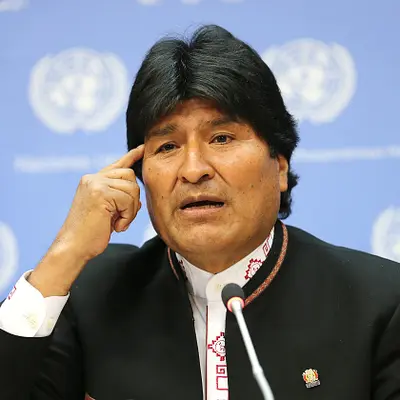
Evo Morales is a Bolivian politician, trade unionist, and former president who has an estimated net worth of $500 thousand. As the first indigenous president of Bolivia, Morales served from 2006 to 2019, implementing socialist policies that emphasized indigenous rights, nationalization of industries, environmentalism, and poverty reduction. However, his leadership was also marred by allegations of authoritarianism, corruption, and links to the coca trade.
Early Life and Education
Juan Evo Morales Ayma was born on October 26, 1959, in Isallavi, Oruro, Bolivia. He was raised in a poor indigenous Aymara farming family. Out of seven children born to his parents, María and Dionisio, only he and two of his siblings—Esther and Hugo—survived childhood, as high infant mortality rates were common in rural Bolivia at the time.
Morales attended the Agrarian Humanistic Technical Institute of Orinoca, receiving a basic education before being conscripted into the Bolivian military from 1977 to 1978. Though he pursued higher education, he did not graduate, opting instead to focus on activism and union work.
Coca Farming and Union Activism
Following his military service, Morales moved to the Chapare region, where he became a cocalero (coca farmer). He rose to prominence as a trade union leader in the Unified Syndical Confederation of Peasant Workers of Bolivia. Morales led campaigns against U.S.-backed coca eradication efforts, which he viewed as an attack on Andean indigenous culture. His activism led to multiple arrests and confrontations with the Bolivian government.
Entry into Politics
In 1995, Morales entered the political arena, forming the Movement for Socialism (MAS) party. His populist rhetoric and emphasis on indigenous rights, land reform, and economic justice gained him a loyal following.
Morales played a significant role in major political uprisings such as the Cochabamba Water War (2000) and the Bolivian Gas Conflict (2003–2005), opposing the privatization of Bolivia’s natural resources. Though he was expelled from Congress in 2002 for supporting anti-government protests, he finished second in that year’s presidential election.
Presidency (2006-2019)
In 2005, Morales won the presidency with 53.7% of the vote—the highest in Bolivia’s history at the time—becoming the nation’s first indigenous leader. His administration focused on:
- Nationalization of Key Industries: Under Morales, Bolivia nationalized gas, oil, and telecommunications sectors, boosting state revenues and economic growth.
- Poverty and Illiteracy Reduction: His government expanded social welfare programs, lifted millions out of poverty, and improved literacy rates.
- Indigenous and Environmental Rights: Morales’s policies prioritized indigenous representation and environmental conservation, though he later faced criticism for backing extractive industries.
- Anti-Imperialism: He distanced Bolivia from U.S. influence, forging alliances with leftist governments such as Venezuela and Cuba.
- Constitutional Reform: In 2009, Morales introduced a new constitution recognizing Bolivia as a plurinational state.
Despite early success, Morales’s later years in office were fraught with internal dissent, corruption scandals, and accusations of democratic backsliding. He controversially sought and won a third term in 2014, bypassing constitutional term limits.
2019 Election Controversy and Exile
Morales ran for a fourth term in the 2019 general election, despite a failed referendum to extend term limits. Allegations of election fraud triggered mass protests, leading to his resignation under pressure from the military and police. Morales fled Bolivia, first seeking asylum in Mexico and later Argentina.
His supporters hailed him as a defender of indigenous and working-class rights, while critics condemned him for consolidating power, undermining democracy, and fostering a narco-state due to his ties to coca farming.
Return to Bolivia and Political Role
After the victory of his MAS party in the 2020 elections, Morales returned to Bolivia from exile. Although he no longer holds presidential power, he remains an influential figure in Bolivian politics, acting as a strategist and powerbroker within MAS.
Controversies and Legal Issues
Narco-State Allegations
Morales’s strong ties to Bolivia’s coca growers led to accusations that his administration protected illicit drug trade networks. While Morales argued that coca leaf farming is part of indigenous tradition, critics claimed his policies facilitated cocaine trafficking.
Statutory Rape Accusations
In 2020, Morales faced two statutory rape accusations, with claims that he fathered a child with a 15-year-old girl and had relations with 19-year-old Noemí Meneses. He denied these allegations, calling them political attacks orchestrated by Bolivia’s interim government.
Personal Life
Morales has never married but has two children, Evaliz and Álvaro, from different relationships. Despite being a lifelong advocate for indigenous and working-class rights, he has often been criticized for an autocratic style of governance.
Evo Morales’s Net Worth and Financial Standing
Although he once held significant political power, Morales’s net worth remains modest compared to many world leaders. His estimated $500 thousand net worth primarily comes from his years in public service, political pensions, and speaking engagements. Unlike some former presidents who amass wealth through lucrative business ventures, Morales has maintained a more modest lifestyle, though questions about hidden assets and financial dealings have been raised by opponents.
Conclusion
Evo Morales remains one of Bolivia’s most polarizing figures. As a champion of indigenous and socialist causes, his impact on Bolivia’s economic and political landscape is undeniable. However, allegations of corruption, authoritarianism, and electoral manipulation tarnish his legacy. Whether seen as a revolutionary hero or a power-hungry leader, Morales’s influence in Latin American politics is far from over.