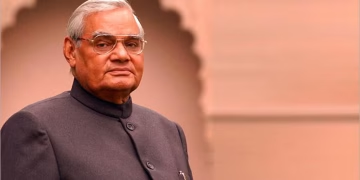
Net Worth: $500 Thousand
Category: Richest Politicians › Presidents
Birthdate: November 13, 1953
Birthplace: Tepetitán, Tabasco, Mexico
Nationality: Mexican
Profession: Politician
What is Andrés Manuel López Obrador’s Net Worth?
Andrés Manuel López Obrador, commonly known as AMLO, is a Mexican politician and former president of Mexico who has a net worth of $500 thousand. He served as the 65th president of Mexico from 2018 to 2024, marking a shift in the country’s political landscape with his left-wing populist approach. Before his presidency, he was the Head of Government of Mexico City (2000–2005) and twice ran unsuccessfully for the presidency in 2006 and 2012. In 2014, he founded the political party Movimiento Regeneración Nacional (MORENA), which became a dominant force in Mexican politics.
During his tenure as president, López Obrador implemented progressive policies aimed at reducing social inequality and boosting government investment in state industries. While his administration was praised for anti-corruption efforts and economic initiatives, it was also heavily criticized for its handling of violent crime, drug cartels, and the COVID-19 pandemic. His presidency concluded in 2024, and he was succeeded by Claudia Sheinbaum.
Early Life and Education
Andrés Manuel López Obrador was born on November 13, 1953, in Tepetitán, a small village in the state of Tabasco, Mexico. He was the eldest son of Manuela Obrador González and Andrés López Ramón, both small-scale merchants. Raised in a working-class family, López Obrador spent much of his childhood in the town of Macuspana before his family relocated to the state capital, Villahermosa.
For his early education, he attended Marcos E. Becerra School before moving on to middle school in Villahermosa. He later pursued higher education at the Universidad Nacional Autónoma de México (UNAM), where he studied political science and public administration. However, he temporarily left university in 1976 to take a government position in Tabasco. He later returned to UNAM and completed his degree in 1987.
Political Career: From Tabasco to National Politics (1976–1999)
López Obrador began his political journey in 1976 as a member of the Institutional Revolutionary Party (Partido Revolucionario Institucional, PRI). He was appointed Director of the Indigenous Institute of Tabasco in 1977, where he worked on social programs for indigenous communities. In 1984, he moved to Mexico City to work at the National Consumers’ Institute, a federal agency focused on consumer rights.
By the late 1980s, López Obrador broke away from the PRI and joined a left-wing movement that later became the Party of the Democratic Revolution (Partido de la Revolución Democrática, PRD). He ran for governor of Tabasco in 1994 but lost to Roberto Madrazo of the PRI. Despite the defeat, he gained national attention for exposing corruption and advocating for electoral transparency. From 1996 to 1999, he served as the president of the PRD.
Head of Government of Mexico City (2000–2005)
In 2000, López Obrador was elected as the Jefe de Gobierno (Head of Government) of Mexico City. During his tenure, he prioritized social welfare programs, public transportation, and urban development. His administration launched initiatives such as:
- The expansion of social pensions for senior citizens.
- Infrastructure projects, including the second tier of the Periférico highway.
- The construction of the Metrobús rapid transit system.
- Crime reduction policies, which received mixed results.
However, his time in office was not without controversy. In 2004, his immunity was revoked due to a legal dispute over land expropriation, which nearly led to his disqualification from running for the presidency in 2006.
Presidential Campaigns and the Rise of MORENA
2006 Presidential Election
López Obrador ran for president in 2006 as the candidate of the PRD-led Coalition for the Good of All. He lost in one of Mexico’s most contested elections to Felipe Calderón of the National Action Party (PAN) by a narrow margin. Alleging fraud, he led mass protests in Mexico City, demanding a vote recount. Although the electoral tribunal recognized irregularities, it upheld Calderón’s victory.
2012 Presidential Election
López Obrador made another bid for the presidency in 2012 under the Progressive Movement coalition but was defeated by Enrique Peña Nieto of the Institutional Revolutionary Party (PRI). After his loss, he distanced himself from the PRD and established MORENA in 2014, a new left-wing political party focused on anti-corruption and economic justice.
President of Mexico (2018–2024)
In 2018, López Obrador ran for president a third time under the Juntos Haremos Historia coalition. This time, he won in a landslide, securing over 53% of the vote and defeating Ricardo Anaya (PAN) and José Antonio Meade (PRI). His election marked a significant shift in Mexican politics, ending decades of dominance by the PRI and PAN.
Key Policies and Achievements
- Anti-Corruption and Government Austerity: López Obrador cut government salaries, including his own, and eliminated pensions for former presidents.
- Social Welfare Programs: Expanded pensions for seniors, increased educational scholarships, and introduced new social assistance programs for the unemployed and farmers.
- Economic Nationalism: Strengthened the role of state-owned industries such as PEMEX (oil) and CFE (electricity) while reducing reliance on private and foreign investment.
- Infrastructure Development: Oversaw major projects, including the Maya Train, Dos Bocas Refinery, and Felipe Ángeles International Airport.
- US-Mexico Relations: Managed diplomatic ties with the Trump and Biden administrations, focusing on trade and migration agreements.
Criticism and Challenges
Despite his achievements, López Obrador faced major challenges, including:
- Crime and Drug Cartels: Under his “hugs, not bullets” policy, violent crime remained a major issue, with record levels of homicides during his presidency.
- COVID-19 Pandemic: His initial reluctance to impose strict measures led to criticism of his pandemic response.
- Media and Press Freedom: Accused of undermining independent journalism and publicly attacking critics.
End of Presidency
In 2024, López Obrador stepped down at the end of his term, as Mexico’s constitution prohibits re-election. He was succeeded by Claudia Sheinbaum, a close political ally and fellow member of MORENA.
Personal Life
López Obrador was married to Rocío Beltrán Medina from 1978 until her passing in 2003 due to lupus. They had three children: José Ramón, Andrés Manuel, and Gonzalo Alfonso. In 2006, he married Beatriz Gutiérrez Müller, a writer and academic. They have one son, Jesús Ernesto, born in 2007.
Wealth and Financial Standing
Despite his long political career, López Obrador has maintained a relatively modest personal net worth of $500 thousand. He has repeatedly emphasized austerity and transparency in his finances, refusing to live in Los Pinos (Mexico’s presidential residence) and choosing to reside in the National Palace instead. His salary as president was significantly lower than his predecessors, as he voluntarily reduced it as part of his anti-corruption measures.
Legacy and Impact
Andrés Manuel López Obrador remains one of the most polarizing figures in modern Mexican politics. Supporters view him as a champion of social justice, economic nationalism, and anti-corruption efforts, while critics argue that his policies weakened democratic institutions and failed to curb Mexico’s security crisis. His influence continues through MORENA, which remains a dominant political force in Mexico.