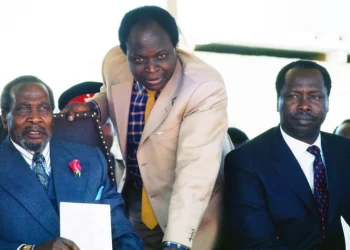
Dr. Paul Adhu Awiti’s political journey stands out as one of Kenya’s most astonishing turnarounds. Once a vocal critic of President Daniel arap Moi’s regime, the Karachuonyo MP was at one point blacklisted and detained for his outspoken political beliefs. Known for his radical stance during the height of one-party rule, Awiti represented the defiant spirit of reformist politicians who risked their freedom for democracy.
However, politics often thrives on irony. In early 2001, fate turned dramatically in his favor. On a Monday morning, while traveling by bus from Kisumu to Nairobi, the unsuspecting MP dozed off mid-journey. He awoke to whispers and stares from fellow passengers. One passenger finally nudged him awake with breaking news — President Moi had just appointed him as a Cabinet minister in a surprise mini-reshuffle announced on national radio.
An Unexpected Honor
By evening, Dr. Awiti arrived in Nairobi, where the realities of his new position quickly unfolded. He was received by government officials who escorted him to his modest Nairobi residence in a chauffeur-driven limousine, complete with a bodyguard and official protocol detail. The transformation from government critic to Cabinet insider was not only swift but also symbolic of Kenya’s shifting political tides in the final years of Moi’s rule.
Just a week later, Dr. Awiti was formally sworn in as Minister for Planning and National Development. His appointment surprised both allies and opponents, as he had long been viewed as an outsider to the establishment. Yet, within months, he proved his worth by bringing fresh energy, accountability, and vision to the ministry, earning recognition as one of the best-performing ministers of the Moi administration.
The Symbolism of a Political Turnaround
Dr. Paul Adhu Awiti’s story remains a powerful reminder of the unpredictable nature of politics — how one’s fortunes can shift overnight. From imprisonment to the Cabinet table, his journey embodied resilience, humility, and the belief that political reconciliation can overcome years of animosity.
In Kenya’s complex political history, few stories illustrate redemption and irony as vividly as that of Paul Adhu Awiti’s Cabinet appointment — a tale that continues to inspire conversations about loyalty, transformation, and destiny in public service.