


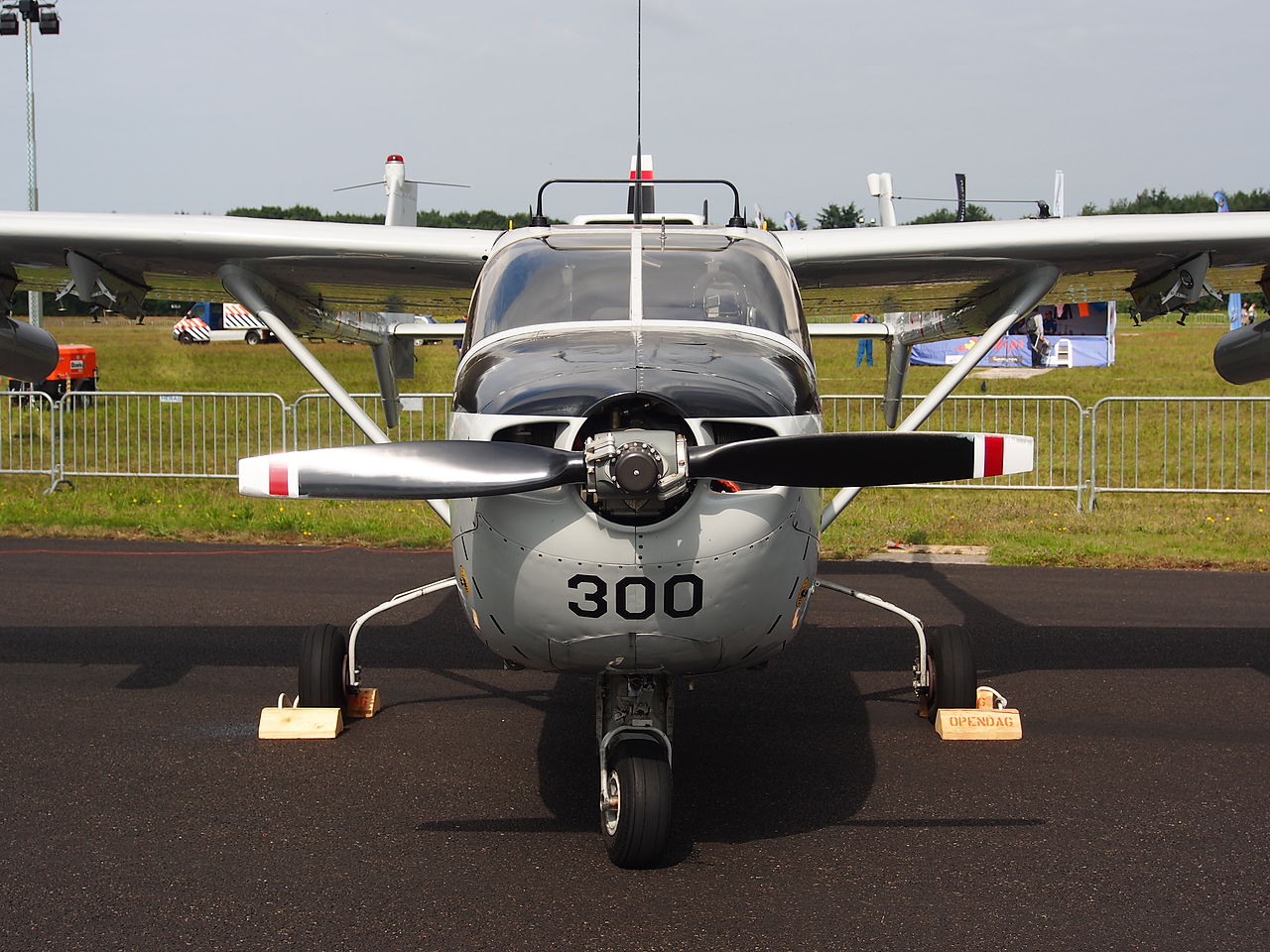
The Cessna O-2 Skymaster, nicknamed “Oscar Deuce”, was a twin-engine observation and reconnaissance aircraft developed from the Cessna 337 Super Skymaster. Designed for forward air control (FAC) and psychological operations (PSYOPS), the O-2 served primarily with the United States Air Force between 1967 and 2010, earning distinction during the Vietnam War.
Design and Development
In 1966, the U.S. Air Force commissioned Cessna to produce a military adaptation of its Model 337 Skymaster, aiming to replace the aging Cessna O-1 Bird Dog. The result was the O-2 — a twin-boom, push-pull propeller aircraft powered by two Continental IO-360 engines that provided centerline thrust. This configuration simplified handling and offered unobstructed downward visibility crucial for reconnaissance missions.
Unlike the civilian 337, the O-2 featured fore-and-aft seating for two crew members — a pilot and an observer — rather than six passengers. The modifications included view panels in the doors, flame-retardant fuel tanks, military-grade communication systems, reinforced components, and the removal of interior upholstery to reduce weight and improve operational efficiency.
The aircraft first flew in January 1967 and entered production by March of that year. A total of 532 units were built before production ceased in June 1970.
Operational History
United States Air Force
The O-2A was introduced into service in March 1967, joining the 20th Tactical Air Support Squadron. It replaced the O-1 Bird Dog for forward air control, coordinating airstrikes and directing ground operations. The O-2B variant specialized in psychological warfare, dropping propaganda leaflets and broadcasting through loudspeakers.
Though the OV-10 Bronco was intended to supersede it, the O-2 continued to serve effectively in night reconnaissance missions, where the Bronco’s illuminated cockpit made stealth difficult. During the Vietnam War, the Air Force lost 178 O-2s to combat and operational causes.
After the war, the aircraft remained active in Air National Guard units through the 1980s, performing surveillance and range-control duties.
United States Navy and Army
In the 1980s, six O-2As were transferred to the U.S. Navy for range control operations at Naval Air Station Lemoore, California. They were later handed over to the U.S. Army in 1990, where they served in test programs at Yuma Proving Ground until their retirement in 2010.
Foreign Service
The O-2 saw widespread international use. 35 aircraft were supplied to South Vietnam, 23 O-2As and 2 O-2Bs to El Salvador during its civil war, and several others to Iran, Botswana, Namibia, and Thailand for reconnaissance, anti-poaching, and training purposes.
In El Salvador, O-2s played a pivotal role in monitoring FMLN rebel movements and coordinating airstrikes. However, the introduction of SA-7 missiles in 1990 led to losses, forcing changes in tactics and operational patterns.
Civilian Use
In the 1970s, the California Department of Forestry and Fire Protection (CAL FIRE) repurposed surplus O-2s for aerial firefighting coordination. Twenty reassembled aircraft entered service in 1976 and operated for more than two decades until replaced by OV-10 Broncos.
The O-2’s durability, visibility, and reliability made it a valuable air attack platform even after its military career ended.
Variants
- O-2A: Forward air control version with four underwing hardpoints for rockets, gun pods, or flares.
- O-2B: Psychological operations variant equipped with loudspeakers and leaflet dispensers; unarmed.
Specifications (O-2A)
| Characteristic | Detail |
|---|---|
| Crew | 2 (pilot and observer) |
| Length | 29 ft 9 in (9.07 m) |
| Wingspan | 38 ft (11.58 m) |
| Height | 9 ft 4 in (2.84 m) |
| Empty Weight | 2,848 lb (1,292 kg) |
| Max Takeoff Weight | 5,400 lb (2,449 kg) |
| Engines | 2 × Continental IO-360C/D (210 hp each) |
| Max Speed | 199 mph (320 km/h) |
| Cruise Speed | 144 mph (232 km/h) |
| Range | 1,060 miles (1,710 km) |
| Service Ceiling | 19,800 ft (6,000 m) |
| Armament | 4 hardpoints for SUU-11/A Minigun Pods, rocket launchers, or bomblet dispensers |
Legacy
The Cessna O-2 Skymaster remains one of the most recognizable light aircraft of the Vietnam era, remembered for its dual-engine reliability, low operating costs, and remarkable endurance in forward observation roles. Although replaced by advanced turboprop and jet-powered observation aircraft, the O-2’s legacy endures in both military aviation history and civil defense aviation.
Several surviving units are displayed in museums across the United States, including the National Museum of the U.S. Air Force, Pima Air and Space Museum, and Castle Air Museum.


