


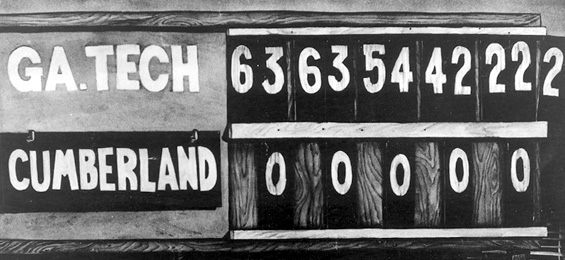
The 1916 Cumberland vs. Georgia Tech football game, played on October 7, 1916, at Grant Field in Atlanta, remains the most lopsided contest in the history of college football. The Georgia Tech Yellow Jackets, led by legendary coach John Heisman, defeated the Cumberland Bulldogs by a staggering score of 222–0. This extraordinary result has never been surpassed, and it stands as a record for dominance, strategy, and controversy in American sports history.
Background
Cumberland College, located in Lebanon, Tennessee, had disbanded its football program before the 1916 season. However, due to a contractual agreement, it was still obligated to play Georgia Tech. Heisman—who also coached Georgia Tech’s baseball team—was motivated by revenge, as Cumberland’s baseball team had defeated his squad 22–0 earlier that same year, allegedly using professional players. To make his point, Heisman insisted Cumberland field a football team or pay a $3,000 forfeit fee (equivalent to about $87,000 in 2024).
Cumberland’s baseball captain, George E. Allen, hastily assembled a team of students and fraternity members to avoid financial penalty. Heisman, aware of the mismatch, offered Cumberland $500 and paid travel expenses to ensure the game went ahead. This led to a historic showdown between an improvised amateur team and one of the nation’s most formidable college squads.
The Game
Georgia Tech scored on every first down and led 63–0 after the first quarter, 126–0 at halftime, and ultimately 222–0 when the shortened fourth quarter ended. Cumberland failed to gain a single first down, committed 15 turnovers, and finished with negative rushing yardage.
Heisman’s men scored 32 touchdowns, all through rushing plays—no passes were attempted or completed. Tech’s left end James Preas kicked 18 extra points, while Cumberland’s only successful defensive play came from blocking one extra-point attempt with a human pyramid formation.
Contemporary reports highlighted the chaos on the field. Cumberland’s quarterback, Charles Edwards, was knocked unconscious three times, and sportswriter Grantland Rice famously wrote that Cumberland’s best play was “a six-yard loss.”
Records and Statistics
Georgia Tech gained an estimated 922 rushing yards while Cumberland lost 42 yards on the ground. Nearly 97% of the game’s plays took place on Cumberland’s side of the field. The halftime score of 126–0 remains, by itself, higher than any team has scored in a full game since 1932.
The final score obliterated previous records, surpassing Newberry’s 159–0 victory over BMI (1913) and Florida’s 144–0 win over Florida Southern (1913). Since then, no major college football game has come close to the same margin.
Motivation and Sportsmanship
Heisman’s intent was twofold: revenge for the baseball humiliation and a demonstration against ranking systems that rewarded teams based solely on point totals. By running up the score, he hoped to prove that such statistics were meaningless without considering the strength of the opponent.
Even so, by the third quarter, Heisman relented, shortening both halves of the game to 12 minutes each to spare further embarrassment.
Aftermath and Legacy
The game marked the final meeting between Cumberland and Georgia Tech in any sport. Cumberland, which later de-emphasized athletics, eventually revived its football program decades later, renaming its team the Phoenix in 2016. Georgia Tech, on the other hand, became a founding member of the Southeastern Conference (SEC) before joining the Atlantic Coast Conference (ACC), where it remains today.
The game ball, inscribed with the 222–0 score, became a piece of sports history. It was rediscovered in the 1980s and later sold at auction in 2014 for $40,388, after which it was returned to Georgia Tech.
In 1956, a 40th anniversary reunion of players from both teams was held, where surviving members recalled the event with humor. One Cumberland player reportedly said that punting instead of sneaking late in the game “probably saved us from losing 229–0.”
Historical Significance
The 1916 Cumberland vs Georgia Tech game is regarded as both a testament to early college football’s unpredictability and a cautionary tale about sportsmanship. Under modern NCAA rules, such a game could not occur: Division III and NAIA programs like Cumberland are prohibited from facing FBS-level schools such as Georgia Tech.
More than a century later, the game remains the benchmark for one-sided defeats in American sports. Its absurd scoreline has entered folklore as the ultimate example of David versus Goliath gone wrong, forever cementing John Heisman’s name in football legend.


